


sk66
Suspended / Banned
- Messages
- 9,557
- Name
- Steven
- Edit My Images
- Yes
Some interesting findings about auto ISO and the Nikon Z9... It seems Nikon has given the Z9 two different REI (recommended exposure index) scales for the different ISO modes. The conversion gain step and sensitivity occurs at ISO 500 in manual mode, but not in auto ISO. In auto ISO the conversion gain step/sensitivity occurs at ISO 560 (not user selectable); ISO 560 in auto is the same as ISO 500 in manual (auto 450 = manual 400, etc).
View: https://youtu.be/GAc_izQzmj8?si=xDLzaKeoffAWYjVW
Another interesting thing I found is that auto ISO is much more granular/linear than I previously thought. I've known that the camera can select/report ISO's in much smaller increments than the 1/3 user selectable steps; but I have found that the camera can use amplification levels smaller than it even reports (Z9 at least). In the image I have generated r separate and progressive exposures all at ISO 800. There was also an exposure at both ends of the sequence which the camera said was being taken at ISO 800, but which the exif recorded as being at the next value instead. The green values are average exposure, the black values are noise level (RMSD). The first set of values are for the entire image, the second set are for the black frame sample area.
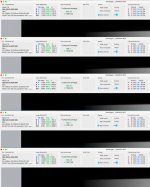
For anyone interested, the tests were done using a gradient displayed on my monitor in a darkened room as the only recordable light source and spot metered different locations. Except for ISO, everything was set to manual/fixed values, to include WB and even focus (defocused slightly to eliminate banding). The raw images were then opened in raw digger as shown (eliminates any ACR/LR type variables).
Another interesting thing I found is that auto ISO is much more granular/linear than I previously thought. I've known that the camera can select/report ISO's in much smaller increments than the 1/3 user selectable steps; but I have found that the camera can use amplification levels smaller than it even reports (Z9 at least). In the image I have generated r separate and progressive exposures all at ISO 800. There was also an exposure at both ends of the sequence which the camera said was being taken at ISO 800, but which the exif recorded as being at the next value instead. The green values are average exposure, the black values are noise level (RMSD). The first set of values are for the entire image, the second set are for the black frame sample area.
For anyone interested, the tests were done using a gradient displayed on my monitor in a darkened room as the only recordable light source and spot metered different locations. Except for ISO, everything was set to manual/fixed values, to include WB and even focus (defocused slightly to eliminate banding). The raw images were then opened in raw digger as shown (eliminates any ACR/LR type variables).
Last edited: