


sk66
Suspended / Banned
- Messages
- 9,557
- Name
- Steven
- Edit My Images
- Yes
I received my 180-600 this morning and I've done some critical testing comparing it to my Sigma 60-600... I've taken a lot of excellent images with that lens and I was quite impressed with it when I first got it and tested it (initial review, technical testing).
Did a zeiss siemens star test with both on the Z9, checking for decentering, and resolution at 15ft. I then used a Normen Koren test chart at 50ft with both lenses. I would say both lenses performed better on the Z9 than the 60-600 did on the D850. And I would put them as being comparable in resolution; neither showed evidence of decentering.
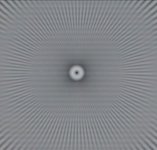
This is the 180-600 showing no notable offset blur/decentering.
I'm guestimating the 180-600's MTF50 at right around 50 lp/mm, and in excess of 100lp/mm MTF10. That is for a raw file demosaiced in LR, and with all edits disabled (no default sharpening/noise reduction/etc) which is a little better than the Sigma 60-600 did on the D850 way back when (similar results, but camera processed jpegs). The reason it is a guestimate is because I did a visual determination and didn't use Imatest/ImageJ to do a direct measurement. It is also limited by the resolution of the printer that I used at that time to make the chart (6yrs ago)... which doesn't seem that great now.
Due to forum limitations I'm choosing to share heavily zoomed screen shots.
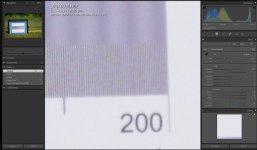
This is the 200lp/mm limit of the test chart taken from 50ft; it's at 800% zoom on my computer where the image pixels are becoming very apparent. The settings used are shown (wide open at 600mm). The chart was only at half the distance it should have been, so the l/mm measurements are 50% of scale.
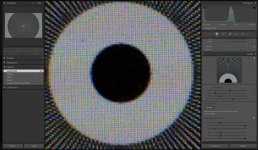
Next is the center of the siemens star projected on my computer monitor taken from 15ft; this time in focus, also shown at 800% zoom. What's interesting here is that you are actually seeing the RGB leds that make up the pixels on my monitor. I cannot see them with the naked eye. The monitor is a MBP liquid retina XDR with a pixel density of 230ppi; that puts the RGB sub pixels at about 690dpi. I was a bit shocked by this, but the Sigma also did just as well. This was also taken wide open at 600mm with a 1/1250 SS as above, but the ISO was 3600 because it was taken indoors... I guess I should have increased my monitor brightness to give it a bit better chance. It does seem to show a slight bit of LaCA (the red/blue fringes on opposite sides), but nothing major (the 60-600 was nearly identical). There might be some color moire as well; I'm not sure.
All of the testing was done on a tripod, with a locked down gimbal head, VR on, 5 second timer, and pinpoint AF. I certainly won't be expecting to get the same kind of results consistently in the field; but it won't be the equipment's fault.
I'm not testing it against my 400/2.8, 120-300/2.8, or any other lens... that's not why I bought it. It is a bit of a tough call because it doesn't seem to outperform my Sigma 60-600 (@600) notably. But it's over a pound lighter, has full VR integration , and has function buttons/integration I want (recall focus). It's also cheaper than the Sigma 60-600 was 8 years ago and has less focus breathing.
So far I'm happy; at least I know I got a decent copy. Now I need to get some time in the field with it... As long as the AF isn't particularly slow or something similar, I think I'll be keeping it.
FWIW, the Sigma 60-600 MTF50 tests a little better than both the 500pf and the 200-500 at max FL, it's also at least equivalent to the Z 100-400 at the long end/max aperture... so keeping up with that isn't bad.
Did a zeiss siemens star test with both on the Z9, checking for decentering, and resolution at 15ft. I then used a Normen Koren test chart at 50ft with both lenses. I would say both lenses performed better on the Z9 than the 60-600 did on the D850. And I would put them as being comparable in resolution; neither showed evidence of decentering.
This is the 180-600 showing no notable offset blur/decentering.
I'm guestimating the 180-600's MTF50 at right around 50 lp/mm, and in excess of 100lp/mm MTF10. That is for a raw file demosaiced in LR, and with all edits disabled (no default sharpening/noise reduction/etc) which is a little better than the Sigma 60-600 did on the D850 way back when (similar results, but camera processed jpegs). The reason it is a guestimate is because I did a visual determination and didn't use Imatest/ImageJ to do a direct measurement. It is also limited by the resolution of the printer that I used at that time to make the chart (6yrs ago)... which doesn't seem that great now.
Due to forum limitations I'm choosing to share heavily zoomed screen shots.
This is the 200lp/mm limit of the test chart taken from 50ft; it's at 800% zoom on my computer where the image pixels are becoming very apparent. The settings used are shown (wide open at 600mm). The chart was only at half the distance it should have been, so the l/mm measurements are 50% of scale.
Next is the center of the siemens star projected on my computer monitor taken from 15ft; this time in focus, also shown at 800% zoom. What's interesting here is that you are actually seeing the RGB leds that make up the pixels on my monitor. I cannot see them with the naked eye. The monitor is a MBP liquid retina XDR with a pixel density of 230ppi; that puts the RGB sub pixels at about 690dpi. I was a bit shocked by this, but the Sigma also did just as well. This was also taken wide open at 600mm with a 1/1250 SS as above, but the ISO was 3600 because it was taken indoors... I guess I should have increased my monitor brightness to give it a bit better chance. It does seem to show a slight bit of LaCA (the red/blue fringes on opposite sides), but nothing major (the 60-600 was nearly identical). There might be some color moire as well; I'm not sure.
All of the testing was done on a tripod, with a locked down gimbal head, VR on, 5 second timer, and pinpoint AF. I certainly won't be expecting to get the same kind of results consistently in the field; but it won't be the equipment's fault.
I'm not testing it against my 400/2.8, 120-300/2.8, or any other lens... that's not why I bought it. It is a bit of a tough call because it doesn't seem to outperform my Sigma 60-600 (@600) notably. But it's over a pound lighter, has full VR integration , and has function buttons/integration I want (recall focus). It's also cheaper than the Sigma 60-600 was 8 years ago and has less focus breathing.
So far I'm happy; at least I know I got a decent copy. Now I need to get some time in the field with it... As long as the AF isn't particularly slow or something similar, I think I'll be keeping it.
FWIW, the Sigma 60-600 MTF50 tests a little better than both the 500pf and the 200-500 at max FL, it's also at least equivalent to the Z 100-400 at the long end/max aperture... so keeping up with that isn't bad.
Last edited:


