I mainly shoot with the flash set to manual - just brought up to do it that way from the days when i used Metz hammerheads – so I'm just altering flash power in accordance to the exposure value, shooting in either AV or Manual. I use a lot of fill-in so I'm generally using power values of 1/8th or less, balancing the exposure in-camera using either exposure compensation (in AV) or by just playing around with the aperture when shooting in manual. There's a fair bit of stuff on my flickr site with flash settings etc....
It's a bit of a 'belt & braces' approach; I just meter the scene (say f/5.6 @ 1/100th) so it's slightly underexposed by a third or half a stop (so the background, usually the sky, has a bit more punch), and then the flash is set to add the fill-in but not overpower the shot.
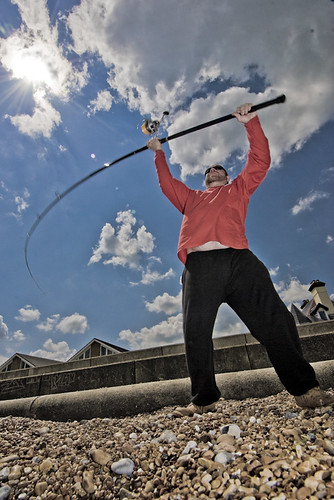
This is an example of doing it that way:
I have used the '28 in Auto mode with the camera in an auto mode like P or AV but because it doesn't support iTTL like the more modern Speedlights do (SB28DX, SB800 etc) it isn't as accurate with regard to exposure. It works but not as well as my SB800. That's why I use manual power settings a lot. It won't damage your camera if you put it on the D300 though, don't worry about that.

Of course, something like an SB800 or SB900 will be ultimately better suited to general on-camera flash work because it integrates with the camera better, plus with several SB600/800/8900s you can take advantage of the brilliant CLS that gives you control of the flashes from within the camera.
The SB28 is a really good piece of kit though if you want to use a second flash off-camera. It doesn't have an optical slave cell like the earlier SB26 so won't fire remotely unless triggered by something like a PT-04, Pocketwizard or Skyport trigger. However, as a powerful flash it's a very good piece of kit and I wouldn't swap mine for the world for use with my Skyports.
I don't know what you're shooting, which can have a bearing on how you sue your flash. if you're doing staged, set-up stuff like I am then you have plenty of time to play around with camera and flash settings to get things right, which is why I like working in manual and don't mind using flashes that aren't nesseccarily designed for my camera. If I'm shooting more press-related stuff where I have little time or only one chance to get the shot then I use my SB800 because I know it communicates with the camera better and will give me a good shot each and every time.
If you're interested in doing off-camera stuff then check out the
strobist blog (lighting: 101 section) and the
strobist flickr site for information about using off-camera flash. I'd look at getting some of
FITP's triggers as a cheap way to start – I only use Skyports because I'm a gear tart and like the fact they can be used at extreme range.
Creative flash really doesn't rely on any rules whatsoever – you just shoot to create the look you want. Joe Mcnally's '
Hotshoe Diaries' book is also a good resource, although it's so casually written it's not totally beginner-friendly. It's good though.
Light Science & Magic is also a good book that covers flash.



 But I am thinking that the SB28 may well be ok for the D300 anyone have any info - I dern't put it on the camera incase I damage the body.......:shrug:


 Thanks
