Nikon D7500 with Nissin Di700a

horse.collier

Suspended / Banned
Messages
95
Name
Andy
Edit My Images
No
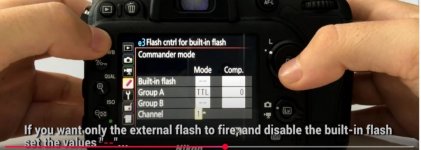
Hello all. Am using the above combo and have come across a problem with using the on board flash as command flash. Followed instructions on set up and both fire fine. However i dont want the built in flash to fire just the slave. Have set the values to 0.0 .reduced.jpgas per the you tube video.Screenshot 2025-01-26 155203.jpg It says to reduce the values "---". Cant get the single 0 though. Go any lower and it goes into negative values. However the on board flash still keeps firingalong with the slave.
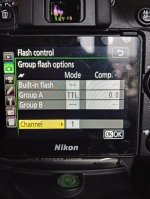
 
It should fire only the slave like that but you will also see the camera flash doing stuff to communicate with the slave. The shutter should operate after this has happened and when the slave is firing. The comp part is about weighting individual groups so they are brighter (+be) or darker (-ve).
 
When you say it’s firing; do you mean that you’ve got an obvious effect on the image? Or just that you saw a flash?

Because as above, there will be at least one flash as part of the communication and calculation process.
 
Understand the process now thanks. Was thinking the link would be passive and I wouldn't see it.
 
It should fire only the slave like that but you will also see the camera flash doing stuff to communicate with the slave. The shutter should operate after this has happened and when the slave is firing. The comp part is about weighting individual groups so they are brighter (+be) or darker (-ve).
So the process is like this
Shutter pressed - in built flash flashes to the slave- (shutter closed)- shutter opens at the same time that the slave flash is fired -picture taken.

Simplified I know, but that's the gist of it?
 
So the process is like this
Shutter pressed - in built flash flashes to the slave- (shutter closed)- shutter opens at the same time that the slave flash is fired -picture taken.

Simplified I know, but that's the gist of it?
That's exactly it Andy - with the addition, if using TTL flash, of a test fire at 10% of the target value from each flash group in turn - which creates the limit of 2 groups (3 with a flash commander mounted on the hot shoe) as all this takes time and lag between button-press and picture-taking :) The protocol is called "Nikon Advanced Wireless Lighting" or AWL. The camera uses the pop-up to send data about the output level to the various flash groups in range, and then the picture is taken. Often called "line of sight" this is not true - it works around corners as long as the data transmission light reaches the flashes (by bouncing off walls etc) it will work. On Nikon flashes, the receiver is on the side - which spawned a whole load of rotating flash mounts so the sensor could face the camera and still have the light pointed in the right direction. The Nikon versions of Godox speedlights will also talk AWL - as both Commander (on the camera) and slave.

It's old but very effective :)
 
So the process is like this
Shutter pressed - in built flash flashes to the slave- (shutter closed)- shutter opens at the same time that the slave flash is fired -picture taken.

Simplified I know, but that's the gist of it?
Less simplified - it’s miraculous when you think about the speed of this.

As shutter is pressed, transmitter flash fires a small pulse of light, camera measures the reflected light through the lens and calculates how much flash power is required to get the exposure based on camera settings, transmitter flash then sends that message to all attached flashes based on the ratio dialled in.
Shutter opens, flash(es) fire.

Edit cross posted with @Scooter
 
And for radio slaves.
Nikon, who had managed this miracle were then joined by most other manufacturers using a similar light based communication. Followed by 3rd party manufacturers copying the protocols but doing it much cheaper.

Then along comes PocketWizard; who in 2009 miraculously manage to take those protocols and turn them into radio comms instead of light. It was clunky, but amazing.
Then Yongnuo copied it and improved on it.
Followed by Canon who ‘designed their own’ ;).
And eventually Godox took the whole lot and added their own protocol, so a Nikon flavoured Godox transmitter can fire Godox lights designed for Canon Fuji etc. cos it takes the Nikon messages and translates them into Godox messages on the fly.

And how far behind are Nikon now? Still not able to give you a hotshoe mounted radio transmitter without adding another dongle to the camera.
 
And how far behind are Nikon now? Still not able to give you a hotshoe mounted radio transmitter without adding another dongle to the camera.
They tried to "do a Canon" and lock people in with a £600 flash, and a £somehundreds dedicated radio transmitter than plugs into the 10-pin socket on the front of the camera. They also deleted the popup from the D8xx series cameras that I use which was really useful for an impromptu off-camera flash shot at events - no trigger required.. I ditched my Nikon flashes at that point and bought Godox V860's - for a fraction of the price of the new Nikon flashes. I don't know anyone who bought into their new system.
 
So AWL is the same as NAS?
AWL was part of Nikon's "Creative Lighting System" or CLS. NAS usually stands for Network Attached Storage. Where have you seen NAS used in relation to lighting?

*edit - another crosspost :P
 
They tried to "do a Canon" and lock people in with a £600 flash, and a £somehundreds dedicated radio transmitter than plugs into the 10-pin socket on the front of the camera. They also deleted the popup from the D8xx series cameras that I use which was really useful for an impromptu off-camera flash shot at events - no trigger required.. I ditched my Nikon flashes at that point and bought Godox V860's - for a fraction of the price of the new Nikon flashes. I don't know anyone who bought into their new system.
The D8xx series would never have had a pop up if they’d been Canon.
Despite the flash controller being useful in a pinch, canon believes that if you want a serious camera, you don’t need a flash built in.
Also when Canon launched their radio flashes, Yongnuo created clones that worked alongside them.

And I can’t see why anyone would buy into the Nikon radio system. It’s the most bulls…. Answer to a simple problem ever.
 
You mention clones for Canon. Do they make ones for Nikon and are they as good?
Loads of speedlights including your Nissin clone the Nikon CLS
As @Scooter posted earlier, the AWL radio system never really took off (why would it?), so no one bothered to clone it.

Again as was pointed out, a shift to Godox makes sense, does a better job than the Nikon AWL and cheaper.

Yongnuo’s clone of the Canon 600ex is ‘interesting’ as it integrates with the canon radio products (they even sell a transmitter that controls the canon speedlight), but it’s still not as good as the Godox ecosystem.
 
Last edited:
Loads of speedlights including your Nissin clone the Nikon CLS
As @Scooter posted earlier, the AWL radio system never really took off (why would it?), so no one bothered to clone it.

Again as was pointed out, a shift to Godox makes sense, does a better job than the Nikon AWL and cheaper.

Yongnuo’s clone of the Canon 600ex is ‘interesting’ as it integrates with the canon radio products (they even sell a transmitter that controls the canon speedlight), but it’s still not as good as the Godox ecosystem.
AWL was the optical thing. Looks like they're calling the new system "Radio controlled AWL" https://www.nikon.co.uk/en_GB/product/speedlights/speedlight-sb-5000
 
.....
Nikon, who had managed this miracle were then joined by most other manufacturers using a similar light based communication. Followed by 3rd party manufacturers copying the protocols but doing it much cheaper.

.....
I think it was actually Minolta that were the first to come out with an optical flash triggering system that provided more than just a simple slave mode.
This was first available (from what I understand) on their Xi Film cameras, and the system is still available in the current Sony mirrorless cameras (not that anyone is likely to use it).
It was useful back when I was shooting with the old A-Mount Sony DSLR, as finding a 3rd party radio trigger for the Minolta style hot shoe was not easy!
 
Back
Top