sk66
Suspended / Banned
- Messages
- 9,557
- Name
- Steven
- Edit My Images
- Yes
I've been working with the D5 for about a month now, and I've been seriously exploring the benefits (?) of raw with this camera. I've found a few things I thought I would share.
First is that at ISO's 1600 and above I don't see any additional "recovery" in the raw files compared to the jpegs. I haven't really tried lower ISO's, this isn't the camera for that. But based on the specs/tests I expect it will be minimal, if at all, even at minimum ISO.
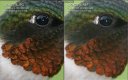
Secondly, the raw files seem to handle hard speculars oddly... there tends to be a scattering of blown pixels around the catchlight which are not present in the jpegs. The jpeg instead has a larger catchlight, but it looks better overall IMO. This example is not "worse case" but it is evident, and this characteristic also affects other highlights/details. (I don't normally leave these types of catchlights in the image... I'm not certain how my D4/D810 renders them in raw files offhand but I don't recall it being "notable").
jpeg (edited) vs raw (SOOC) 100% crop
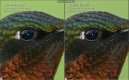
Here I have edited both in LR to the best of my abilities. Minimal tweaks to the jpeg. Numerous edits to the raw file; probably 3-4x the time required. The "noisy" characteristic of the catchlights/speculars remains even with significant noise reduction (~15% luminance and 50% color). Additionally, looking at the details in the darks near the eye, the jpeg looks a little better IMO (raw file sharpening is at 50% with 50 masking). I could potentially have removed more noise from the catchlight (luminance) with a negative effect elsewhere, or selectively treated/removed with additional time/effort.
raw vs jpeg edited 100% crops (note that they have flipped sides)
I'm not trying to say that the raw files are crap, they're fine. But I'm not seeing any real benefit to using the raw files... There might be a benefit if you have to push the colors hard or the WB is way off, but the files do not seem to tolerate it as well as my other Nikons. There is a real possibility that LR processing for the raw file is not nearly as optimal as the built in jpeg rendering. I did open the raw file in Nikon's software (which I hate) with *slightly* better results, but still not as good as the jpeg IMO... that doesn't make a lot of sense to me as the software automatically applies the jpeg settings. And yes, with a lot of tweaking/fussing I could probably have gotten slightly better results from the raw file that I did... but I don't see the point.
So my current approach with the D5 is to record raw + jpeg to separate cards and just use the jpegs by default... when I have a jpeg I can't quite get what I want/need from then I'll revisit the raw file editing. In the long term, I may go to only recording jpegs... we'll see.
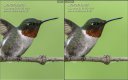
To show how minimal these differences really are, here's a 1:4 view of both...
First is that at ISO's 1600 and above I don't see any additional "recovery" in the raw files compared to the jpegs. I haven't really tried lower ISO's, this isn't the camera for that. But based on the specs/tests I expect it will be minimal, if at all, even at minimum ISO.
Secondly, the raw files seem to handle hard speculars oddly... there tends to be a scattering of blown pixels around the catchlight which are not present in the jpegs. The jpeg instead has a larger catchlight, but it looks better overall IMO. This example is not "worse case" but it is evident, and this characteristic also affects other highlights/details. (I don't normally leave these types of catchlights in the image... I'm not certain how my D4/D810 renders them in raw files offhand but I don't recall it being "notable").
jpeg (edited) vs raw (SOOC) 100% crop
Here I have edited both in LR to the best of my abilities. Minimal tweaks to the jpeg. Numerous edits to the raw file; probably 3-4x the time required. The "noisy" characteristic of the catchlights/speculars remains even with significant noise reduction (~15% luminance and 50% color). Additionally, looking at the details in the darks near the eye, the jpeg looks a little better IMO (raw file sharpening is at 50% with 50 masking). I could potentially have removed more noise from the catchlight (luminance) with a negative effect elsewhere, or selectively treated/removed with additional time/effort.
raw vs jpeg edited 100% crops (note that they have flipped sides)
I'm not trying to say that the raw files are crap, they're fine. But I'm not seeing any real benefit to using the raw files... There might be a benefit if you have to push the colors hard or the WB is way off, but the files do not seem to tolerate it as well as my other Nikons. There is a real possibility that LR processing for the raw file is not nearly as optimal as the built in jpeg rendering. I did open the raw file in Nikon's software (which I hate) with *slightly* better results, but still not as good as the jpeg IMO... that doesn't make a lot of sense to me as the software automatically applies the jpeg settings. And yes, with a lot of tweaking/fussing I could probably have gotten slightly better results from the raw file that I did... but I don't see the point.
So my current approach with the D5 is to record raw + jpeg to separate cards and just use the jpegs by default... when I have a jpeg I can't quite get what I want/need from then I'll revisit the raw file editing. In the long term, I may go to only recording jpegs... we'll see.
To show how minimal these differences really are, here's a 1:4 view of both...