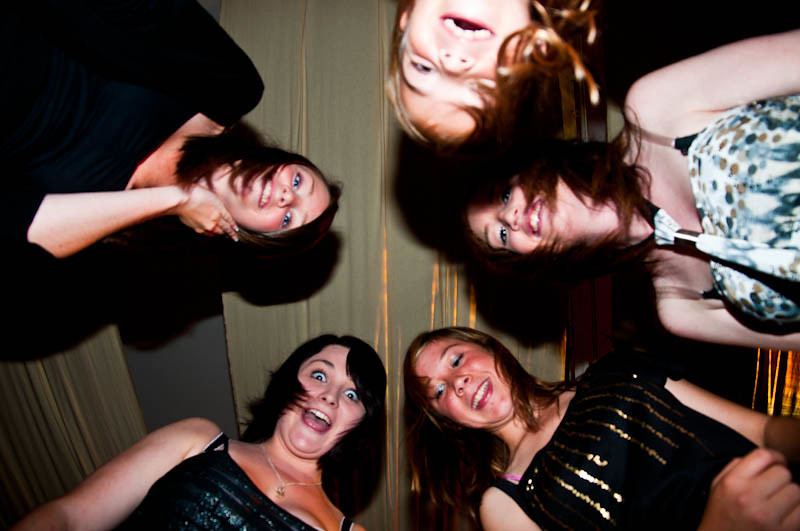
Nightclub photography

Give that a whirl and see if you get any different results
 
From memory our base settings for nightclub were iso 1600, 1/125th, F6. Flash in rear shutter sync.
Then play with shutter speed to add background and ambient blur, do some zoom blurs etc.
Tweak apperture to increase or decrease your ambient.
Normally had positive flash compensation to try and stop colour cast on the people.
 
Ps rarely deviated from kit lens in nightclubs, too much risk for good kit.
 
From memory our base settings for nightclub were iso 1600, 1/125th, F6. Flash in rear shutter sync.
Then play with shutter speed to add background and ambient blur, do some zoom blurs etc.
Tweak apperture to increase or decrease your ambient.
Normally had positive flash compensation to try and stop colour cast on the people.

You mean rear-curtain (or second-curtain) sync? That doesn't work until shutter speed drops below 1/30sec, even when enabled.
 
You mean rear-curtain (or second-curtain) sync? That doesn't work until shutter speed drops below 1/30sec, even when enabled.
And doesn't make much difference unless the subject is moving in a defined direction where the subject will be frozen at the 'end' of a blur. Randomly moving people or camera movements recorded with a flash exposure - no difference whatsoever.
 
There are pros and cons to second-curtain sync. Most of the time it makes sod all difference, if only because second-curtain sync only gets significantly different to first-curtain at quite long speeds like say 1/8sec and more. And with random movement like waving light wands or whatever, it makes no difference if the blur runs one way or the other. It's not the magic bullet that some club photographers seem to think it is, and it certainly doesn't 'overlay' the flash exposure more prominently, which is another myth.

However, with faces blurred by ambient movement, they certainly look better when moving away from the blur, rather than into it. The downside of that though, is the delay before the flash fires makes it hard to predict the moment of capture, and fleeting gestures are missed. And the other thing is when second-curtain sync is combined with auto-TTL exposure control, the pre-flash makes the subject think the shot has been taken and they move before it actually has been.

Personally, I use normal first-curtain sync unless there's a real reason not to. Good link on second-curtain sync from Neil van N http://neilvn.com/tangents/first-curtain-sync-vs-rear-curtain-sync/
 
Sorry, during longer exposures for zopm blur etc so tje flash is triggered at the end of the exposure.
 
Im no expert but looking I to this on youtube and talking to a few people f4 at an 1/8second would be fine as long as the flash is enough to freeze the subject. Like if using rear sync flash. Using faster shutter speeds will only result in dark backgrounds. The lack of sharpness will either be down to 1/16 flash not being powerful enough OR f2.8 not giving enough DOF
 
yes im bouncing light off the ceiling. this particular club has a very low white ceiling so i think bouncing is ideal. i set it to 45 degrees and use a stofen as well as 1/16th power flash.

im shooting at the same club again tonight so will post some more pics up. i was thinking of the following settings but correct me if im wrong?

f4 aperture, approx 1/10th shutter (will know better tonight when i try it out), ISO800, and i will give manual focusing a go, otherwise just use the center focus point.

in regards to the flash, i am still tempted to stick with a stofen and 1/16th power, however will try TTL and possibly lose the stofen.

sound good?
Hi.
I am in the learning side too so take it as it is...
I think you are killing the party atmosphere by bouncing light. ..
Drag the shutter. Use ttl . Flash to the front and use flash ev compensation as needed...
I have f2.8 to . You must have deep of field in mind always. Think how manybpeople and at wich distance they are. If there is a group step down. .. allow more ambien light. And freeze subjets with flash...
 
I'm no expert but the focus is the big issue for me, as said 2.8 might be a bit restrictive. are you on centre focus or FULL AF (where all the focus dots are being used)?


and.. I must be getting old, cus it looks more a school disco/youth club, than night club lol
 
Better than previous. Personally though I think your letting in to much ambience. It's meant to be a night club. Should be darker in my opinion. But definitely better still some unflattering shots though.
 
Last edited:
Better than previous. Personally though I think your letting in to much ambience. It's meant to be a night club. Should be darker in my opinion. But definitely better still some unflattering shots though.
This^
It's your second attempt after I wrote:
It's not just your flashgun lighting the room, your settings are allowing the ambient to play too large a part.

It's not effective, it's distracting. People and furniture in the background are imposing on your images. All the 'faults' are down to the same issue.

And the overall issues haven't improved that much. I understand why you want to 'capture' some of the ambient, but the ambient is almost balanced, meaning your subjects are competing with their surroundings, rather than the background offering a hint of atmosphere.

And you're still posting unflattering images, people will judge you as a portrait photographer by how nice you make them look, historically the best portrait photographers are the ones who best use lighting and posing and then retouching to create beautiful images.

My mates can take snaps of me half p***ed looking fat and gormless, if I'm paying for a service I want to look slim and attractive. (That might be too difficult for even the best though).
 
I agree with the comments.

You can't actually tell that the people are in a nightclub - the background is too lit.

There's no right answer here - you have to experiments and gain experience.

Personally, I'd ditch the TTL and shoot entirely manual, adjusting as you go. That way you'll learn about what effect your changes are having on your images rather than having the camera react to situations that you can't necessarily see.

Finally, watch your backgrounds, especially if they're not blacking out.
 
shutter speed is way to slow, none and i mean NONE of these pictures look as if they were taken in a club. more like a group meeting in a room somewhere you have to reduce the light around your subjects to make it "look" dark/nighclubish .this was taken at a party i attended and shows you need some darkness in the shot to give it a "location" hth mike. (camera settings are in the flickr info)


the girls
by Mike Rockey, on Flickr
 
ok thanks for the feedback guys. how else would you guys suggest restricting ambient light? increase shutter and reduce aperture?? or simply lower ISO?
 
I'd lower the iso first. Will improve image quality.

You could speed up the shutter but may as well increase the quality first. you don't want to make the aperture any smaller as this will sharpen more of the background and you don't want that, its distracting enough already with too much ambience.
 
Last edited:
I would freeze the movement 1/60s
dial down the flash a little
set the aperture to more then f/4 so that you get everyone in focus
then ramp up the ISO a little (depends on the camera) so that ambient light gets a look in too
 
I would freeze the movement 1/60s
dial down the flash a little
set the aperture to more then f/4 so that you get everyone in focus
then ramp up the ISO a little (depends on the camera) so that ambient light gets a look in too
Already too much ambient light. Up the shutter a little but lower the iso
 
Already too much ambient light. Up the shutter a little but lower the iso

ok thanks. will bear that in mind and try a few stops lower ISO this weekend :)

was shooting at 1250, will maybe try 800 or 640
 
Last edited:
ok thanks. will bear that in mind and try a few stops lower ISO this weekend :)

was shooting at 1250, will maybe try 800 or 640
Please, stop it with the numbers. I mentioned this earlier, photography isn't about numbers, it's about light. And portraiture definitely isn't about numbers, it's about people and light.

Go to the club, turn off your flash, and shoot in M until you have your background exposure just right. That's underexposed and looks right, not a centred needle or 1/60 or ISO 640 or anything else, just measure around the club at different points, measure your ambient and what settings you need to make it into a nice background. Then use those settings when you're in that spot.

Then dial in the flash on a foreground subject, if you're bouncing it off the ceiling zoom it in a bit to try to narrow it's spread. Once you're happy, they're your settings.

Settings aren't something photographers really consider without a camera in their hand, they're what we use to create the effect we want with our subject in front of us. And they might change from one minute to the next depending what we need to achieve.
 
Last edited:
Please, stop it with the numbers. I mentioned this earlier, photography isn't about numbers, it's about light. And portraiture definitely isn't about numbers, it's about people and light.

Go to the club, turn off your flash, and shoot in M until you have your background exposure just right. That's underexposed and looks right, not a centred needle or 1/60 or ISO 640 or anything else, just measure around the club at different points, measure your ambient and what settings you need to make it into a nice background. Then use those settings when you're in that spot.

Then dial in the flash on a foreground subject, if you're bouncing it off the ceiling zoom it in a bit to try to narrow it's spread. Once you're happy, they're your settings.

Settings aren't something photographers rarely consider without a camera in their hand, they're what we use to create the effect we want with our subject in front of us. And they might change from one minute to the next depending what we need to achieve.
I agree every situation is different. It's ok to have a ballpark figures for settings but they not biblical. As above, personally I shoot manual without flash first to get the background settings, then use my flash(es) in manual too until I get what I want. Whether it be fill or key. The only setting that's really important in this case is the aperture. Just enough depth for the subject, the rest wants to be out of focus. Generally, the focus point is is a third into the field. Ie four people in a line, focus on the second person. Then set your shutter to depict the amount of motion you want in the background. The last is the iso, start as low as possible to increase the chance of better quality and lift it up till you get the amount of light you need. If its still to bright on lowest iso then up the shutter some more. Finally onto the flash. This is what will give you your subject exposure.
 
I agree every situation is different. It's ok to have a ballpark figures for settings but they not biblical. As above, personally I shoot manual without flash first to get the background settings, then use my flash(es) in manual too until I get what I want. Whether it be fill or key. The only setting that's really important in this case is the aperture. Just enough depth for the subject, the rest wants to be out of focus. Generally, the focus point is is a third into the field. Ie four people in a line, focus on the second person. Then set your shutter to depict the amount of motion you want in the background. The last is the iso, start as low as possible to increase the chance of better quality and lift it up till you get the amount of light you need. If its still to bright on lowest iso then up the shutter some more. Finally onto the flash. This is what will give you your subject exposure.

We've been going back and forth over settings for a while and perhaps there's been a slight improvement but the photos are not that different from the earlier shots (background ambient competing with subject matter, 50/50 on being in focus).

I think Phil's nailed this one by saying the op should stop worrying about the exact settings and re-approach the issue from the ground up, unless this is the look he's after (I assume that's not the case).
 
how else would you guys suggest restricting ambient light? increase shutter and reduce aperture?? or simply lower ISO?

Definitely lower the ISO. I don't see why you are using ISO 1250 with a flash. Last night I took some band pictures in a pub at ISO 100 with a flash. Aperture was f4 and shutter speed was 1/250.

At ISO 1250, I doubt that the flash is adding much other than filling in shadows.

As an experiment, set your camera to manual with the shutter speed at or just below maximum sync speed (probably 1/160 or 1/250) then with the flash switched off, take shots at various apertures until you are happy with the amount of ambient light i.e. the brightness of the general background. Then slowly increase the flash power (if you can do this manually) until you get a combination you like.

EDIT: I see Phil has suggested the same thing. That's me doing my normal trick of replying before reading the whole thread!


Steve.
 
Last edited:
Already too much ambient light. Up the shutter a little but lower the iso
I don't think it's the ambient. The bounce flash just lights the whole scene. Otherwise there'd be quite a significant colour shift.
 
Back
Top