Night shots

Sebas77

Suspended / Banned
Messages
78
Edit My Images
No
Hi,

my first attempt of night shots:

https://plus.google.com/u/0/photos/105257085260231047119/albums/5919896921865608241

There is something I am missing there, so I am looking for advices.

First: this is the INTECH Science Centre - Planetarium, as I suspected the quality of the sky there seems to be even better than in new forest.

second: I have seen many pics of night shots take at 30sec, however every photo I took with an exposure longer than 20sec was already showing star trails! Why? Are the stars faster in the UK? :D

third: I wonder if it is not better to take the pic slightly under exposed, correct exposure shows too much pollution.

fourth: what am I doing wrong here? I use a f/4 lens, 17mm and tried everything from 15-30sec and 1600-6400iso.
 
Are you using a crop sensor? If so you're looking at 1.6x 17mm =27mm at 35mm equivalent.

If you use the 600 rule (600 / focal length in 35mm terms) that gives you 22 seconds before you stars turn into trails.

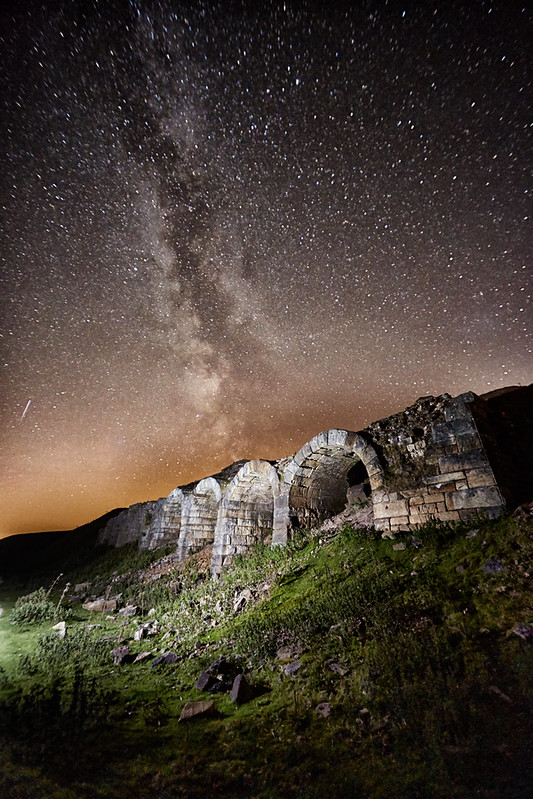
I shot this on Monday and because I was using 14mm on full frame I could have gone to 43 seconds (600/14) if necessary, I actually used 30 seconds at f2.8, ISO 6400


The Milky Way at Rosedale Abbey by mark_mullen, on Flickr
 
oh, wow, I did not know about this rule and I am also not sure if I understand it. What is the physical explanation of it? (never mind this question, I am already reading this: http://photo.stackexchange.com/questions/30263/what-is-the-rule-of-600-in-astrophotography)

Anyway now I am looking forward to have back my 10-20mm (sigma) that is under servicing. I will try again next month (clouds allowing).

Also, I keep an eye on the new samyang, if they will release a 10mm 2.0 I might buy it.

However, in your shot, I can see star trail on the borders, how come?

Finally, how come your sky is so black instead to be blue?
 
Last edited:
If you divide 600 by the focal length of your lens, in 35mm terms, it tells you how long an exposure you can use without your stars turning into trails.

If you imagine using a long telephoto the stars will soon be across the frame, with an ultrawide angle it will take longer.

Regarding the colour of the sky, it is down to what white balance you use.

I don't know why I've got trails to the outsides TBH.
 
Hi,

my first attempt of night shots:

https://plus.google.com/u/0/photos/105257085260231047119/albums/5919896921865608241

There is something I am missing there, so I am looking for advices.

First: this is the INTECH Science Centre - Planetarium, as I suspected the quality of the sky there seems to be even better than in new forest.

second: I have seen many pics of night shots take at 30sec, however every photo I took with an exposure longer than 20sec was already showing star trails! Why? Are the stars faster in the UK? :D

third: I wonder if it is not better to take the pic slightly under exposed, correct exposure shows too much pollution.

fourth: what am I doing wrong here? I use a f/4 lens, 17mm and tried everything from 15-30sec and 1600-6400iso.

I'd say these were pretty good for a first attempt, even more so because that's not an easy place to try and shoot. Well done!

You will notice star trails start to appear after a very short time. This is affected not only by focal length but also which direction you're facing - for us, facing south (away from Polaris) creates the most movement for any given exposure time.

If you can't get the exposure spot-on then it probably is best to go slightly under, just don't ask too much from your files when processing. Dark, high-ISO files don't really like having exposure added so the images will look noisy with very little adjustment.

Optimum settings for the Milky Way are ISO3200, f/2.8, 30 sec but it's very much subject to the location whether that's possible. If you have to drop a stop of ISO you might still capture some Milky Way but could lose the definition. Still, better to do that than come home with no shot!
 
Thank you very much for the answer. How come you say the pace was not simple? Another question, with 1.5x crop factor and a 16mp sensor, what focal length would you suggest to use?
 
Thank you very much for the answer. How come you say the pace was not simple? Another question, with 1.5x crop factor and a 16mp sensor, what focal length would you suggest to use?

If you want ultra wide angle on a crop sensor then you need to be looking at say 10-20 lenses, the tokina 11-16/2.8 gets rave reviews :thumbs: 10mm on a crop sensor camera gives you a similar FoV as a 15-16mm would give on a full frame camera :thumbs: I hope that helps
 
the question is if on a 16mp I will loose too much detail (stars not visibile anymore)
 
the question is if on a 16mp I will loose too much detail (stars not visibile anymore)

Shouldn't have thought so, I've shot tens of thousands on 12mp (CROP) and I've shot tens of thousands on 22mp (FF) what's made you think the size of the sensor would make you loose stars?
 
well a 10mm covers a huge amount of area and the number of pixels on the sensor is fixed...that means that small stars could get lost (but it helps for the trails ;))
 
well a 10mm covers a huge amount of area and the number of pixels on the sensor is fixed...that means that small stars could get lost (but it helps for the trails ;))

You've got 16 million pixels :) it's not too likely that there will be 16 million visible stars in your frame even at 10mm if you used half the frame as foreground that still gives you 8 million pixels to play with :thumbs:

Edit: not intending to sound cocky by the way, it's just that your maybe over thinking it, as to pick up the really faint stars your going to need different settings to what you'd use for the brightens stars etc, then your really getting into the realms of deep sky stacking and a whole different realm of photography from starscapes as such
 
Last edited:
don't worry, my reasoning was slightly different, but not sure if it was correct. As you said I was more worried about the more distant stars, which if missing could make the frame a little bit emptier. I'd like to shoot something like this:

http://1.bp.blogspot.com/-0zHY40uKKUY/UhQL4fxmwaI/AAAAAAAAYKI/VzBimn1-7j0/s1600/1600x1200-Natural-World-Milky-Way-Galaxy.jpg

Also note from that rather stunning image you've linked that has been resized to 1600x1200 which is under 2mp :D obviously I'm sure it was originally shot well in excess of that but I can confidently say at 16mp if you get into a area with as little light pollution as possible you should be able to get photos like that....tragically far too much of the UK has far too much light pollution :(
 
if you had to choose a lens for stars photography, what would you go for, a 10mm 2.8 or a 24mm 1.4 (and then stitch more photos)?
 
if you had to choose a lens for stars photography, what would you go for, a 10mm 2.8 or a 24mm 1.4 (and then stitch more photos)?

10mm 2.8 every time, I've got a 24-70 and I really wish I'd gone for the 16-35 instead :( realistically I've never felt the need to shoot at a larger aperture that f/4 in any case so there wouldn't be a need for ultra fast lens like the 24/1.4 you mentioned :D
 
well for stars photo ultra fast can be a big difference, no?

No not really if I'm honest because unless your planning just stars then a really large aperture is going to cause you to have an OOF foreground or your going to have to do two exposures for foreground focus and the stars focus where as shooting at around f/4 you can just about get away with a single exposure and with much wider focal lengths you can expose for longer before trailing becomes an issue
 
well I was implying a double stacked exposure....which is pretty normal in most of the cases (not all, especially if you use a torch, but most)
 
well I was implying a double stacked exposure....which is pretty normal in most of the cases (not all, especially if you use a torch, but most)

If you want to say stuff it is always better to just say it rather than imply it :) it's blooming hard to pick up implications online

That said I've never needed to do focus stacks of that nature
 
hmm ok, it is still a viable solution...many people use it for large night landscapes in place of using a torch:

5163128618_6fc3c10705.jpg


knowing this, would you still go for the 10mm?
 
hmm ok, it is still a viable solution...many people use it for large night landscapes in place of using a torch:

knowing this, would you still go for the 10mm?

I'm not sure I really get what your saying? "In place of using a torch" for what....on a crop sensor yes I would still got for a 10mm

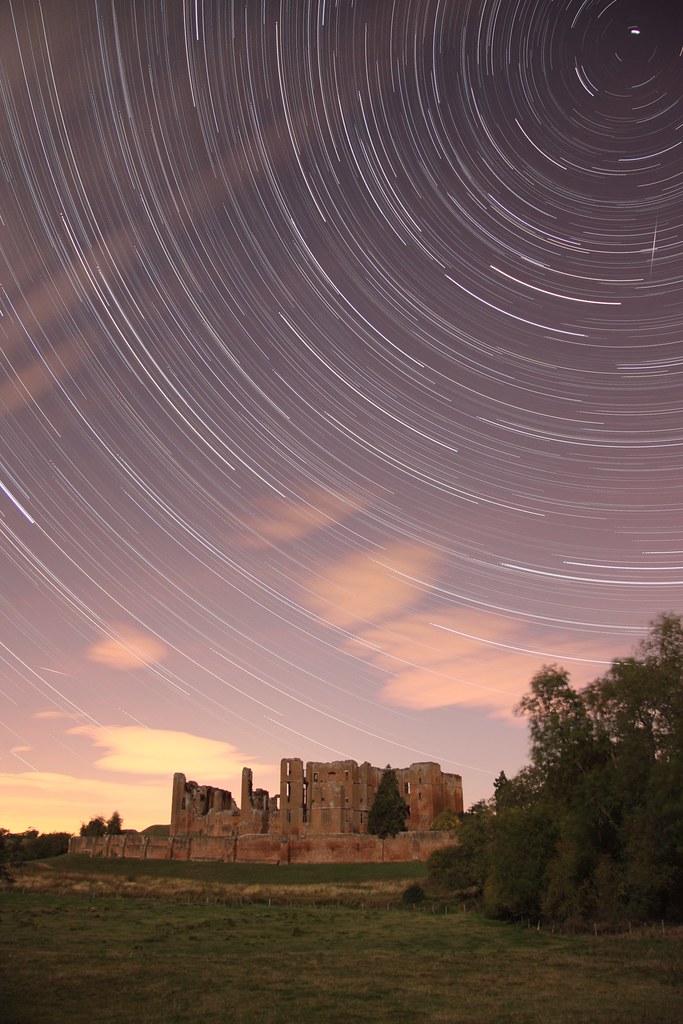
This was shot at 24mm to get the same or similar FoV you'd need a 15mm lens on a crop sensor camera


323/366 (688) by mwhcvt, on Flickr

Each frame was shot for 30 seconds @ f/4.5 ISO2500

This one is a bit older it was shot at 17mm on my 450D rather than 5D3 @ f/4 ISO800


257/365 (Explored) by mwhcvt, on Flickr

The last one was on a full moon so fewer visible stars plus was closer to the light pollution of Coventry and Birmingham so again fewer stars but the light of the full moon did a great job lighting the castle :D
 
pheew, ok I am mixing up several techniques, therefore I understand it can be confusing.

let's recap

1) the 10mm 2.8 would be the nicest solution for a simple single shot image. I agree
2) 24mm 1.4 would give without any doubt much more light (it's true that I can expose for only 15 seconds, but I gain one stop more in aperture). However with this lens I need to take several shots, both to create a panorama that could recreate a 10mm FOV and because I could have a foreground that I need to refocus.
3) the torch thing was a sidetrack, I was talking about being able to light up the foreground. In this case either a torch OR the ambient light is usually used, but in the latter case the foreground is shot way before the background(when there is still some light available)

all that said, I have seen people using all the techniques mentioned. In fact there are people like you who suggest to go for the 10mm, but on another forum I have been suggested to go for the 24mm for the light benefit.
 
Last edited:
pheew, ok I am mixing up several techniques, therefore I understand it can be confusing.

let's recap

1) the 10mm 2.8 would be the nicest solution for a simple single shot image. I agree
2) 24mm 1.4 would give without any doubt much more light (it's true that I can expose for only 15 seconds, but I gain one stop more in aperture). However with this lens I need to take several shots, both to create a panorama that could recreate a 10mm FOV and because I could have a foreground that I need to refocus.
3) the torch thing was a sidetrack, I was talking about being able to light up the foreground. In this case either a torch OR the ambient light is usually used, but in the latter case the foreground is shot way before the background(when there is still some light available)

all that said, I have seen people using all the techniques mentioned. In fact there are people like you who suggest to go for the 10mm, but on another forum I have been suggested to go for the 24mm for the light benefit.

All correct looking as with anything there is always going to be different routes to getting the image you want in the end...

I would question however how many night shooters shoot below f/2.8 or even f/4 on a regular basis obviously I can only say with certainty that I rarely venture wider than f/2.8 but that would hardly be representative of reality
 
3) the torch thing was a sidetrack, I was talking about being able to light up the foreground. In this case either a torch OR the ambient light is usually used, but in the latter case the foreground is shot way before the background(when there is still some light available)

Not always the case. Moonlight can do a fine job of exposing your foreground in one shot. Of course you have to consider the effect the moonlight in the sky will have on reducing the number of stars you can record.
 
No-one can make your lens choices for you but with astro in mind for a crop sensor I'd look at the Tokina 11-16mm f/2.8. Depth of field will not be an issue except in the most unlikely circumstances, like wanting sharp stars above a very small, closely positioned foreground subject. By the time you're focused on a larger subject a few feet away you'll find the whole frame will be in focus, even at f/2.8

That Tokina lens won't move with you to an FX body, though. For Nikon FX you'd be looking at the Nikon 14-24mm. DoF is more of a consideration but still not really an issue for landscape work. The lens is legendary for image quality. Someone else can help with the Canon equivalent, I'm sure.

I would question however how many night shooters shoot below f/2.8 or even f/4 on a regular basis obviously I can only say with certainty that I rarely venture wider than f/2.8 but that would hardly be representative of reality

On a crop body I was frequently shooting at f/1.4 or f/1.8 or f/2 as allowed by my 50mm, 85mm & 35mm respectively. Since moving to FX I don't shoot wide open as often but I'd go that route if I was hoping to catch the Northern Lights, or making a Milky Way timelapse.

The reason for the differentiation between DX & FX is how much better the smaller sensor copes with vignetting, corner sharpness & lens coma - due to the image circle of the lens going way beyond the corners of the sensor.

Not always the case. Moonlight can do a fine job of exposing your foreground in one shot. Of course you have to consider the effect the moonlight in the sky will have on reducing the number of stars you can record.

^ Good advice
 
Really nice pictures. Never tried the stars yet but will certainly give this a try.

Never heard of the 600 rule either so will give it a shot and see how I go.
 
What 10mm f/2.8 is this everyones talking about? I know samyang has been planning on releasing one, but it's been delayed over a year so far.

Also I agree, a wide and slightly slower lens will be a lot more use than a narrower fast lens.
 
What 10mm f/2.8 is this everyones talking about? I know samyang has been planning on releasing one, but it's been delayed over a year so far.

Also I agree, a wide and slightly slower lens will be a lot more use than a narrower fast lens.

Don't wish to crash the party here but I have 24-70 f2.8 on FF Canon would this be a better lens to use than the 17-40 f4 lens?
Thank you
Russ
 
Back
Top