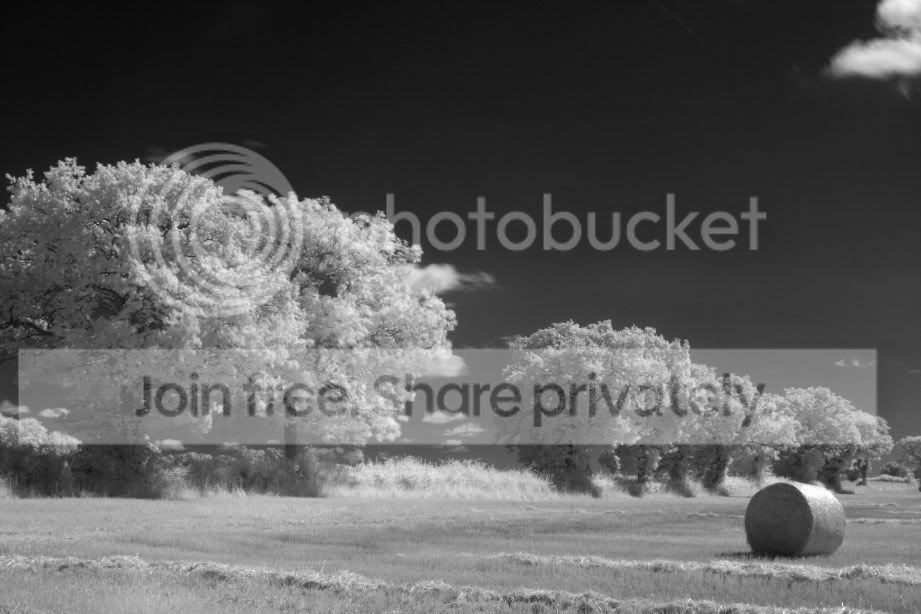
You do know that IR Photography does not give thermal scanner style images right? It works on reflected light like that of the sky so hot objects do not come out white. Be careful taking portraits as well because plant fibres like cotton become invisible in IR light (Get what I mean...) Sony had some problems like that with their nightshot mode on their handycams until they limited it to prevent being sued.
I've just found two Praktica MTL 50 bodies of my dads with a Pentacon auto 1.8/50 MC, a Sirius MC zoom 80-200mm (aperture is stuck wide open) and a Carl Zeiss Jena DDR MC 135mm.
Do those lenses have an IR focus mark? Its usually a little (most of the time red) mark close to the main focusing mark on the lens barrel which is needed as IR light diffracts and as so focuses differently to visible light so if the lens doesn't have one its almost impossible to use it for IR.
What Sort and Where to Get Film
There are three/four current types of IR film:
- Ilford SFX 200 - this is not 'true' IR film its extended red sensitivity, but it gives the same effect and is easier to handle as it can be loaded in subdued light and does not need freezing when stored. Its sensitive to 720nm and is widely available. Because of these reasons, I would use this as an initial IR film.
- Efke IR820 - this is a 'true' IR film and is sensitive past 820nm but NOT to 950nm, giving a more dramatic effect. However as it is 'true' IR film, it needs freezing or at the least chilling when stored, being loaded in at least subdued light although total darkness is better. It should also be processed as quickly as possible. For these reasons I would wait until you are a bit more experienced with IR before using it.
- Efke IR820 AURA - this is the same as above, but it lacks an anti-halation layer so the IR effect is stronger but it MUST be loaded in total darkness as there is no anti-halation layer to stop light from reaching the film and burning up its length, fogging it.
- Rollei IR400 - this is in-between the others in that it is 'true' IR film and is sensitive to just (but hardly beyond) 820nm and does not require loading in the dark but once again subdued light is necessary.
The Efke and Rollei can be brought in Silverprint or AG Photographic, be aware that Silverprint has a £30 minimum spend. Ilford SFX 200 can usually be got in most serious photography websites but I would get it at 7dayshop.com where I get most of my films from.
Filters
Initially I would get a cheap 720nm filter off ebay as this will give you a nice IR effect with any of the above films. For the Efke or Rollei you can also use an 820nm filter for a more dramatic effect but these cut out more light.
I've read that a 950nm filter is suitable for outdoor and strong light use. If I try it indoors is the only negative a slower shutter speed?
DO NOT BUY/USE A 950nm FILTER, THESE ARE TOO STRONG FOR ANY CURRENT IR FILMS AFTER THE DICONTINUATION OF KODAK HIE Sorry to make it so plain, but all you will get is either just blackness or an extremely dim/unseeable image.
Taking IR Pictures
- Load the film in subdued light or total darkness like I said above.
- With the filter OFF, meter and focus normally.
- Put the filter on the lens. With a 720nm filter add 4 stops onto the reading and with an 820nm filter add on 5 or 6 stops. Adjust the focus so that the IR focus mark is over where the normal focus mark was.
- Take the picture! Its likely to be a fairly slow exposure so a tripod will likely be needed.
With the metering you can adjust the metering so that you don't have to add the stops on after putting the filter on. For example with a 720nm filter and SFX 200, ISO 200 - 4 stops = ISO 12.
Developing
I would not bother using any highstreet shops like Boots or Jessops or Tesco as most usually don't have a B&W minilab machine and they frequently use IR thermometers or film cutters that will fog any of the above films except SFX 200 as its not 'true' IR film. I would use a lab like:
Club 35
http://www.club35.co.uk/35mmb&w.html
Peak Imaging
http://www.peak-imaging.com/
Ilford Lab
http://www.ilfordlab.com/page/57/Black-and-White-Prints-from-Film.htm
All of these should do IR if you forewarn then first by contacting them. Clearly mark both the film and order, that it is IR and to keep any IR sources away during development like IR thermometers, night vision goggles (seriously some places use them!) etc. There should not be any problems.
All of these places give both excellent quality and service and I frequently use all three. As this is black and white though, Ilford Lab will likely give the best quality prints as they print on proper black and white paper and don't cheat and use colour like the other two do. Use the online form though as you get to use a freepost address then.
I hope this somewhat long post helps