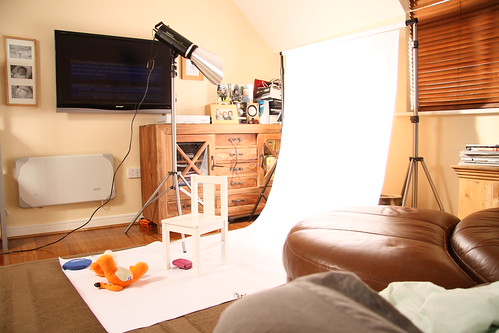
New to portraiture and need some help with background lighting, please.

Naboo32

Suspended / Banned
Messages
3,278
Name
Andy
Edit My Images
Yes
I've been into photography for a couple of years now and although I haven't done much 'people photography', I have recently been asked to make some family portraits for a friend. The first session went fairly well (for a beginner), but I want to be better prepared for the next session, so as not to waste too much time.

My question here is specifically about how best to light the shots in order to get a plain (bright) white background, whilst still retaining fairly even lighting on the subject/s. The thing is, I am only using two flash guns (Nikon SB900s) to provide all the lighting :|. I also have a large (white/silver/gold) reflector and a willing volunteer to hold it for me :naughty:. The setting for the shoot is a fairly small bedroom with white, emulsioned walls. I have no access to backdrops, bed sheets etc.

So, let me first show you one shot from the last session, which I rather like, apart from the under-exposure and the murky grey background :( ...

Siblings_02c_1000pix_80pct.jpg


And now let me show you my favourite shot of the session, which has been converted to monochrome and had the contrast increased a lot to whiten the background ...

Siblings_01e_1000pix_80pct.jpg


What I would like to discuss here are ways to use the tools that I have to get pictures with similar lighting properties to the second shot, but straight from the camera :shrug:.

One suggestion I've had is to use one flash to light the subjects and the reflector to bounce it back to fill the opposite side and then to light the wall with the other flash. This sounds like it could well be the answer, but I wonder what you lighting experts think :naughty: and also whether any of you have pictures to post, which were lit in this way, so that I can see how it might look. I'm also a bit confused about how to balance the power between the two flashes and how to get the wall to look smoothly illuminated.

Additionally, I have a white shoot-thru/silver reflector umbrella and a couple of Lumiquest attachments for the other flash (an Ultrasoft and an 80/20).

All advice/input is most welcome. Thanks for reading :thumbs:.
 
Hi! I use 2 flash head directed on my white paper background. when I first started I used two flash guns - vivitar 283 fired via wireless transmitter.
works fine and gived me white background stright from the camera.
 
Have a look at Edinburgh Gary's thread, white backgrounds are so last season! grey is the new white ;)

Although for white backgrounds don't forget to use spot metering on the subject and adjust exposure compensation accordingly to get a brighter background because it seems that at the moment you might be using matrix metering and so them whites will underexpose to grey.
 
This is not hard m8 :)

1st - use one light to get a white background, lets assume full power on your SB900

2nd - use one light to light your subject but make their exposure at least 1-stop less (i.e. 1/2 power on your SB900) job done

Remember you are lighting two separate subjects and you need to treat them accordingly, if you can get 1 to 2 stops difference between the background and your subject you have cracked it; but if the background spills onto you subject too much you need to move them further way

A bit of practise and you'll crack it - then you'll change to avoiding white backgrounds too as trends change :lol:

DD
 
Keep practising and try to get it right in the camera, but in the meantimne please don't disregard this shot - you've really caught a special moment between these two. I love the pose, the splash of red, it just needs a bit of editing.

5238214709_06f04603c4_o.jpg
 
Have a look at Edinburgh Gary's thread, white backgrounds are so last season! grey is the new white ;)

Although for white backgrounds don't forget to use spot metering on the subject and adjust exposure compensation accordingly to get a brighter background because it seems that at the moment you might be using matrix metering and so them whites will underexpose to grey.

That's me - always waaay behind any kind of fashion (I was listening to The Sex Pistols on my iPod on the way home ... and loving it :D)!

Anyway, great tip about the metering and something that hadn't even occured to me :thumbs:. I live in Matrix mode and normally, it works fine for other stuff (with certain predictable adjustments). Anyway, I'm going to go for Manual mode next time, I think, as I already know the aperture I want to use (f/4) and I know that I want a shutter speed around 1/100th sec with the 85mm lens and possibly faster if I use the 70-200mm f/2.8. That just leaves the flash guns, which I might as well control with the radio triggers, to ensure consistent firing and exposure. Once they're dialled in, there's no changing ambient light to interfere with them :naughty:.

The big question is how will the images look, if I'm going for more brightness from the flashes? Time will tell, I suppose ...

Thanks!

This is not hard m8 :)

1st - use one light to get a white background, lets assume full power on your SB900

2nd - use one light to light your subject but make their exposure at least 1-stop less (i.e. 1/2 power on your SB900) job done

Remember you are lighting two separate subjects and you need to treat them accordingly, if you can get 1 to 2 stops difference between the background and your subject you have cracked it; but if the background spills onto you subject too much you need to move them further way

A bit of practise and you'll crack it - then you'll change to avoiding white backgrounds too as trends change :lol:

DD

Wow, you make it sound so easy Dave :lol:!

You've answered my main question, about balancing the two flashes, so thanks for the headstart with that. I won't have a lot of time to practise these techniques, as the baby gets grumpy quickly, so I really need to get the gear set up and make the shots as fast as I can. Don't have anyone to practise on at home either :'(.

Anyway, how should I position the flash for the wall? On the floor pointing up, or on a stand with a diffuser? I don't have much room to work with, remember :(.

Keep practising and try to get it right in the camera, but in the meantimne please don't disregard this shot - you've really caught a special moment between these two. I love the pose, the splash of red, it just needs a bit of editing.

5238214709_06f04603c4_o.jpg

Hi CT!

I'm flattered that you chose to comment on my Nikon-related issues, really :D!

Rest assured, there's no chance of me 'disregarding' these early attempts at portraiture - I just want to make the next set look better and involve less PPing for me. These two siblings are so great in front of the camera, that it's really like shooting fish in a barrel (and almost as hard to light, for me :lol:).

The family loved the pictures that I made for them and I was chuffed with them too. The plain truth is though; they were all under-exposed and the image quality suffered with the PPing that went into them to get them to the current standard. I just want them to look more like your edit, but without changing the levels too much. Am I asking too much there :p ....
 
As above really. Beware DD though - he's a bit of a master at this sort of thing and manages to deliver outstanding results using a couple of candles :D

There are quite a few threads on getting nice white backgrounds but I suspect the trouble you will have is getting the background evenly lit all the way across, with no hot spots. The figure to aim for is usually about half to one stop brighter all over the background, no more and no less. With the larger area needed for couples and groups, this is very difficult with just one gun (you ideally need one on each side, exactly the same position, at 45 degrees) but a compromise might be to get it right immediately behind the subject and then mop up the grey around the edges in post processing. The tempation is to just blitz the background with light, but then you get outline bleaching and flare and it all goes down hill.

The way I do it is to set the light for the foregound subject, then switch on the background light at low power and keep turning it up until the blinkies flash. That's your warning that the background is about to blow (you'll also see it on the histogram) and with a bit of trial and error you'll know just how far you need to push it to get a clean result. You're aiming for only just blown, not a nuclear dawn. It's not easy, switch everything to manual so you know where you are and have control, then trial and error.
 
As above really. Beware DD though - he's a bit of a master at this sort of thing and manages to deliver outstanding results using a couple of candles :D

There are quite a few threads on getting nice white backgrounds but I suspect the trouble you will have is getting the background evenly lit all the way across, with no hot spots. The figure to aim for is usually about half to one stop brighter all over the background, no more and no less. With the larger area needed for couples and groups, this is very difficult with just one gun (you ideally need one on each side, exactly the same position, at 45 degrees) but a compromise might be to get it right immediately behind the subject and then mop up the grey around the edges in post processing. The tempation is to just blitz the background with light, but then you get outline bleaching and flare and it all goes down hill.

The way I do it is to set the light for the foregound subject, then switch on the background light at low power and keep turning it up until the blinkies flash. That's your warning that the background is about to blow (you'll also see it on the histogram) and with a bit of trial and error you'll know just how far you need to push it to get a clean result. You're aiming for only just blown, not a nuclear dawn. It's not easy, switch everything to manual so you know where you are and have control, then trial and error.

Ignoring the apparent pish-take/stroke compliment :D

Hoppy is right that I have had a few years at this sort of thing - if you are struggling at all, you can always call me for a chat about it :)

DD
 
I note above you said you wanted to use f4 for the subject. Better to set an appropriate aperture for that half power flash you're using. f4 could be too wide.

When using flash like this forget aboutr metering modes - you need to shoot manual.
 
I quite like your grey BG actually, but this is my setup for white BG - one on the BG only with spill kit and the other light you cant see here but is just out of frame to the left.

Hope it helps

5071360021_e81f8f9894.jpg
 
I'll take one of mine next time I use it.... A lot less space than you have Natalie but I use 2x 400BX lights inside a Lastolite HiLite and one 500BXri for the subject. I'd like to add another light for fill though - just do't have the space :(
 
As above really. Beware DD though - he's a bit of a master at this sort of thing and manages to deliver outstanding results using a couple of candles :D

There are quite a few threads on getting nice white backgrounds but I suspect the trouble you will have is getting the background evenly lit all the way across, with no hot spots. The figure to aim for is usually about half to one stop brighter all over the background, no more and no less. With the larger area needed for couples and groups, this is very difficult with just one gun (you ideally need one on each side, exactly the same position, at 45 degrees) but a compromise might be to get it right immediately behind the subject and then mop up the grey around the edges in post processing. The tempation is to just blitz the background with light, but then you get outline bleaching and flare and it all goes down hill.

The way I do it is to set the light for the foregound subject, then switch on the background light at low power and keep turning it up until the blinkies flash. That's your warning that the background is about to blow (you'll also see it on the histogram) and with a bit of trial and error you'll know just how far you need to push it to get a clean result. You're aiming for only just blown, not a nuclear dawn. It's not easy, switch everything to manual so you know where you are and have control, then trial and error.

Richard, this is exactly the kind of detailed yet concise burst of technical information that I have come to rely on you for ... and I thank you for it :thumbs:.

I have a clear idea of what I need to try and do now - I'm just not sure about how to project the b/g flash onto the wall yet :shrug:!? Should I put it on the floor (the wall has no woodchip paper, or real texture), or should I be aiming to blast it from the front :thinking:?

Ignoring the apparent pish-take/stroke compliment :D

Hoppy is right that I have had a few years at this sort of thing - if you are struggling at all, you can always call me for a chat about it :)

DD

Call you what, Dave :shrug:!? How about, "Jammy so and so" :D?

Thanks for the offer - it's really decent of you. Let me see how I get on with the tips that I read here and if I'm still struggling nearer the time (late next week), I'll be in touch ;).


I note above you said you wanted to use f4 for the subject. Better to set an appropriate aperture for that half power flash you're using. f4 could be too wide.

When using flash like this forget aboutr metering modes - you need to shoot manual.

I do intend to go to full manual for this 'controlled' environment, but tell me, why might f/4 be a bad choice :shrug:? I would like a degree of selective focus, if possible, and I would have thought that a wider aperture would help to nullify the (problem) background and make the flash guns work less hard.

Am I missing something here (quite possible) :thinking: ....?

I quite like your grey BG actually, but this is my setup for white BG - one on the BG only with spill kit and the other light you cant see here but is just out of frame to the left.

Hope it helps

5071360021_e81f8f9894.jpg

Is 'spill kit' a reference to diffusers of some sort, Natalie? Sorry, but this is all fairly new to me.

Anyway, I'm only using two flash guns and don't have any proper studio lights, so I really need some advice on how to position them and control the light output, but I thank you for your input :).
 
Rest assured, there's no chance of me 'disregarding' these early attempts at portraiture - I just want to make the next set look better and involve less PPing for me. These two siblings are so great in front of the camera, that it's really like shooting fish in a barrel (and almost as hard to light, for me :lol:).

The family loved the pictures that I made for them and I was chuffed with them too. The plain truth is though; they were all under-exposed and the image quality suffered with the PPing that went into them to get them to the current standard. I just want them to look more like your edit, but without changing the levels too much. Am I asking too much there :p ....

Of course you're not asking too much - they were under-exposed, but I've no doubt you'll get there with the attitude you have, and you've had plenty of good advice in this thread to help you. :thumbs:
 
I do intend to go to full manual for this 'controlled' environment, but tell me, why might f/4 be a bad choice :shrug:? I would like a degree of selective focus, if possible, and I would have thought that a wider aperture would help to nullify the (problem) background and make the flash guns work less hard.

Am I missing something here (quite possible) :thinking: ....?

Not saying f4 would necessarily be a bad choice, just that you need to go with what the correct setting is according to the power of the light source.

Aperture relates to the power of the flash, shutter speed controls ambient light.
 
Of course you're not asking too much - they were under-exposed, but I've no doubt you'll get there with the attitude you have, and you've had plenty of good advice in this thread to help you. :thumbs:

You're perfectly correct, CT - I have had some very good, specific advice here :). Like all of the advice that I get from TP, I'll go out and do the best that I can with it and, if the results are still not quite right, I'll come back and ask the right questions to find out why :|.

Basically, I am a stubborn old perfectionist (i.e. doomed to eternal disappointment) :p!
 
Is 'spill kit' a reference to diffusers of some sort, Natalie? Sorry, but this is all fairly new to me.

Look at the flash light in the image - that silver thing is a background reflector. It stops (kills) the light from spilling onto your subject and keeps it focussed on the background.
 
Not saying f4 would necessarily be a bad choice, just that you need to go with what the correct setting is according to the power of the light source.

Aperture relates to the power of the flash, shutter speed controls ambient light.

:thinking: OK, so how does using a smaller aperture benefit the flash guns? Are you maybe suggesting that the smaller aperture will shut out more ambient light and give me more control over the overall lighting :shrug:? If so, from the test shots that I made last time, f/4 and 125th/sec under the bleak gaze of a 40W light bulb will just result in a black screen :lol:!

The smaller the aperture I use, the more watts the flashes are going to be asked to kick out and that's not really something that I want to encourage.

I'm sure that I'm missing something here :thinking: ...
 
Thanks Andy :)

First thing you need to do is get a little distance between the subject and the background, so you can light them both separately with minimal interference from one to the other. Watch out for the background light/s spilling directly on to the subject from behind. You may need to flag the flash to ensure that - I use a small piece of card as a flag stuck to the flash head with BluTack, which is nice and adjustable, to ensure the light goes only on the background.

If you have two background lights, the best place to put them is either side at 45 degs, level with the subject. The further away you can get them the more even the light will be (inverse square law) but that brings it's own problems, even if you have the space. With one light you'll just have to experiment.

I wouldn't start out shooting at f/4. Shallow DoF can be very nice but a bit of a luxury when you're just starting out. It's not easy to nail the focus even with solo portraits but when you've got two or more people in the shot the chances of getting them all directly in line to within an inch or two and all in focus, are close to zero. Try f/8 on full frame.

Edit: crossed post with some of the above. You need decent DoF to ensure all is sharp, and you need to keep the power output of the guns low to ensure fast recycling - 1/4 power works well for me. You should be okay but if needs be, crank the ISO - no worries on a D700. Every stop of ISO (or f/number) is an effective doubling of flash power.
 
Last edited:
Look at the flash light in the image - that silver thing is a background reflector. It stops (kills) the light from spilling onto your subject and keeps it focussed on the background.

I'm 90% certain that I'm being a ******** here :lol:, but I can't see anything in that picture that resembles a 'flash gun' (as I understand the term) - seeing as I am only equipped with little, plastic flash guns :(. Is that light on the stand some kind of flash gun :shrug:!?

Anyway, it's immaterial - I don't own that kind of equipment and I don't have a proper backdrop to work with, so I just need to know where to point my SB900s and what to put over them :|!?
 
It's the strobe I'm talking about - the thing on the top of the stand - it's not an on camera flash.
 
Thanks Andy :)

First thing you need to do is get a little distance between the subject and the background, so you can light them both separately with minimal interference from one to the other. Watch out for the background light/s spilling directly on to the subject from behind. You may need to flag the flash to ensure that - I use a small piece of card as a flag stuck to the flash head with BluTack, which is nice and adjustable, to ensure the light goes only on the background.

If you have two background lights, the best place to put them is either side at 45 degs, level with the subject. The further away you can get them the more even the light will be (inverse square law) but that brings it's own problems, even if you have the space. With one light you'll just have to experiment.

I wouldn't start out shooting at f/4. Shallow DoF can be very nice but a bit of a luxury when you're just starting out. It's not easy to nail the focus even with solo portraits but when you've got two or more people in the shot the chances of getting them all directly in line to within an inch or two and all in focus, are close to zero. Try f/8 on full frame.

Edit: crossed post with some of the above. You need decent DoF to ensure all is sharp, and you need to keep the power output of the guns low to ensure fast recycling - 1/4 power works well for me. You should be okay but if needs be, crank the ISO - no worries on a D700. Every stop of ISO (or f/number) is an effective doubling of flash power.

Ah, OK, I see! The f/4 'problem' is more to do with getting the focus right, rather than the exposure. I can relate to that :). Actually, given that I will be using an f/1.8 capable lens, I thought that f/4 was pretty restrained :D, but I can see the logic behind going for out-and-out image sharpness (at f/8) when the background is not going to play a part in the image anyway.

I can also see how stepping out of the comfort zone, ISO-wise (i.e. 200 or 400) would work, if it means that no additional PP lightening is required :naughty:.

Christ, there's a lot to think about - makes me want to go back to shooting landscapes :D!

Thanks again to everyone who has helped me think this one through :thumbs:.
 
It's the strobe I'm talking about - the thing on the top of the stand - it's not an on camera flash.

OK, now you're scaring me JD :shake:.

;) No, I know what you're on about (now). Anyway, it's nearly midnight here in Germanyland, and I need my beauty sleep (more than most :naughty:), so I'll bid you all a fond farewell.

Bis morgen :thumbs:!
 
For a solo head and shoulders portrait on full frame, at f/4 your DoF will be about 4cm. At f/8 it rises to 10cm ;)
 
:thinking: OK, so how does using a smaller aperture benefit the flash guns? Are you maybe suggesting that the smaller aperture will shut out more ambient light and give me more control over the overall lighting :shrug:? If so, from the test shots that I made last time, f/4 and 125th/sec under the bleak gaze of a 40W light bulb will just result in a black screen :lol:!

The smaller the aperture I use, the more watts the flashes are going to be asked to kick out and that's not really something that I want to encourage.

I'm sure that I'm missing something here :thinking: ...

The 1/125th is exactly what you want to block out the ambient light (you don't generally want any ambient in the scene using flash)

Smaller aperture doesn't necessarily benefit anything other than makingsure you get sharp subjects. I shoot at f8 but if you need f4 for a shallower dof then you need to adjust the power output accordingly (lower flash power) - also you will need to adjust the background light too so that it remains around +1 stop brighter than your main light.

Use ISO to control both too. As Hoppy says.

Takes a little getting used to but once you start to understand it things click into place. A couple of great sites - www.strobist.com and www.zackarias.com

Check out Zack's one light stuff. Editing tips too :)
 
For a solo head and shoulders portrait on full frame, at f/4 your DoF will be about 4cm. At f/8 it rises to 10cm ;)

Gotcha :thumbs:! I must admit, I thought that most portraits were shot with focus on the eyes and shallow DOF, but looking around and some examples, it seems that that is not really the case :|.

Actually, I realised another problem last night, which f/8 could really help with - focusing in low light :thinking:. In the last session, I had a bit of trouble with getting AF lock (under the ambient light of one light bulb) and missed a few important moments. This time, I thought about pre-focusing in manual focus mode and removing the Focus Lock priority on the shutter button, so that I could just get the model to stand roughly on the spot and then every time I fire off a shot, the shutter will release and the flashes will go off (courtesy of the radio triggers).

The question is, will I get even focus across the face at f/8, or is this likely to result in a lot of soft looking pictures :shrug:. Again, I haven't tried this yet, so I don't know. Any ideas :shrug:?


The 1/125th is exactly what you want to block out the ambient light (you don't generally want any ambient in the scene using flash)

Smaller aperture doesn't necessarily benefit anything other than making sure you get sharp subjects. I shoot at f8 but if you need f4 for a shallower dof then you need to adjust the power output accordingly (lower flash power) - also you will need to adjust the background light too so that it remains around +1 stop brighter than your main light.

Use ISO to control both too. As Hoppy says.

Takes a little getting used to but once you start to understand it things click into place. A couple of great sites - www.strobist.com and www.zackarias.com

Check out Zack's one light stuff. Editing tips too :)

Right JD, I think I've got it now. Thanks :)!

I think that I was underestimating the power of these SB900s - f/8 or even f/11 might be the way forward, especially given the focus issue mentioned above.

I'll check out those links this morning, as well. Thanks for taking the time to post them and to help me :thumbs:.
 
The question is, will I get even focus across the face at f/8, or is this likely to result in a lot of soft looking pictures :shrug:. Again, I haven't tried this yet, so I don't know. Any ideas :shrug:?
As HoppyUK has said, the DoF at f/8 for head and shoulders is 10cm. Yes, you can manual focus, but if you or the model move more than a few cm from where you are standing when you do manual focus, the in focus plane will move, thus your model will still be out of focus in the resultant picture.
 
As HoppyUK has said, the DoF at f/8 for head and shoulders is 10cm. Yes, you can manual focus, but if you or the model move more than a few cm from where you are standing when you do manual focus, the in focus plane will move, thus your model will still be out of focus in the resultant picture.

Actually, the next photography session that I am doing is just going to be with the girl and not her baby brother. So, I figured that I could put the camera on a tripod :naughty:, all set up to focus on a pre-determined point (marking a line on the floor for the model to stand on) and then I don't even have to stand behind the camera. I can just sit to one side and let her do her thing, clicking the remote just before any key poses are struck :).

Sounds like a great plan, doesn't it :)? I can't imagine it working though :lol:.
 
You should be able to turn on the room lights without making any intrusion on your exposure - that should allow you to focus - I re-focus for EVERY shot!

If you shoot at f8, 1/125 ISO100, the image will look black with just room light. Your flash is far more powerful. Use the room light to allow you to focus.
 
Actually, the next photography session that I am doing is just going to be with the girl and not her baby brother. So, I figured that I could put the camera on a tripod :naughty:, all set up to focus on a pre-determined point (marking a line on the floor for the model to stand on) and then I don't even have to stand behind the camera. I can just sit to one side and let her do her thing, clicking the remote just before any key poses are struck :).

Sounds like a great plan, doesn't it :)? I can't imagine it working though :lol:.

You will be surprised at how little DoF you've got with a tight head and shoulders portrait, but unless your subject's nose is longer than 10cm you should be okay :D

Even then, with portraits I am always focusing and refocusing all the damn time! Just sitting on a chair, the subject will move around at least 10cm, and you will move a couple of cms behind the camera just by breathing. I use focus-recompose technique with the AF point closest to the nearest eye and try to hold it there, then crop for the final framing in post.

Check your DoF here www.dofmaster.com
 
DoF is affected by magnification and aperture. Moving back or rcomposing a litte wider will increase the dof. With the large resolution images these days, cropping can help.
 
You will be surprised at how little DoF you've got with a tight head and shoulders portrait, but unless your subject's nose is longer than 10cm you should be okay :D

Even then, with portraits I am always focusing and refocusing all the damn time! Just sitting on a chair, the subject will move around at least 10cm, and you will move a couple of cms behind the camera just by breathing. I use focus-recompose technique with the AF point closest to the nearest eye and try to hold it there, then crop for the final framing in post.

Check your DoF here www.dofmaster.com

See? I knew it was too good to be true :lol:!

OK, AF it is then :'(.

DoF is affected by magnification and aperture. Moving back or recomposing a little wider will increase the dof. With the large resolution images these days, cropping can help.

Indeed! I think that I can handle that part of it though ;). It's really just the flashes that I have little experience with - everything else is stuff that I do automatically (with other types of photography) and never really think about, until it gets discussed in a thread like this :thinking:.

So, I'm feeling a lot better prepared for this session now. Thanks again to all who've posted :thumbs:.
 
Is 'spill kit' a reference to diffusers of some sort, Natalie? Sorry, but this is all fairly new to me.

Anyway, I'm only using two flash guns and don't have any proper studio lights, so I really need some advice on how to position them and control the light output, but I thank you for your input :).

Yes, but it would still be a similar setup to get a white wall, pop a flashgun on a stand, facing the wall / backdrop like my studio lights, then have another off camera flash with maybe a popup softbox to light the subject - no reason why it cant work in a similar way !
 
Yes, but it would still be a similar setup to get a white wall, pop a flashgun on a stand, facing the wall / backdrop like my studio lights, then have another off camera flash with maybe a popup softbox to light the subject - no reason why it cant work in a similar way !

OK, thanks, I think that I get it now :thumbs:. Yesterday, I wasn't sure if that studio light was for lighting the subject or the background, but I can see from the little chair that it is obviously meant for the background now.
 
Back
Top