New guy here - thanks for having me! Learning Product Photography and Looking for Lighting Advice

Messages
16
Name
Phil
Edit My Images
Yes
Hi folks,

I figured it was time to stop lurking and actually join up and introduce myself. My name is Phil and I’ve been getting more serious about photography lately and right now I’m mainly focusing on product photography.

Most of what I’m interested in working on is small tabletop stuff. Things like guitar effects pedals, small kitchen products, various types of packaged items, that sort of thing. I’m trying to get to the point where I can consistently shoot clean commercial quality product photos. Eventually I want to start learning food photography as well.

I’m still very much in the learning phase and trying to really understand the fundamentals. Exposure, depth of field, lighting, reflections, all the things that make product shots look clean instead of amateur.

My current gear setup is:

Camera: Nikon D5300
Nikon 40mm Micro-Nikkor f/2.8
Sigma 105mm f/2.8 Macro
Nikon 18-55 kit lens

Most of my shooting right now is tripod-based tabletop setups while I experiment with lighting and camera settings.

Speaking of lighting, that’s probably the area I’m trying to improve the most right now. If anyone here has recommendations for solid but reasonably affordable lighting for product photography, I’d really love to hear what’s worked for you. Right now I’m using some cheap lighting that’s pretty amateurish that I got from Amazon.

So I’m curious - If you were starting over today and wanted a good but inexpensive lighting setup, what would you buy first?

Anyway, glad to be here and looking forward to learning from the community.

Phil
 
Welcome to TP, IMHO the lighting section here is a great place to learn all you’ll ever need to know, plus loads you don’t.

You could do a lot worse than starting with the lighting challenges there.
 
Hi and welcome to the forum, enjoy ;)
 
I suppose you’ve asked a direct question, so we should focus in on that.

What are you calling ‘inexpensive’? Ie what’s your budget.

If I was starting today from scratch, to do product photography. I’d probably spend £100 on a camera, £200 on a lens and £500 ish on lifting gear and other studio bits.

But s/h there are bargains to be had, if you’re creative. On a budget I’d head to eBay for someone’s unused kit.
 
Most of what I’m interested in working on is small tabletop stuff. Things like guitar effects pedals, small kitchen products, various types of packaged items, that sort of thing. I’m trying to get to the point where I can consistently shoot clean commercial quality product photos. Eventually I want to start learning food photography as well.
Can I ask why?
A new interest? If it's a new interest then you can limit yourself, initially at least, to spending a fairly small amount of money.
Do you want to do it on a professional basis, with a very sharp learning curve and a fairly substantial investment needed?
Or are you selling online and want decent photos? If so, and if they are only small products, again you won't need to spend a lot.
My current gear setup is:

Camera: Nikon D5300
Nikon 40mm Micro-Nikkor f/2.8
Sigma 105mm f/2.8 Macro
Nikon 18-55 kit lens
The camera is neither here nor there, unless you're planning on making enormous prints, which you won't need to do. Your camera will be fine and, because it has an APS size sensor, you won't normally have any dof problems as long as you shoot at around f/11, which is the smallest aperture you should routinely use with that size of sensor. That's an advantage.

Your 40mm lens will be too short for most uses, one thing that we need to avoid in product photography is unwanted perspective distortion, and anyway short lenses need larger backgrounds for the same reason, you'll be shooting from too close a distance.
Your 105mm lens will be far too long for most shots
Your kit lens should be fine, at the long end. The image quality may not be great at large apertures, but you won't need large apertures.

Speaking of lighting, that’s probably the area I’m trying to improve the most right now. If anyone here has recommendations for solid but reasonably affordable lighting for product photography, I’d really love to hear what’s worked for you. Right now I’m using some cheap lighting that’s pretty amateurish that I got from Amazon.
My advice is to stick with what you have until you've got to grips with the physics, or a basic understand of how light works. As @Phil V suggested, start by reading, and then working your way through, the various lighting challenges. Contribute to them and learn by doing. The full list is here https://www.talkphotography.co.uk/threads/list-of-lighting-challenges.763636/
I've also written a few tutorials on lighting, and also on lighting gear, look in the Resources tab

Hope that helps, we're a pretty friendly lot on here, don't hesitate to keep coming back with more questions, and post examples too. Never post anything that's been retouched, if you're looking for advice then we need to see only the genuine SOOC shots,
 
Hi and welcome to TP

This post might be worth a read by @Garry Edwards who has made many posts in regard to lighting and lights. Suffice to say that he knows his stuff.


That's an excellent post and a great starting point. Thanks!


I suppose you’ve asked a direct question, so we should focus in on that.

What are you calling ‘inexpensive’? Ie what’s your budget.

If I was starting today from scratch, to do product photography. I’d probably spend £100 on a camera, £200 on a lens and £500 ish on lifting gear and other studio bits.

But s/h there are bargains to be had, if you’re creative. On a budget I’d head to eBay for someone’s unused kit.

Well, I'm a full-time Uber driver, so cash is limited.
 
Can I ask why?
A new interest? If it's a new interest then you can limit yourself, initially at least, to spending a fairly small amount of money.
Do you want to do it on a professional basis, with a very sharp learning curve and a fairly substantial investment needed?
Or are you selling online and want decent photos? If so, and if they are only small products, again you won't need to spend a lot.

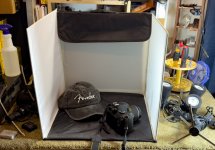
Limited space. I have a small desktop light tent that I can use to start with. I do have an office that I will most like be able to turn into a studio eventually. I do want to do this professionally eventually. I used to own a vaping company and did all of my own product photography and enjoyed it immensely.

IMG_4098 (Large).jpg

The camera is neither here nor there, unless you're planning on making enormous prints, which you won't need to do. Your camera will be fine and, because it has an APS size sensor, you won't normally have any dof problems as long as you shoot at around f/11, which is the smallest aperture you should routinely use with that size of sensor. That's an advantage.

Your 40mm lens will be too short for most uses, one thing that we need to avoid in product photography is unwanted perspective distortion, and anyway short lenses need larger backgrounds for the same reason, you'll be shooting from too close a distance.
Your 105mm lens will be far too long for most shots
Your kit lens should be fine, at the long end. The image quality may not be great at large apertures, but you won't need large apertures.

The D5300 I think is fine for now, although eventually I do want to upgrade to a Z7 II. But that's not for quite a while.
The 40mm and 105mm I bought for close up product photos. I used to make custom vaping coils, and needed something that would take high quality close up photos of coils that were maybe 8-9mm max. I would definitely be interested in what you would suggest for one additional lens.


My advice is to stick with what you have until you've got to grips with the physics, or a basic understand of how light works. As @Phil V suggested, start by reading, and then working your way through, the various lighting challenges. Contribute to them and learn by doing. The full list is here https://www.talkphotography.co.uk/threads/list-of-lighting-challenges.763636/
I've also written a few tutorials on lighting, and also on lighting gear, look in the Resources tab

I agree. I really have a lot of learning to do. I purchased two books that I need to read - one is "Understanding Exposure" (fourth edition) , and the other is "Light: Science and Magic: An Introduction to Photographic Lighting" (3rd edition), as well as a few other in my Kindle Unlimited library. I took a quick look at your lighting challenges, and they look AMAZING! Definitely something I'll be taking full advantage of. I'll also check out your tutorials.


Hope that helps, we're a pretty friendly lot on here, don't hesitate to keep coming back with more questions, and post examples too. Never post anything that's been retouched, if you're looking for advice then we need to see only the genuine SOOC shots,

Everything you (and the others) have written is immensely helpful, and I thank you all for being so helpful to a new member of the forum!
 
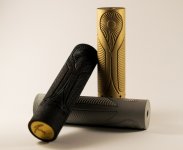
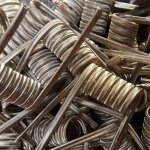
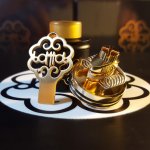
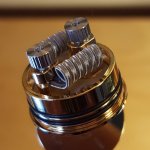
Here are a few product photos I took when I had the vaping business. Although they're not bad for an amateur, there's a lot of room for improvement. The one with all the coils is done with focus stacking, and you can see a few spots where I definitely needed improvement.


1.jpg2.jpg3.jpg4.jpg
 
Sadly, that light cube is just junk. They aren’t designed for product photography, they’re designed to sell to people who want to do product photography. They don’t and can’t work because they produce general lighting from all directions, the opposite of what we want. Lighting isn’t about quantity of light, it’s about quality of light, i.e controlling direction, intensity, angle of incidence and reflection. So, forget about what I said about making do with what you have for now, I assumed that you had some actual lighting – but learn the absolute basics first, before spending any money on lighting gear. So, what I’m about to say is for your future needs, and of course for anyone else who reads this.

Nearly all of us use flash for this type of photography, not continuous lighting, for lots of valid reasons.

In about 2012 the lighting business that I worked with introduced IGBT flash, I won’t bother to go into the details but it has the advantage of extremely short flash durations at low power setting, very useful for freezing subject movement, and with far better and more consistent colour temperature too.

In my opinion – which won’t be popular with people who sell lighting gear – the introduction of IGBT was the last useful improvement to studio flash – since then they’ve become more and more complicated, and more and more expensive, with lots of extra features, but they haven’t got any better, so there’s no point in buying an expensive new one.

Today, most cheap new flash heads use the old technology, which is perfectly fine for product photography, and the expensive ones use IGBT. Both types are available second-hand, and when the time comes for you to buy flash heads just ask on here about items you’re interested in, typically on eBay, because although many are good, some are just junk, and they all tend to sell at broadly similar prices. Just as an indicator, I've bought 3 old technology flash heads, each of which are very good brands, for around £50 each.

But that’s for the future. Right now, you’re at ground zero, so let’s go back to the lighting challenges. The first one, on Brightfield lighting, used a computer monitor as the light source, so that everyone could do it, with or without any lighting equipment. The second one, on darkfield lighting, could have used a computer monitor. The next few became a bit more complicated, they all needed just one light, but suited flash – but members here used all sorts of lights, whatever they had available, and many of their results were outstanding – it’s all about thought, care and understanding the principles of lighting, not about gear.

These lighting challenges have inevitably grown, I started them off but some other people are now taking them forward, which was essential, but the principle is unchanged – they are learning experiences that we can all gain from, but they can only work if we actually do them.

Light: Science and Magic is an excellent book, but it’s basically a cookbook that shows us what can be done but doesn’t really tell us how to do it. I’ve written some books myself, and as you have unlimited Kindle access you may want to read the one on product photography, “Product Photography Magic” on Amazon.

As for your camera, it's more than good enough for this purpose. I use one of its big brothers, full-frame, older and more basic.
As for your lenses, just stick with your kit lens, you'll need to become extremely good before anyone will notice any improvement from a better lens, it's all about the lighting - and space!

When I did this for a living I had a 4,000 sq ft dedicated studio, now I have a tiny living room with too much furniture. I manage, just, but the largest item I can photograph well enough is about 60cm wide, and that's pushing it. Currently, I'm photographing an antique shotgun, that's 112cm long, and far too big, but I've got around that by just photographing the small bit in the middle that actually matters. As long as we recognise the limitations, we can manage in a small space, but if we try to photograph subjects that are too big, we fail.
 
That's an excellent post and a great starting point. Thanks!


Well, I'm a full-time Uber driver, so cash is limited.
But you do realise we need to know a rough budget before we can make specific recommendations.
The D5300 I think is fine for now, although eventually I do want to upgrade to a Z7 II. But that's not for quite a while.
And whilst saying there’s no money for lighting (that you know you need) you’re daydreaming a a camera you absolutely don’t need :thinking:

I’m reminded of the guy who asked a similar question some years ago. He’d already spent thousands on a camera, and had left himself a budget of a couple of hundred for a lens and lighting.

He couldn’t understand why everyone was telling him to send the camera back and address his budget, because in his mind, he’d bought the best camera for the job.

So again; what kind of budget are you looking at?
 
Surely as an asp-c lens it has the FF equivalent of 60mm so perspective distortion shouldn't be an issue?
For stuff as small as the vape kit I would say it's an ideal lens.
You're right, according to the view of most people, and perspective distortion may not be the right terminology.

But, based only on my own experience, if I'm filling the frame then anything less than around 80mm seems too short. There's also the point I made about backgrounds - shoot too close and the background becomes too small.

But, everyone has their own views on this. I remember a post from someone who shot full-length portraits in her tiny garage, using a 17mm lens on a FF camera, they were horrible but when someone pointed out that she needed a longer lens she went into a strop and accused them of being unreasonable, she said that her clients loved her work, and maybe they did.
 
You're right, according to the view of most people, and perspective distortion may not be the right terminology.

But, based only on my own experience, if I'm filling the frame then anything less than around 80mm seems too short. There's also the point I made about backgrounds - shoot too close and the background becomes too small.

But, everyone has their own views on this. I remember a post from someone who shot full-length portraits in her tiny garage, using a 17mm lens on a FF camera, they were horrible but when someone pointed out that she needed a longer lens she went into a strop and accused them of being unreasonable, she said that her clients loved her work, and maybe they did.
I get what you're saying. When I mess about with tabletop stuff my usual go to is a 55mm for really small stuff or 90mm for slightly bigger (both flat field low distortion macro lenses) . I prefer flat field lenses so if a subject is on the edge of a frame it doesn't suffer from the distortion you get from less well corrected lenses.
 
Last edited:
Sadly, that light cube is just junk. They aren’t designed for product photography, they’re designed to sell to people who want to do product photography. They don’t and can’t work because they produce general lighting from all directions, the opposite of what we want. Lighting isn’t about quantity of light, it’s about quality of light, i.e controlling direction, intensity, angle of incidence and reflection. So, forget about what I said about making do with what you have for now, I assumed that you had some actual lighting – but learn the absolute basics first, before spending any money on lighting gear. So, what I’m about to say is for your future needs, and of course for anyone else who reads this.

Thank you, that's exactly why I'm here - to learn not only what to do, but what not to do.
Nearly all of us use flash for this type of photography, not continuous lighting, for lots of valid reasons.

In about 2012 the lighting business that I worked with introduced IGBT flash, I won’t bother to go into the details but it has the advantage of extremely short flash durations at low power setting, very useful for freezing subject movement, and with far better and more consistent colour temperature too.

In my opinion – which won’t be popular with people who sell lighting gear – the introduction of IGBT was the last useful improvement to studio flash – since then they’ve become more and more complicated, and more and more expensive, with lots of extra features, but they haven’t got any better, so there’s no point in buying an expensive new one.

Do you have any IGBT flash suggestions compatible with the D5300 (and eventually the Z7 II) for under £150?


But that’s for the future. Right now, you’re at ground zero, so let’s go back to the lighting challenges. The first one, on Brightfield lighting, used a computer monitor as the light source, so that everyone could do it, with or without any lighting equipment. The second one, on darkfield lighting, could have used a computer monitor. The next few became a bit more complicated, they all needed just one light, but suited flash – but members here used all sorts of lights, whatever they had available, and many of their results were outstanding – it’s all about thought, care and understanding the principles of lighting, not about gear.

I absolutely agree. But I like to do my research ahead of time. I'm most definitely looking forward to learning from (and getting constructive criticism from) your challenges.


Light: Science and Magic is an excellent book, but it’s basically a cookbook that shows us what can be done but doesn’t really tell us how to do it. I’ve written some books myself, and as you have unlimited Kindle access you may want to read the one on product photography, “Product Photography Magic” on Amazon.

Thank you! I've added it, as well as your books "Learn Photography" and "Lighting Magic".


As for your camera, it's more than good enough for this purpose. I use one of its big brothers, full-frame, older and more basic.
As for your lenses, just stick with your kit lens, you'll need to become extremely good before anyone will notice any improvement from a better lens, it's all about the lighting - and space!

True. I only mentioned the Z7 II because it's mirrorless/full-frame and will come in handy down the road. But that's not for at least a year. I've focused (hah!) mainly on the micro lenses in the past, so now it's time to learn more about the 18-55mm kit lens that I have I guess.

Again, thank you for your incredibly detailed replies to my posts.
 
Do you have any IGBT flash suggestions compatible with the D5300 (and eventually the Z7 II) for under £150?
All flash heads are fully compatible with all DSLR cameras, but your budget is way out, sorry. And then you'll need a flash trigger/remote, various heights of stands, and the all-important modifiers.

The market is now totally dominated by Godox, which dramatically reduces choice, and as they are in a monopoly position their prices seem to go up constantly, good for them but not for us. What you DON'T need is high power for this type of photography, so don't waste money by buying a high-powered model.

As for my books, please leave reviews on Amazon, which helps to increase sales and raise money for the charity that the sales benefit.
 
Don't know how it compares to other models but I use a godox ms300v studio strobe. You can pick one up with a basic soft box, standard reflector and stand new for around £120-30 on eBay.
Paired with a used wireless trigger you're looking at around £150 all in.
It doesn't have all the bells and whistles but uses s mount modifiers and is mains powered which suits me better than having to charge batteries for indoor tabletop stuff.
 
Don't know how it compares to other models but I use a godox ms300v studio strobe. You can pick one up with a basic soft box, standard reflector and stand new for around £120-30 on eBay.
Paired with a used wireless trigger you're looking at around £150 all in.
It doesn't have all the bells and whistles but uses s mount modifiers and is mains powered which suits me better than having to charge batteries for indoor tabletop stuff.
Not IGBT, not that Phil needs that technology. I've never used one myself but it should be OK, and they can be bought for just under £100 new, head only. You should, with a bit of patience, be able to pick up a used Lencarta SmartFlash 3 or an old Bowens Esprit for about half that cost, and these are brands that just last and last.
 
Last edited:
Not IGBT, not that Phil needs that technology. I've never used one myself but it should be OK, and they can be bought for just under £100 new, head only. You should, with a bit of patience, be able to pick up a used Lencarta SmartFlash 3 or an old Bowens Esprit for about half that cost, and these are brands that just last and last.
I only suggested the ms300v as it's cheap and the integrated 2.4ghz wireless connectivity makes it easy to control from the camera/ trigger. Plus adding more lights into the system later on would be a dawdle as long as they are also godox/ 2.4ghz compatible.
The esprit and smartflash are probably better quality but older tech and a bit less convenient as they would need receivers on top.
 
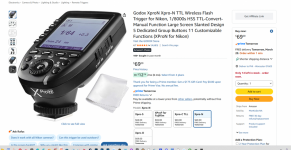
What are your thoughts on this (I'm in the U.S.)?
That's the one I have, a decent basic strobe although you would need a godox x system wireless trigger like an xpro-n or x1n
 
Just a couple of reservations about the Godox MS300, which @RyanB should be able to help with . . .

The blurb doesn't mention a cooling fan, probably for the same reason that the specs for my off-road car didn't mention fuel economy:) I don't know whether that might cause overheating problems, still-life photography doesn't involve high-volume shooting, but flash heads do get very hot when using restrictive modifiers such as tight honeycomb grids.

And the modelling lamp is only 10W. Is that bright enough? That's relative of course, becasue if we can exclude pretty much all ambient light then it shouldn't be a problem.
 
Just a couple of reservations about the Godox MS300, which @RyanB should be able to help with . . .

The blurb doesn't mention a cooling fan, probably for the same reason that the specs for my off-road car didn't mention fuel economy:) I don't know whether that might cause overheating problems, still-life photography doesn't involve high-volume shooting, but flash heads do get very hot when using restrictive modifiers such as tight honeycomb grids.
And the modelling lamp is only 10W. Is that bright enough? That's relative of course, becasue if we can exclude pretty much all ambient light then it shouldn't be a problem.
I assume it has a fan as I can hear a fan sound when it is turned on. I have never had an overheating problem either and I use it for biiiiiig focus stacks so lots of shots in fairly quick succession.

I didn't realise this was the case but there are 2 variants of the MS300, the MS300'V' has a 10w LED modelling light but the original MS300 has a 150w traditional bulb. I have the traditional bulb one but a 10W LED chip should be more than powerful enough. I have a 10W led flood light out back and its bright enough to illuminate half the yard, obviously ISL applies. I can't comment on the thermal properties though so whether the LED heatsink is better or worse at dissipating heat than the heat from the 150W, I don't know.

A few things to note are, from what I read original Bowens brand modifiers wont fit without some minor modification with washers to get a tight fit. I have only used third party modifiers so if you want to use original Bowens brand stuff you might want to research more in depth. Secondly there is no auto dump feature so if you turn the power down you will need to manually dump the power either by taking a shot or using the test button. Also power-wise it only goes down to 1/32 so that is something to keep in mind. There have been occasions where 1/32 has been a bit too powerful but a light ND filter sorted that out.

Overall for a beginner from my limited experiences with studio lighting I think its a great budget friendly strobe, others may disagree.
 
Last edited:
I have the Godox MS300V, and have found it to be very capable. Ive used it on some Corporate Headshot days with various modifiers for quite a few hours at a time and havent experienced any overheating issues. I do use it at home occasionally, but my available room at home is a lot less, so generally favour a manual speedlight (Godox TT600 which can be found pretty cheaply) with a small modifier and my X3 Pro, and some black or white boards (from the craft shop) as cheap DIY V-Flats where needed. Doesnt need to be expensive.
 
What are your thoughts on this (I'm in the U.S.)?
It’s perfectly capable, but if you’re working to a budget, as Garry has pointed out, an old school decent s/h head could be half that price?

Decent stands, are important (so don’t cheap out), and cheap softboxes will collapse after a few cycles of build / dismantle. Invest in a decent pop up type and it’ll pay you back several times over. Particularly if you’re using space where it all needs packing away regularly.

The good news is for what you’re trying to achieve, piles of black and white card, desktop clamps etc are dirt cheap, don’t look ‘professional’ or have matching price tags, but are worth their weight in gold.
 
It’s perfectly capable, but if you’re working to a budget, as Garry has pointed out, an old school decent s/h head could be half that price?

Decent stands, are important (so don’t cheap out), and cheap softboxes will collapse after a few cycles of build / dismantle. Invest in a decent pop up type and it’ll pay you back several times over. Particularly if you’re using space where it all needs packing away regularly.

The good news is for what you’re trying to achieve, piles of black and white card, desktop clamps etc are dirt cheap, don’t look ‘professional’ or have matching price tags, but are worth their weight in gold.
Yes. I can guarantee that even if you have the best equiped studio on the planet, you will still be nipping to the shed looking for a thing to hold the wotsit to the doodah!
 
Yes. I can guarantee that even if you have the best equiped studio on the planet, you will still be nipping to the shed looking for a thing to hold the wotsit to the doodah!
HA HA, so true

I have found three inch spring clamps are invaluable, kinda like big clothes pegs.
card to boards
cloth to chairs
etc.
 
@Bondservant,

I am also on the West side of the big pond in Central North Carolina, USA. I sold off all of my more expensive lights about 6 years ago because I was having reliability problems with them, and I went with Godox. I tested the water, by buying two TT600 speedlites (flash guns) and an X2T transmitter, because it has the pass through hot shoe on top of it, so I could stack my old transmitter on top of the X2T and use both kinds of lights at the same time. It was only a few shoots later that I started replacing everything with Godox or Flashpoint (a Godox re-brand sold by Adorama in NYC). Every time my old lights failed to fire, my Godox speedlites never missed.

So I began replacing everything lighting in my studio and field kit with Godox/Flashpoint as fast as my budget allowed. It almost broke me, but I had replaced everything over about a year time. That was almost 6 years ago, and I haven't looked back. It was one of my best decisions. For the studio I bought some of the MS300 studio strobes to start and I now have 4 of them. They work OK and never fail, except for human error, but the SK300, and SK400, though slightly more expensive are a little better made but slightly longer, and they were my choice for additional studio strobes. The MS300's now mostly get used when I need to place a light up close to the 8' studio ceiling and pointed down, because of their physical length. The MS300 fits closer to the ceiling.

For table top product shoots you will find that 300 w/s is more than adequate, but having a speedlite (flash gun) or two behind something to pass light through it ilike a vase is sometimes very handy. I have never wished that I had more than 300 w/s lights for table top work. In fact, they are most often turned way down for the shoots. My studio is a converted 19 X 26' master bedroom suite upstairs in my home. There is another master bedroom downstairs that we use, so when my last two sons moved out, this upstairs bedroom became my studio. It's set up for video, portrait, still life, and small product shoots. I only started doing table top work with digital cameras just a couple of years ago, but had tried it back in the 1960's with film. At that time my studio was my living room with the furniture pushed aside, and raising 4 children meant that it was only my studio for an hour or at best two, before my photo gear had to go back in the closet and the furniture put back in place. So product shooting with film technology just didn't work in that environment well when the setup couldn't be maintained until the film was developed to see what changes were needed.

I do have one DP1000 III in the studio, but I rarely use it. I bought it to power a focusing lens that allows me to project images on the backdrops when portrait shooting. A few months ago in November 2025 I also purchased three AD200 Pro II lights to enhance my field kit, but they are seeing some use in my studio now as well.

When doing product photography of small things that can be placed on small table about the size of a card table, you won't need more power than 300 watt/seconds and speedlites (flash guns) are adequate for most shoots power wise. Using studio strobes with the 3 pin Bowens type mounts let you add many kinds of modifiers (soft boxes, snoots, 7" reflectors, barn doors, colored gels, grids, etc. quickly and easily, and the MS and SK series lights are mains powered, so can be left on all day, if needed, without the need to charge batteries. So for me, the studio lights have worked out better and are easier to use than speedlites for most studio work.

For this tabletop kind of photography I am also a bit new and only started a couple of years ago with digital cameras and better lighting than I had back in the 1960's. I'm an old man at 84 and fully retired now, but love to experiment with light and photography, so I'm still doing it. I began taking pictures in about 1952, was stage manager (one man everything) for an Off Broadway Summer Theater, and worked on the development of a few special cameras for NASA. I was an electrical engineer for most of my working career but was always a photographer too.

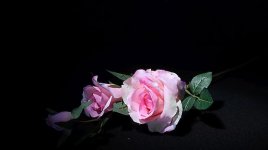
One Youtube site that I have found to be quite helpful for table top shooting is "Camera Club Live". He has been putting out new shows every Wednesday and for the East Coast of the USA the new ones appear around 3 PM. He is a great teacher and always shows the final image first, then takes you through the entire setup, explaining each step as he goes, to reach that final image. Don't think that you need any of his top of the line photo gear though. I can do the same thing here in my studio using Godox/Flashpoint gear and Canon DSLR cameras. My studio is painted ceiling white for the walls and floor, and I depend heavily on the inverse square law to keep reflections down for these shoots, but frequently use my white walls and ceiling for portrait shoots and video when I want controlled, but reflected soft light. Attached is one of my recent table top shots. The inverse square law keeps you from seeing my light stands and gear behind the table. The ceiling light (my work light) was ON during this shoot. I raised the F-Stop high enough to keep the light from the ceiling light out of the shot. So I can freely see and walk around in my studio without tripping while doing this kind of photo shoot.

Watch a few of the "Camera Club Live" videos and let us know what you think of them. There are quite a few, as he has been posing a new one every week for about 4 years now.

Charley
 

Attachments

  • IMG_0385LoRes.jpg
    IMG_0385LoRes.jpg
    37.2 KB · Views: 6
Back
Top