ND Filters on wide angle lenses

muaawiyah

Suspended / Banned
Messages
15
Edit My Images
No
Hi

I was gonna purchase a variable NF filter for my tokina 11-16 so that I could get some nice time lapse shots but read this in the description.

"Specifications:

Type: Fader ND
Color: Black
Rotating: Yes
Neutral Density Grade: 2 - 400
Material: High Quality Optical Glass
Filter Thread Size (attach to lens): 72mm
Note:

According to the optics theorem, it is not recommended to apply this filter for wide angle lens (<24mm, 35mm film format equivalent).
Image quality may drop when focal length above 200mm"

Is this an issue only with variable filters or with nd filters as a whole? And what are the negative effects it has?
 
The problem with filters on wide angle lenses is that the filter holder can get be visible in the frame if you are using slide-in square filters.

This one looks like a screw-in filter that goes directly onto the lens. On very wide angle lenses, the filter surround can be visible in the edges of the frame. You may find you need to shoot at 13mm instead of 11mm for example.

You can get square filter systems such as Lee filters which have wide angle adapters and get around this problem.
 
I believe the issue with very wide angle lenses is noticeable vignetting due to the longer optical path around the edges, i.e. the light travels through more of the filter glass than it does near the centre.
 
I'm no expert but I believe theres an extra issue with these "fader" ND filters that work by having two rotating polarisers that become less effective on UWA since the effect of the polarisation is not going to be as even across the frame.

I'm not sure whether you'd actually end up with uneven levels of light blockage but I have seen it stated in a few places that these filters become less effective on very wide lenses in terms of the maxmum ND effect they can offer.
 
Last edited:
Thanks for all of your replies. I think this disclaimer was specific to the variable nd filters and this the last post about two polarisers is more relaxant.

What supposed me was the ability to get to n400? What would that be used for? Exposures spanning the whole day? I was thinking that if someone wanted to take a picture of a building in the day time but didn't wanted to get people in the shot, they could use this as no body would be in the frame long enough to register on the sensor. Am I right in this assumption?
 
I'm no expert but I believe theres an extra issue with these "fader" ND filters that work by having two rotating polarisers that become less effective on UWA since the effect of the polarisation is not going to be as even across the frame.

I'm not sure whether you'd actually end up with uneven levels of light blockage but I have seen it stated in a few places that these filters become less effective on very wide lenses in terms of the maxmum ND effect they can offer.

Yeah, it is 2x CPL on one ring, and you don't really want CPL on UWA unless you shoot in specific conditions. To make it worse the ring is fatter and can introduce vignetting problems

Normal ND filters are fine.
 
Don't buy that "filter", it's total junk.

Buy a proper ND, more expensive but it does the job.
 
odd jim said:
Don't buy that "filter", it's total junk.

Buy a proper ND, more expensive but it does the job.

Ok, I won't. But just so that I can learn, what's wrong with them on normal lenses (not ultra wide)?

And a general question to all, why buy an expensive ND filter rather than a cheap £11 one from eBay? Usually expensive things work better (or at least work properly) but in this case, why and how would it not work so good?
 
A cheap filter will degrade image quality.

The Tokina 11-16mm is a very sharp lens, however if you stick a cheap filter on the front you will loose sharpness and contrast. In addition with ND filters cheaper filters can introduce dome awful colour casts and in some cases the glass does not filter evenly across the frame.
 
RichardtheSane said:
A cheap filter will degrade image quality.

The Tokina 11-16mm is a very sharp lens, however if you stick a cheap filter on the front you will loose sharpness and contrast. In addition with ND filters cheaper filters can introduce dome awful colour casts and in some cases the glass does not filter evenly across the frame.

Thanks for that. As you know, when I see £11 for three compared to £50 for one, it does become a difficult decision sometimes. But do you have any advice for getting cheaper high quality ND filters?
 
For a start you want multicoated filter to deal with flare, ghosts and reflections. Cheap are plain shiny glass.

Then you want uniform darkening, again cheap can be a problem

Then you don't want a heavy magenta cast. That can be a problem to remove

Then you want a good quality slim filter rim. This may sound strange, but ebay ones may come with notoriously bad rims - sharp to cut your finger, poorly threaded and very thick to cause vignette. You get what you pay for.
 
Wow. What a lot of irrelevant answers.
  • It's got nothing to do with cheap vs expensive. All VNDs will have the same problem on UWA lenses.
  • It's got nothing to do with vignetting because of the filter-holder being visible.
  • It's got nothing to do with the degree of polarization varying across the sky.

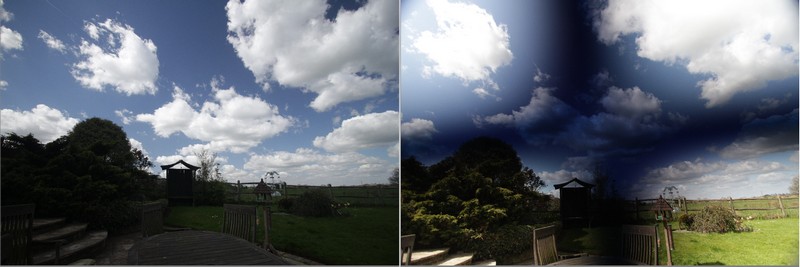
It is a limitation of the way these VNDs work. With wide lenses and a strong density you get a cross-type pattern. Here's a CPL and a VND showing the same image. No problem with one, but the other is useless.

CPL_vs_VND.jpg
 
SarahLee said:
No need for that Frank.

You've made a helpful post, taken the time to illustrate with some examples and there's nothing wrong with disagreeing with other posters either. The tone of that opening however, was uncalled for.

+1

Sincere advice would have gone down better, as you would not have liked it to be on the receiving end of such a reply.
 
hollis_f said:
Wow. What a lot of irrelevant answers.

[*]It's got nothing to do with cheap vs expensive. All VNDs will have the same problem on UWA lenses.
[*]It's got nothing to do with vignetting because of the filter-holder being visible.
[*]It's got nothing to do with the degree of polarization varying across the sky.


It is a limitation of the way these VNDs work. With wide lenses and a strong density you get a cross-type pattern. Here's a CPL and a VND showing the same image. No problem with one, but the other is useless.

Thanks for the knowledge (minus the attitude).
 
Thanks for the knowledge (minus the attitude).

Maybe, but Frank is right... ;)

Short answer, if you're on a budget, is get a Haida 3.0 either from CameraGear UK on e bay, or Premier-Ink.

Mechanical vignetting shouldn't be a problem with a slim-line mount, but all extreme NDs have some optical vignetting with super-wides because the lens looks through the edges of the filter at an angle, so it's effectively thicker and therefore darker. You can correct it quite easily in post processing if it's a problem.

Ten stops is 3.0 in optical density or an exposure factor of x1000 (technically x1024). Therefore x2-400 is one stop to a bit under nine stops.

Edit: there's a thread on the Haida here http://www.talkphotography.co.uk/forums/showthread.php?t=337439
 
Last edited:
Back
Top