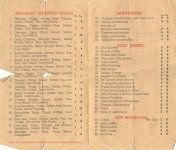
@Box Brownie @Garry Edwards well after truly going down a rabbit hole i have discovered something very random.
on the above menu there is a small poem, it is signed PAKSEEMA .
I looked around and after some curious googling came up with the below court document, its a long read but basically it looks like the below people
started this venture in about 1936 and it fell apart in 1949 with monies being owed, looks like the place has had multiple names and this battle had been in the
courts still in 1989
Bombay High Court
Hubert P. James vs Gulam Hussein Pakseema on 11 January, 1949
Equivalent citations: (1949)51BOMLR945
JUDGMENT
John Beaumont, J.
1. This is an appeal from a judgment and decree of the High Court of Judicature at Bombay passed in its appellate jurisdiction dated October 4, 1945, in part reversing and in part confirming a decree of that Court passed in its ordinary original civil jurisdiction on December 22, 1944.
2. The main question in this appeal is whether the appellant, who was the plaintiff in the suit, and the respondent, who was the defendant, were partners hi a restaurant business, or whether the defendant was an employee of the plaintiff in the business entitled to a share of the profits as remuneration for his services. The appellant also claimed from the respondent a sum of over Its. 8,000 alleged to be due in respect of food and other necessaries supplied to the respondent and his family from the business. This last claim failed in both the Courts in India and has not been raised before the Board. At the trial Bhagwati J. held that the defendant was an employee of the plaintiff; the appeal Court held that they were partners.
Bhagwati, J.
3. in a very long, but admirably clear, judgment discussed all the evidence in detail, and gave his reasons for regarding the only important oral evidence, namely that of the appellant, the respondent, and of one B.D. Engineer called on behalf of the respondent, as unreliable. The evidence was also discussed in some detail in the Court of appeal. Their Lordships will not again go through the evidence in detail, but will confine their judgment to the matters on which the Courts in India differed.
4. In the month of June 1936, the Pioneer Coffee House, then known as "Cafe Chevalier," situate in Churchgate Street in the Fort area of Bombay, was purchased by the appellant in conjunction with the respondent, and the question for determination relates to the rights which the parties then acquired in the; business. The arrangement between the parties was oral, but in August, 1936 the appellant set down in writing in a document (Ex. A) what he alleged to be the terms of the arrangement. More particular reference will be made to this document later. It is not disputed that the appellant paid the whole of the purchase money amounting to Rs. 1,150 that the sale-deed of the premises dated June 19, 1936 (Ex. 10) was in his name, as were all the licences and authorities necessary to enable the business to be carried on. These comprised a licence for the sale of tobacco, an eating house licence, and an authority from the Commissioner of Police enabling the restaurant to be kept open until 12-30 a.m., all of which were granted to the appellant as proprietor of the restaurant. As the purchase money was provided by the appellant and all the documents relating to the business were in his name, the burden lies heavily upon the respondent to show that he was interested in the business as a partner.
5. At the date when the purchase was effected the appellant was a marine engineer employed by the Merchant Steam Navigation Co., Ltd., and Was frequently at sea. The respondent had been engaged for many years in the catering business but had met with reverses, and in 1935 a decree of the High Court had been passed against him under which he was liable to pay a sum of approximately Rs. 900 for costs. In the litigation in which this decree had been passed the said B.D. Engineer, then an articled clerk of the respondent's solicitors but afterwards an advocate, had acted for the respondent, and a friendship had sprung up between them. On the occasion of the purchase of the Pioneer Restaurant, Engineer, on the suggestion of the respondent, acted both for him and the appellant, and thereafter he continued to help the parties in the business of the restaurant. It is the respondent's ease, which was supported by Engineer in the witness box, that the purchase of the restaurant was made by the appellant and the respondent in partnership, the share of the appellant being one-third, and the share of the respondent being two-thirds, and that the documents were all to be in the name of the appellant in order to conceal the interest of the respondent from his creditors. It is the case of the appellant that he was the proprietor and the respondent was his manager on the terms mentioned in Ex. A.
6. In or about the month of August 1936, the appellant, whilst on board his ship, wrote out the terms upon which he alleged that the business had been purchased as between himself and the respondent, and handed over the document which is Ex. A to Engineer. Clauses IV to VII of this document are in the following terms:
'IV. The basis of the Agreement entered into between Mr. Hubert James on the one side and that of Mr. Gulam Hussein on the other are:that two-thirds of the profit will be his share, as his remuneration as manager of the restaurant. The other one-third goes to me as financier of the same.
V. Should Mr. Ghulam Hussein, after the restaurant starts to pay, desire to acquire a partnership in the same, on his son's Ali or that of his wife's name, he may do so by paying two-thirds of the sum spent on the restaurant, at interest of 6 per cent, per annum. The same may be paid in instalments from time to time till the above sum is paid in full. When two-thirds of the capital will then be his. The other one-third will still remain as mine, sharing the profits in the ratio of two to one, i.e., 2 Gulam Hussein and 1 Mr. James.
VI. The whole management of the restaurant is in his hands. He stands to lose nothing, but to gain everything. If Mr. Gulam Hussein is the man I believe him to be, he will for his own interest work up the business. The materials are there, only it wants working up. I am positive the restaurant must pay and that handsomely in a year or two at the most. Provided Mr. Gulam Hussein gives of his best.
VII. The restaurant has been financed by me not for my own personal gain, but solely on behalf of Mr. Gulam Hussein, as a token of friendship towards him. To enable him to take once again that position he once held in the restaurant business and his community. All I ask in return is honesty and straightforwardness on his part in the affairs of the restaurant. He must think it his own and so keep down as far as possible all unnecessary expenditure. It will be to his own advantage because the sooner it pays, the sooner he will be admitted to partnership.
7. This document was not signed, but is admittedly in the handwriting of the appellant. It was undated, but certain endorsements made upon it by Engineer in August 1936 show that it was executed at about that time, and this has not been disputed.
8. The learned trial Judge accepted this document as correctly stating the terms of the arrangement between the parties and considered it to be the bedrock of the appellant's case. In appeal the learned Judges thought the document of very little value as it merely served to corroborate the evidence of a discredited witness. Chagla J. (as he then was) who delivered the leading judgment expressed himself in these terms:
It is a statement made by the plaintiff in writing at or about the time recording what in his view were the terms of the agreement. At the highest it is corroborative evidence on behalf of the plaintiff and be it noted that it is not crroboration by any independent testimony but it is corroboration by himself. Now I have already pointed out that as Car as the oral testimony of the plaintiff is concerned, it has been thoroughly discredited by the learned Judge. If the substantive evidence itself is tainted and unworthy of credence, it is rather surprising for Mr. Munshi seriously to ask us to attach importance to the corroboration of that substantive evidence by that very man who had been called by the learned Judge a liar.
9. The learned Acting Chief Justice who delivered a concurring judgment dealt with Ex. A in these terms:
On the plaintiff's own admission it was subsequently written out by him. Therefore, to put it at its highest, it is only a piece of corroborative evidence. If the plaintiff's substantive oral evidence on the question of initial agreement is disbelieved, this document loses much of its value because if the substantive evidence is rejected there cannot be anything to corroborate.
10. With all respect to those learned Judges their Lordships are unable to follow this reasoning. Plainly a document written in 1936 could not corroborate evidence to be given by the writer eight years later. The fact that in 1944, when the parties were at arms length, the appellant gave untrue evidence in the witness box, does not afford an adequate reason for supposing that in August, 1936, he deliberately misrepresented an arrangement arrived at two months earlier. In August, 1936, the parties were on friendly terms, and the appellant had no motive for misrepresenting the arrangement arrived at; whilst the fact that he handed the document to Engineer, the friend and legal adviser of the respondent, seems a sufficient guarantee that the appellant himself thought that he was correctly stating the arrangement arrived at. The evidence of Engineer relating to this document is in the view of their Lordships, as it was in the view of the trial Judge, manifestly false. He professed in the first instance not to remember whether he had ever read the document. Eventually he said that when he read the document it had struck him that the appellant was trying to resile from the agreement arrived at between the parties, but that he kept silent for fear of causing a rupture between the parties. In their Lordships' opinion, Engineer must have read the document, otherwise he would not have known whether to keep it or destroy it. If the respondent was to be a partner in the business, Engineer must have realised that the document completely misrepresented the position, and his plain duty was to bring the matter to the attention of the parties. There was no reason for fearing a rupture at that time when the business had only just commenced, and Engineer must have realised the importance of putting the arrangement between the parties on a proper and agreed basis from the start. In their Lordships' view the only explanation of Engineer's conduct is that he was satisfied that Ex. A correctly stated the agreement arrived at.
11. Their Lordships would observe that the arrangement embodied in Ex. A seems to have been a very natural one for the parties to have made in the circumstances in which they were placed. The appellant would hardly desire to have as a partner a man who was in financial difficulties, with a creditor who was in a position to attach the share of a partner under Order XXI, Rule 49. So far as the respondent was concerned he was to be employed in the class of work to which he was accustomed. He was to receive as his remuneration two-thirds of the profits of the business, and he was relieved of the risk of losing the good will built up by his exertions by the right secured to him to acquire a two-thirds share in the business. He would seem to have been better off than if he had been a partner liable to the debts of the firm and to have his interest attached by his creditors.
12. Their Lordships are in agreement with the learned trial Judge in regarding Ex. A as a most important contemporary document which correctly stated the terms agreed between the parties, and further in thinking that all the: later documents treated the appellant as the proprietor of the business for no other reason than that he was in fact such proprietor.
13. In the Court of Appeal, the learned Judges considered that the really decisive document in the case was a will executed by the appellant on August 20, 1037, Clause 4 of this document was in the following terms:
4. I have during my lifetime invested a part of my estate in a business now carried on under the name and style of the Pioneer Coffee House at Churehgate Street, Bombay, I have agreed with one Gulam Hussein Pakseema to carry on the said business in partnership with him, his share in the said business being 2/3 whereas my share in the same being 1/3 At. the request of my said partner, I have contributed the whole of the capital for the time being employed in the said business including my said partner's share in it and it has been agreed between myself and my said partner that the 2/3 part of the capital advanced by me to the partnership in excess of my share for the time being in the said partnership Him should be treated as a loan from me to my said partner and I should be entitled to charge interest thereon at the rate of six per cent, per annum. I hereby direct my Trustees that if my said partner is not able to repay to me during my lifetime the amount of the said advances made by me for his share of the capital my Trustees shall at the request of the said Bejonji Dinshaji Engineer absolve the said Gulam Hussein Pakseema or in case of his death the person or persons entitled to his estate from payment of the interest on the said loan or both the principal amount and interest in respect of the entire loan or the balance thereof for the time being payable by him, provided however that it shall be entirely in the absolute discretion of my said Executor and Trustee Bejonji Dinshaji Engineer whether to release my said partner or incase of his death such person or persons interested in his estate from the whole or any part of such liability without repayment by him or them of the said loan or any part of it as aforesaid.
14. This will in a sealed cover was deposited in the office of the District Registrar, Bombay, on August 30, 1937, under the
Indian Registration Act and was revoked by the appellant in August, 1940. The plaintiff in the witness-box gave evidence that he did not understand the terms of the will, and that Engineer had not correctly carried out his instructions, but as the learned trial Judge emphatically rejected this evidence, it must be accepted that the appellant appreciated the contents of the document.
15. It is strange that none of "the three Judges who dealt with this case in India, and none of the counsel engaged on behalf of the appellant, nor the counsel who signed the appellant's case before the Board seem to have considered that the Court was doing anything unusual in acting upon the will of a living person, a will, too, which had been revoked before the commencement of the suit. The document was throughout referred to as a will and apparently regarded as entitled to the same degree of solemnity and importance as would have attached to it had it been in truth a will, that is the will of a deceased person, A will takes effect on the death of the executor and during his lifetime is an ambulatory document, revocable at any moment, having no legal effect whatsoever. It is a secret and confidential document which the executant is never ordered to produce. In India, where a will may be deposited with the Registrar under the
Indian Registration Act, the terms of the Act ensure that the contents remain secret until the death of the executant. [See Sections 42-45,
Section 55(4),
Section 57(2)].