

Monochrome and digital cameras

  • Thread starter Thread starter Deleted member 68495
  • Start date Start date
D

Deleted member 68495

Guest
I'm curious. My camera can take photographs in B&W, as probably can all digital cameras. However we all know that the image the camera takes includes all the colours too and only displays in monochrome because you told it to. Move the file to LR, for example, and it is quite straightforward to bring out the colour image. So what is the point of having the ability to shoot in monochrome when I can turn a colour picture into B&W any time I like?

Also, I was looking at true monochrome cameras such as the Leica M11 Monochrome, but they don't seem to offer much advantage over a camera that takes colour and then displays in B&W . I would have expected a high pixel count sensor or extremely low noise at very high ISOs but this doesn't really seem to be the case.
 
So what is the point of having the ability to shoot in monochrome when I can turn a colour picture into B&W any time I like?
My guess: because it looks like an extra feature and costs very little (if anything) to provide.
Also, I was looking at true monochrome cameras such as the Leica M11 Monochrome, but they don't seem to offer much advantage over a camera that takes colour and then displays in B&W.
I consider the digital Leicas to be jewellery that can record images and the mono only Leicas are a particular version for the serious poseur.

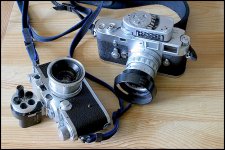
It's sad really: I've always thought of the film Leicas, particularly the M3, M2 and M4, as excellent picture making tools. Even a Leica IIIc was a good user, if you could tolerate that pokey viewfinder (easily fixed with an auxilliary finder) and the film loading...

Leica IIIc and M3 cameras.jpg
 
Last edited:
Reading the info about the new Pentax K3-iii Monochrome that is being launched (expected price circa £2199 I believe), it suggested that the removal of the colour capability in the sensor improved the capture of luminescence of now-B&W only pixels, this reducing noise and getting better sharpness, although it did go on to suggest that the changed pixel performance created a more grainy feel. Not sure I understand any of that, but it did get me interested, at 1/4 the price of the Leica M11 Mono.
I have old Leica iiia and g models, and totally agree about the film loading and viewfinders! Lovely engineering though (although I prefer Contax in general for build and functionality).
 
(although I prefer Contax in general for build and functionality).
Agreed.

Much nicer handling than the screw Leicas and a considerably better viewfinder. Pity they cost so much time and/or money to service that shutter!
 
I'm curious. My camera can take photographs in B&W, as probably can all digital cameras. However we all know that the image the camera takes includes all the colours too and only displays in monochrome because you told it to. Move the file to LR, for example, and it is quite straightforward to bring out the colour image. So what is the point of having the ability to shoot in monochrome when I can turn a colour picture into B&W any time I like?

Also, I was looking at true monochrome cameras such as the Leica M11 Monochrome, but they don't seem to offer much advantage over a camera that takes colour and then displays in B&W . I would have expected a high pixel count sensor or extremely low noise at very high ISOs but this doesn't really seem to be the case.
The reasons as I see it are:

1) The ability to see the image in black and white before you get home - not everything works in b+w. If using mirrorless, you might be able to see it in the viewfinder when shooting, I’m not sure.

2) not everyone uses raw, so a monochrome jpeg might be fine for some people.

Personally I don’t use it as I shoot with the intention of doing my own conversion, but I can see the advantages. From the tests I’ve read of the Leica Q2 Monochrom, there is more dynamic range and the high iso performance is improved.
 
Reading the info about the new Pentax K3-iii Monochrome that is being launched (expected price circa £2199 I believe), it suggested that the removal of the colour capability in the sensor improved the capture of luminescence of now-B&W only pixels, this reducing noise and getting better sharpness, although it did go on to suggest that the changed pixel performance created a more grainy feel. Not sure I understand any of that, but it did get me interested, at 1/4 the price of the Leica M11 Mono.
I have old Leica iiia and g models, and totally agree about the film loading and viewfinders! Lovely engineering though (although I prefer Contax in general for build and functionality).

They just need to make a 45 to 61mp FF K1 mk3 in Mono and colour formats. It's so needed for them it is unreal.
 
I think it is as Andy says above, so that you can see what it looks like in B&W. Some images just don't work.

I often set my Pen F to shoot B&W. It has a few presets which I really enjoy for shots around a city for example. It then gives me a B&W jpeg, but also the raw file if I want to use that. It will also allow me to tweak the curve before I take the shot if I really want to play with it in camera. I haven't used it in ages - I must get it out for a play!
 
This may seem a gnomic but … I believe it all centres on the intention.
 
1) The ability to see the image in black and white before you get home - not everything works in b+w. If using mirrorless, you might be able to see it in the viewfinder when shooting, I’m not sure.

I think it is as Andy says above, so that you can see what it looks like in B&W. Some images just don't work.

Thirded.

Also, shooting in jpeg black & white in your digital camera will remove the colour and you lose the chance to get the colour back (or at least you did with older digi cameras). To those photographers who don't shoot raw or use pp software, it's the only way to go monochrome without post processing.

I've found shooting with a red filter also really helps get a feel for how an image will look in B&W as all my film cameras have colour viewfinders with no black & white mode :( Red/orange/yellow filters also help with adding a bit of contrast.
 
I like setting mine to monochrome jpeg + RAW and seeing in mono in the viewfinder, (jpeg), which can give a better indication of light.
The RAW file is saved to use colour, (or more data), if wanted or even re-work to mono.
 
If I set the picture control on my Nikon DSLR to monochrome then that is what comes up on liveview and the review picture. It is also what comes up in Nikon's raw processing software as a default, although of course I can change it.

I think that in order to get a realistic picture you effectively need the same sensors as a standard camera. You could do it with a single sensor only if it mimicked the sensitivity of our eyes. You would also get lots of white balance issues with a single sensor.

What would be nice is if I could also get a bigger variety of filters for monochrome picture controls (to match the full spectrum of colours and an intensity function for the strength of the filter).
 
There are some clever people in this world.
That link to Cambridge Colour doesn't explain the advantages of a black and white sensor, but it does provide the background. Dedicated black and white sensors don't do any of the clever colour stuff described in that article. With a B &W sensor each photo site simply records luminance. This allows them to provide artefact free, cleaner, better tonal gradation images than you can get from converting to B/W from data interpolated/demosaiced from a colour sensor.

A lot of the control over monochrome processing with a colour sensor comes from manipulating the underlying colour, which doesn't exist in files from a monochrome sensor. So processing (on the computer) is restricted to selectively changing luminance (i.e dodging and burning as used to be the case with black and white printing using an enlarger, plus contrast curves). Big changes in tonal relationships based on colour, needs to be done by using colour filters on the camera(again, as was done in the film days).

I've never used a monochrome digital camera, but some people seem to love them because they give results much closer to black and white film. Others 'like the results" but miss the flexibility in processing black and white from a colour file, and go back to using a colour sensor, even if they specialise in B/W images.
 
Last edited:
Unless you are using a mono sensor red, yellow, blue and green filters are pointless on digital. Good PP will do what you need. Using a colour sensored camera you should adjust the colour channels in PP to get the tones you need.

Auto or in camera conversion to mono is usually going to get you a boring low contrast mix of greys like auto printing in B&W film. Many will say they have produce a high contrast mono image but a quick look at a the histogram will often show no blCk or white tones and often not close.
 
Last edited:
On Tuesday I'm going on a solo two-day landscape-hunting and camping trip to North Devon totally devoted to photography and I intend to try quite a few different exercises and one of them will be to have a couple of hours with my camera set to B&W to see if I can get my eye back in to my old B&W film days.
 
If I set the picture control on my Nikon DSLR to monochrome then that is what comes up on liveview and the review picture. It is also what comes up in Nikon's raw processing software as a default, although of course I can change it.

I think that in order to get a realistic picture you effectively need the same sensors as a standard camera. You could do it with a single sensor only if it mimicked the sensitivity of our eyes. You would also get lots of white balance issues with a single sensor.

What would be nice is if I could also get a bigger variety of filters for monochrome picture controls (to match the full spectrum of colours and an intensity function for the strength of the filter).

I think the only way a camera sensor could mimic what our eyes “see” is if it were monochrome and thus ”saw” what our eyes ”see” in dim light using cones only.

Once colour is involved it all becomes very artificial (unnatural?) since what we “observe” with our brain is not what we “see” with our retina.
 
On Tuesday I'm going on a solo two-day landscape-hunting and camping trip to North Devon totally devoted to photography and I intend to try quite a few different exercises and one of them will be to have a couple of hours with my camera set to B&W to see if I can get my eye back in to my old B&W film days.
That’s more the point at issue. Some people, and we have to believe them since they are describing their personal experience, say that having a colour film ( or digital equivalent) in the camera blocks their ability to see the scene in B&W tones. It’s possibly just the way they learned their photography but I don’t why it shouldn’t be valid and doesn’t force anyone else to follow their practise.
 
I feel a diversion to a discussion of 'self-awareness' and whether or not a tree falling in the woods makes a noise if there is no one there to see/hear it. :D :D

Careful! I see signs of “thinking” ;)
 
On Tuesday I'm going on a solo two-day landscape-hunting and camping trip to North Devon totally devoted to photography and I intend to try quite a few different exercises and one of them will be to have a couple of hours with my camera set to B&W to see if I can get my eye back in to my old B&W film days.
I find this useful on my iPhone


As well as saving time, by using it to explore different viewpoints before setting up my tripod, unpacking the camera and deciding which lens to put on, it also has a good b/w emulation (scroll down the web site a bit).

I'm not necessarily suggesting you should buy this, but it makes it easy to explore picture ideas (and visualise in B/W), even when you don't have a camera available. I'm sure there are other phone options available.
 
I think the only way a camera sensor could mimic what our eyes “see” is if it were monochrome and thus ”saw” what our eyes ”see” in dim light using cones only.

Once colour is involved it all becomes very artificial (unnatural?) since what we “observe” with our brain is not what we “see” with our retina.
Yes, but if it doesn't look right in terms of what we see in terms of brightness then it will look very wrong. Imagine a black and white camera where anything towards the red end of the spectrum was ignored; or something that didn't peak in the green range so all the trees look dull. It would be rubbish and look wrong. Similarly something that couldn't adjust the white balance like we do naturally would be unrealistic.

You could make a single colour sensor that gets around those problems, but it would be a lot of effort for not much gain over the really well developed existing sensors.

Here is something to try if you have a mirrorless camera with an electronic viewfinder. Select a monochrome picture control and see if it goes black and white. I expect it does.
 
I find this useful on my iPhone


As well as saving time, by using it to explore different viewpoints before setting up my tripod, unpacking the camera and deciding which lens to put on, it also has a good b/w emulation (scroll down the web site a bit).

I'm not necessarily suggesting you should buy this, but it makes it easy to explore picture ideas (and visualise in B/W), even when you don't have a camera available. I'm sure there are other phone options available.
Looks useful, unfortunately I have an Android phone, although Magic Viewfinder seems to do similar things, I'll check it out.
 
Yes, but if it doesn't look right in terms of what we see in terms of brightness then it will look very wrong. Imagine a black and white camera where anything towards the red end of the spectrum was ignored; or something that didn't peak in the green range so all the trees look dull. It would be rubbish and look wrong. Similarly something that couldn't adjust the white balance like we do naturally would be unrealistic.

You could make a single colour sensor that gets around those problems, but it would be a lot of effort for not much gain over the really well developed existing sensors.

Here is something to try if you have a mirrorless camera with an electronic viewfinder. Select a monochrome picture control and see if it goes black and white. I expect it does.

I suspect, but can’t prove, that the reason monochrome photos were so widely accepted so quickly and for so long was because people were unconsciously experienced at seeing in mono.

I’m not argue about any colour aspects of photography/cameras as I’m red-green colour blind which may also be a factor in my generally preferring mono!
 
This is what is intriguing me and stoking my GAS: Pentax K3 iii Mono
I have no need for it etc, but love the idea of it and have always been a Pentax fan (in film at any rate)
 
This is what is intriguing me and stoking my GAS: Pentax K3 iii Mono
I have no need for it etc, but love the idea of it and have always been a Pentax fan (in film at any rate)
ISO 200- 1.6million! That's insane.

myotis: Watched the video and that guy takes some lovely images.

The camera looks very chunky but I do like the understated colouring on the monochrome version.

TBH I didn't know Pentax were still in business, never mind coming out with new cameras but further investigation shows the name is owned by Ricoh it would seem..
 
Thinking about how we see, and hopefully not too far off topic... I listened to a judge this week who has had two cataract operations. He says they have effectively interfered with his white balance. When the first was done he could see a different white balance with each eye. He has had both done now and they are the same, but plainly different to what he perceived before.
 
TBH I didn't know Pentax were still in business, never mind coming out with new cameras but further investigation shows the name is owned by Ricoh it would seem..
Ricoh didn’t just buy the name (though in a sense Pentax has just been a “name ” for some time) everything that was Pentax. Ricoh are also going with producing a new Pentax film camera while they still have the expertise etc.

I always get the impression that cameras are a sort of hobby business for Ricoh ㋡
 
I find shooting in bnw its much easier to see where the light is, being all tonal values
 
Off topic (sorry!), but just to add, I wrote a review of Truegrain 2 which is an app that allows you to emulate B&W film with your colour images. It uses the spectral sensitivity of the original film stock(s) as well as allowing you to enter your own settings if you have an obscure film you want to emulate (and still have the data sheet!). All of the B&W conversions I did from digital looked terrible and I could never get anything I liked that resembled black & white film - namely the look of HP5, Tri-X, Double-X and Delta 3200. When I tried this, I was blown away.
 
ISO 200- 1.6million! That's insane.

myotis: Watched the video and that guy takes some lovely images.

The camera looks very chunky but I do like the understated colouring on the monochrome version.

TBH I didn't know Pentax were still in business, never mind coming out with new cameras but further investigation shows the name is owned by Ricoh it would seem..
I've watched the video now, I just didn't have time until this morning. He is one of the people I follow on Youtube, and he often has interesting things to say as well as interesting pictures. I'm glad to see he confirmed some of the same points I made in my earlier post about monochrome sensors.

Especially the different responses that people show towards monochrome sensors. Some find the nuanced differences absolutely worthwhile and others are more lukewarm. It would be interesting to search out a comparison with the Leica or/and Phase One monochrome sensors. And maybe one day, a Fuji mono, as there is regular noise from some fuji enthusiasts for a mono fuji Xpro 3, maybe that will be his next weeks video :-)

Not that I own one, but Pentax (Ricoh) seem to be a bit of a forgotten gem, including the low cost (relatively speaking) 645z medium format digital.
 
That must be a very small market these days.
Ricoh has long been a niche camera producer though I think when they bought Pentax they said they did it to become more mainstream which I did ythink was a bit unlikely given the decline of ’real’ camera manufacturing.
 
Ricoh made a decision with Pentax not to try to compete with Nikon/Canon on Mirrorless, but to stick with DSLRs and concentrate on niche product improvements, hence the astro capabilities of the K1-ii and now the Mono K3-iii. As the video guy and Pentax fans have been saying, a B&W version of the GR3 compact using the same B&W APS-C sensor makes sense, and the research into a new film model (it's not a done deal, they are trying to transfer and thus retain the skills of the retiring film guys with a new film camera as the potential project aim). I'd buy the new film camera if it could improve on my LX, which would be really hard to achieve.
 
On Tuesday I'm going on a solo two-day landscape-hunting and camping trip to North Devon totally devoted to photography and I intend to try quite a few different exercises and one of them will be to have a couple of hours with my camera set to B&W to see if I can get my eye back in to my old B&W film days.


Valley of the Rocks!
 
Ricoh made a decision with Pentax not to try to compete with Nikon/Canon on Mirrorless, but to stick with DSLRs and concentrate on niche product improvements, hence the astro capabilities of the K1-ii and now the Mono K3-iii. As the video guy and Pentax fans have been saying, a B&W version of the GR3 compact using the same B&W APS-C sensor makes sense, and the research into a new film model (it's not a done deal, they are trying to transfer and thus retain the skills of the retiring film guys with a new film camera as the potential project aim). I'd buy the new film camera if it could improve on my LX, which would be really hard to achieve.
Yes, they are being quite clever I think though I feel (and there seems to be a lot of others that agree) that a B&W Ricoh GR would have been a better choice. GR/GRD users have always seemed to have lot of B&W in their output. However no doubt Ricoh have their reasons for going for Pentax possibly including building the brand as more special rather as Leica does but at a lower non-Veblen price.
 
Back
Top