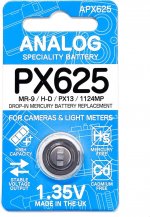
Minolta SRT101 (or any camera with PX625 battery) question

Kell

Suspended / Banned
Messages
5,130
Name
Kell
Edit My Images
Yes
Anyone use of these enough to help with an answer to a question?

Picked one up a week or so back as it came bundled with a lens. The focus screen is cracked so is far from perfect. But it's a nice looking thing, so I thought I'd run some film through it.

There were no batteries with it, so looked online and found that hearing-aid batteries can be used instead of the old Mercury ones. They're the wrong shape, but will work and are of similar voltage.

Reading up before doing this, I saw someone say that their batteries would only last a day or so - even less in the cold.

I assumed they'd bought cheap batteries and went ahead with getting some Panasonic PR675 Zinc Air batteries.

I only shot about 15 frames and the meter stopped working. I had thought maybe the fractured screen was trapping it somehow, but then replaced a battery to check and it started working again.

Much as I like the look of it, I can't make it work if it eats batteries that quickly.

Is there a better solution?


Thanks
 
Last edited:
From a quick lookup, it seems that your Minolta takes PX13 (renamed PX625) mercury batteries, as does my OM1, Lunasix et al. I bought a number of MR9 battery adapters to enable silver cells to be used - it works fine. Online prices seem to vary from £3 to £31 for them...

Edit to add: When I bought, of the three components of what I had to pay (item price, post and packing, PO charge to unwrap and charge customs) the highest was the Post Office item. Almost half the total.
 
Last edited:
Thanks for that. Have edited the thread title to reflect that other film camera users may also have this problem and solutions.

I've just been looking in to those adapters. Does yours do the voltage reduction?

And which batteries do you then use as it seems like there are various ones that can be used depending on design.

There's also the Wein Cell which I've seen recommended elsewhere too. This promises a year-long operation, but reviews seem to suggest this is a massive overclaim.
 
Last edited:
I think you could get away with a LR44 and a rubber O-ring, or blue-tac to stop the slightly smaller battery from wobbling about. Check the meter as the voltage is slightly higher, but good enough for a play. I did use a Wein cell on my Canonet QL17, and I think it lasted longer than I kept the camera (I now regret selling it, of course!).
 
I think you could get away with a LR44 and a rubber O-ring, or blue-tac to stop the slightly smaller battery from wobbling about. Check the meter as the voltage is slightly higher, but good enough for a play. I did use a Wein cell on my Canonet QL17, and I think it lasted longer than I kept the camera (I now regret selling it, of course!).

I've seen people say just go that way and adjust the ASA to compensate. Also watched a YT video of a guy adjusting the meter in the camera to compensate (which seems excessive).

I've gone ahead and ordered an MR9 converter and 386 battery from the Small Battery Company.
 
My understanding is that the adapter handles the voltage reduction - in my experience with the Lunasix, readings are unaffected. I say that because I have multiple Lunasixes, from the original with PX13 written on the back to the later variety which takes a 9v wireless battery (as I think of them, from transistor radios). All agree.

On the Wein cell, again I recall reading that decay started from when they were opened rather than first used, and six months was given as the lifespan. Given their cost and replacement rate (even if unused) the MR9 was the cheaper option in the medium term.
 
P.S. From memory, there is a double battery holder available for items that take two batteries. I just checked: Gossen appear to list it. Useful if you need to use two batteries as the Lunasix does, although I use two MR9 adapters.
 
For negatives, half a stop is probably within its latitude but for slides, you'll need to compensate for the difference.
 
I think you could get away with a LR44 and a rubber O-ring, or blue-tac to stop the slightly smaller battery from wobbling about. Check the meter as the voltage is slightly higher, but good enough for a play. I did use a Wein cell on my Canonet QL17, and I think it lasted longer than I kept the camera (I now regret selling it, of course!).
My Oly 35RC was made working with the blu-tack method. It reliably shoots about 3/4 stop under (or over, I can't remember)
 
Many cameras will be fine with the additional 0.15V of a silver oxide cell as the meter is basically a Wheatstone bridge where one of the resistors is the photo cell. The meter needle deflects due to the difference in voltage on the photo cell and the calibration variable resistor, reflecting the flow of current, as both sides of the circuit have the same increased voltage no re calibration is required.

Note: I did say many not every. YMMV
 
As Chris says i.e. use a LR44 battery. I've had mine (AG13/L44) in a SRT101b for years and just checked it and meter still reading OK.
All you need to do, when using a 1.5v battery, is to adjust the ASA on the camera to compare readings to another camera/phone/or whatever........this is good enough for an old camera as you don't know if the shutter speeds are accurate and anyway the film lattitude will compensate.
The other solution is to use a hearing aid battery (1.375v), I use them with my hearing aids but never bothered using them in an old camera......erm forgotten why not :rolleyes:
Note: Just looked at my hearing aid batteries and they used to be 1.375 and now in 2025 have upped the voltage to 1.45v probably newer hearing aids need more power for bluetooth etc
 
Last edited:
Many cameras will be fine with the additional 0.15V of a silver oxide cell as the meter is basically a Wheatstone bridge where one of the resistors is the photo cell. The meter needle deflects due to the difference in voltage on the photo cell and the calibration variable resistor, reflecting the flow of current, as both sides of the circuit have the same increased voltage no re calibration is required.

Note: I did say many not every. YMMV

It's weird - I don't know if I've just got duff batteries or not, but when I put a fresh PX675 batteries in, the meter looks like it's reading more or less correctly (it's moving at least) but after a day, it stops moving. I do have a strip of LR44 batteries so may try one of those while I await the MR9 adapter.

As Chris says i.e. use a LR44 battery. I've had mine (AG13/L44) in a SRT101b for years and just checked it and meter still reading OK.
All you need to do, when using a 1.5v battery, is to adjust the ASA on the camera to compare readings to another camera/phone/or whatever........this is good enough for an old camera as you don't know if the shutter speeds are accurate and anyway the film lattitude will compensate.
The other solution is to use a hearing aid battery (1.375v), I use them with my hearing aids but never bothered using them in an old camera......erm forgotten why not :rolleyes:
Note: Just looked at my hearing aid batteries and they used to be 1.375 and now in 2025 have upped the voltage to 1.45v probably newer hearing aids need more power for bluetooth etc

The batteries I'm currently trying are marked as Hearing Aid batteries. But as the camera is new to me, I have no idea if maybe there's an issue with the camera producing a error in which there's a constant draw, or if it's the batteries being dud. Unfortunately, it's hard to guarantee that you're buying genuine anything these days so even though they're marked as Panasonic, who knows...
 
I don't think those Minolta's age very well, to be honest. Having seen pictures of them apart they look like a bit of a nightmare, and prone to numerous light seals failing.
 
it's hard to guarantee that you're buying genuine anything these days so even though they're marked as Panasonic, who knows.
I've had a packet of powerone p675 batteries for about 7+ years (made in Germany and too large for my aids) and it says on the packet 1.4v, if you go online to check the same batteries and it says 1.45v ......so it looks like the new standard is 1.45v, anyway unless you can get these batteries free on NHS they don't last long (when activated) as the battery drains even when not used.
 
Last edited:
Back
Top