StewartR
Suspended / Banned
- Messages
- 11,513
- Name
- Stewart
- Edit My Images
- Yes
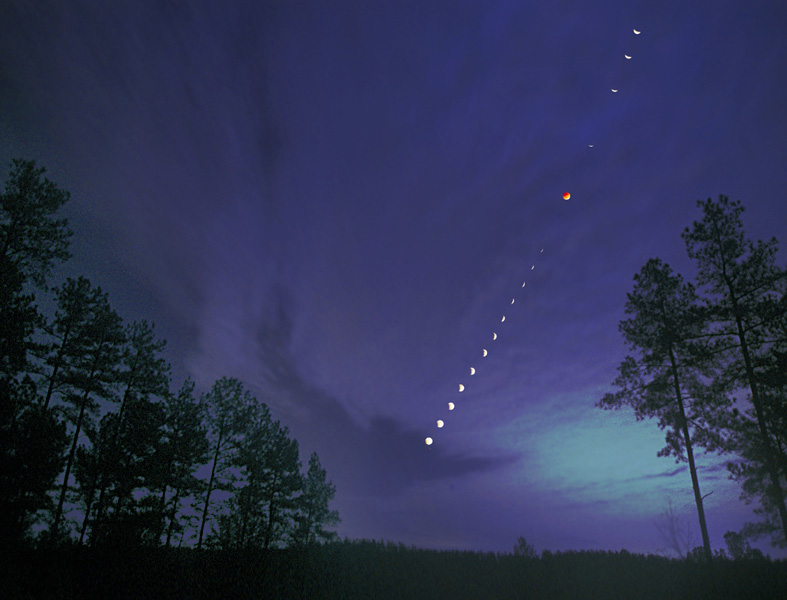
Since theres so much interest in photographing the lunar eclipse thats taking place on Wednesday / Thursday, I thought it might be useful to pull together a few resources to help people who are thinking of trying to photograph it or, indeed, of photographing the moon when it isnt eclipsed. (Which is much easier, not least because you don't have to be up at 3 a.m. to do it!)
How big will the moon be?
This depends on your focal length and sensor resolution. TABLE 1 below (which I created) tabulates the average diameter of the moon, in pixels, for each DSLR in the Canon range. Note that since the moons orbit isnt perfectly circular, its apparent size varies throughout the month by up to about +/ 5% from these figures. Note also that this is the actual focal length, as marked on the lens; any crop-factor calculations are performed in the table.
(Non-Canon users: You'll need to interpolate from this table, based on the Canon camera(s) nearest in specification to your own.)

How fast will the moon be moving?
We all know that the moon moves across the sky. It traverses its own diameter every 2 minutes, roughly. So if you have a slow shutter speed there might be a danger of getting some motion blur. TABLE 2 below (which I created) tabulates the shutter speed to freeze the moon: it is the time it takes for the moon to move by 1 pixel on your sensor. The variations in the moons apparent size and speed arent significant here. Again, this is the actual focal length, as marked on the lens; any crop-factor calculations are performed in the table.

How bright will the moon be?
Obviously when the moon is full it is illuminated directly by the sun and you can use a variant of the Sunny 16 rule to calculate the required exposure. However, at other times its less straightforward. When the moon is in a non-full phase, the suns illumination is at an oblique angle; during a partial lunar eclipse some of the suns light is obscured by the earth; and of course during a total lunar eclipse the only illumination is sunlight scattered through the earths atmosphere. TABLE 3 below (which was developed by Fred Espenak, a.k.a. Mr Eclipse, of NASA) shows what exposure time youll need for different phases of the moon, for different apertures and ISO settings. You can easily extend it to the left if you need to.

(Note: The luminosity of the eclipsed moon can vary wildly and unpredictably from one eclipse to another, depending on atmospheric conditions. Theres a five-point scale. L=0 is a very dark eclipse, with the moon almost invisible. L=4 is a very bright copper-red or orange eclipse.)
Putting it all together
Heres an example. I have a 350D, a 500mm f/4 and a 2x Extender. What can I hope to achieve?
Table 1 tells me that the moon will be about 1431 pixels across on my sensor. That sounds pretty good.
Table 2 tells me that I need a shutter speed of 1/11th to freeze the moon. That sounds pretty good too.
Table 3 tells me that, at f/8 (the fastest I can achieve with the 2x Extender) and ISO 400, Ill need a shutter speed of about 1/60th to photograph the partial eclipse at the 0.05 phase (i.e. when the moon is 95% obscured). Thats faster than 1/11th so Ill be OK. It looks like Ill probably be able to get it when its even closer to a total eclipse.
But as soon as it goes total, Ive got little to no chance. At ISO 400, Ill need a shutter speed of anywhere from 1 second to 4 minutes, and there will be horrible motion blur unless my camera is attached to a driven mount which it wont be. Maybe next time...
If the eclipse is a "very bright" one (L=4) - which it might not be, of course - then I could crank up the ISO to 1600 and use a shutter speed of 1/4 - I'll get a bit of motion blur (about 3 pixels) but it could be OK. Or I could take the Extender off, which gives me a bit more freedom to use a slower shutter according to Table 2. I might get a half-decent result, good enough to show on the web at least, if not to print.
But if the eclipse isn't a very bright one (L=3 or worse) then I might as well forget about photographing it until the moon emerges from totality about 50 minutes later.
Hope that helps. Let's hope for clear skies!
How big will the moon be?
This depends on your focal length and sensor resolution. TABLE 1 below (which I created) tabulates the average diameter of the moon, in pixels, for each DSLR in the Canon range. Note that since the moons orbit isnt perfectly circular, its apparent size varies throughout the month by up to about +/ 5% from these figures. Note also that this is the actual focal length, as marked on the lens; any crop-factor calculations are performed in the table.
(Non-Canon users: You'll need to interpolate from this table, based on the Canon camera(s) nearest in specification to your own.)
How fast will the moon be moving?
We all know that the moon moves across the sky. It traverses its own diameter every 2 minutes, roughly. So if you have a slow shutter speed there might be a danger of getting some motion blur. TABLE 2 below (which I created) tabulates the shutter speed to freeze the moon: it is the time it takes for the moon to move by 1 pixel on your sensor. The variations in the moons apparent size and speed arent significant here. Again, this is the actual focal length, as marked on the lens; any crop-factor calculations are performed in the table.
How bright will the moon be?
Obviously when the moon is full it is illuminated directly by the sun and you can use a variant of the Sunny 16 rule to calculate the required exposure. However, at other times its less straightforward. When the moon is in a non-full phase, the suns illumination is at an oblique angle; during a partial lunar eclipse some of the suns light is obscured by the earth; and of course during a total lunar eclipse the only illumination is sunlight scattered through the earths atmosphere. TABLE 3 below (which was developed by Fred Espenak, a.k.a. Mr Eclipse, of NASA) shows what exposure time youll need for different phases of the moon, for different apertures and ISO settings. You can easily extend it to the left if you need to.
(Note: The luminosity of the eclipsed moon can vary wildly and unpredictably from one eclipse to another, depending on atmospheric conditions. Theres a five-point scale. L=0 is a very dark eclipse, with the moon almost invisible. L=4 is a very bright copper-red or orange eclipse.)
Putting it all together
Heres an example. I have a 350D, a 500mm f/4 and a 2x Extender. What can I hope to achieve?
Table 1 tells me that the moon will be about 1431 pixels across on my sensor. That sounds pretty good.
Table 2 tells me that I need a shutter speed of 1/11th to freeze the moon. That sounds pretty good too.
Table 3 tells me that, at f/8 (the fastest I can achieve with the 2x Extender) and ISO 400, Ill need a shutter speed of about 1/60th to photograph the partial eclipse at the 0.05 phase (i.e. when the moon is 95% obscured). Thats faster than 1/11th so Ill be OK. It looks like Ill probably be able to get it when its even closer to a total eclipse.
But as soon as it goes total, Ive got little to no chance. At ISO 400, Ill need a shutter speed of anywhere from 1 second to 4 minutes, and there will be horrible motion blur unless my camera is attached to a driven mount which it wont be. Maybe next time...
If the eclipse is a "very bright" one (L=4) - which it might not be, of course - then I could crank up the ISO to 1600 and use a shutter speed of 1/4 - I'll get a bit of motion blur (about 3 pixels) but it could be OK. Or I could take the Extender off, which gives me a bit more freedom to use a slower shutter according to Table 2. I might get a half-decent result, good enough to show on the web at least, if not to print.
But if the eclipse isn't a very bright one (L=3 or worse) then I might as well forget about photographing it until the moon emerges from totality about 50 minutes later.
Hope that helps. Let's hope for clear skies!