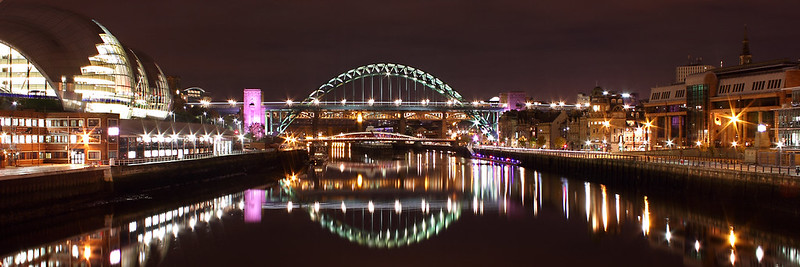
Long exposure night shots

Missy1981

Suspended / Banned
Messages
55
Name
Sarah
Edit My Images
No
Evening everyone,

Recently I have really enjoyed practicing taking long exposure night shots. I love the look of these pictures and have been really inspired by some of the photos I've seen on here and on Flickr.

Anyway I'm currently attending an evening class and last week we got to go out for a couple of hours and take some pics. I only have my 18-55mm kit lens and a nifty fifty so was using my kit lens to get a wide angle.

I was using ISO of 100, f/11 and a shutter speed of between 10-13 seconds. Having uploaded the pictures I'm quite pleased with the outcome as this was my first attempt but I still don't think they look that sharp compared to others I've seen. I was using a good tripod (my tutors) so I was wondering what may have caused this?

I had turned off IS and used spot metering. (My tutor told me to do this..... I'm not quite sure what that is yet)

Is my lens holding me back? I know it's a cheapy kit lens. Looking at some of the lenses other people have used e.g. Tamron SP AF 17-50mm f/2.8......I wondered if a better lens would give sharper results? Would this be the case? Any other tips to get the shots really sharp?

Thanks everyone :-)

Sarah
 
Last edited:
Evening everyone,

Recently I have really enjoyed practicing taking long exposure night shots. I love the look of these pictures and have been really inspired by some of the photos I've seen on here and on Flickr.

Anyway I'm currently attending an evening class and last week we got to go out for a couple of hours and take some pics. I only have my 18-55mm kit lens and a nifty fifty so was using my kit lens to get a wide angle.

I was using ISO of 100, f/11 and a shutter speed of between 10-13 seconds. Having uploaded the pictures I'm quite pleased with the outcome as this was my first attempt but I still don't think they look that sharp compared to others I've seen. I was using a good tripod (my tutors) so I was wondering what may have caused this?

I had turned off IS and used spot metering. (My tutor told me to do this..... I'm not quite sure what that is yet)

Is my lens holding me back? I know it's a cheapy kit lens. Looking at some of the lenses other people have used e.g. Tamron SP AF 17-50mm f/2.8......I wondered if a better lens would give sharper results? Would this be the case? Any other tips to get the shots really sharp?

Thanks everyone :-)

Sarah
 
The tamron would be better than your kit lens yes, as would your 50mm prime. You wanted to go wide, so it made sense to use the kit, which is fine - but could be better as you discovered. Better glass will deliver better long exposures, just as it would with regular exposures.

Do you have a wired or wireless remote shutter realease cable? If not, that will help as you wont have to tough the camera to start the exposure, preventing shake. If you dont have one for now, use the camera's timer to delay the exposure
 
I've taken some pin sharp night shots with the kit lens. make sure its in manual focus, not quite sure why spot metering would be used at night. I use evaluative, shoot using live view to focus, use a remote shutter release or if you haven't got one. Use a 10 second delay to minimise camera shake :-) I usually go for f11, iso 100 exposure of around 45-60 seconds and up with something like this

 
Last edited:
Try the 50mm lens, you won't have any sharpness issues with it. Are you cropping the image? I've never done night photography, but what are you spot metering off? Are you shooting manual as this means you're already dictating exposure rather than using the meter.

It's probably best to post a pic up for others to see.

Good points re. shutter release above.
 
Last edited:
In terms of sharpness, it's actualy quite hard to get everything absolutely pin sharp with a long exposure, anywhere outside where there's wind or any other kind of vibration.

Just using a tripod is no guarantee at all of maximum sharpness. Solid tripod, no centre-column extension, extra ballast slung underneath, heavy head to kill shutter vibration at source, mirror lock-up, self-timer release, and a small prayer. Shoot a few frames if there is any doubt, like a car rumbling past or a slight gust of wind. It's not as easy as just putting the camera on a tripod.
 
In terms of sharpness, it's actualy quite hard to get everything absolutely pin sharp with a long exposure, anywhere outside where there's wind or any other kind of vibration.

Just using a tripod is no guarantee at all of maximum sharpness. Solid tripod, no centre-column extension, extra ballast slung underneath, heavy head to kill shutter vibration at source, mirror lock-up, self-timer release, and a small prayer. Shoot a few frames if there is any doubt, like a car rumbling past or a slight gust of wind. It's not as easy as just putting the camera on a tripod.

Richard, really nails it, there are so many factors that could have caused the issue, another useful tip that I occasionally have to employ is taking the strap off the camera as that blowing in wind link a flag can ruin many a great photo :(

Maybe post some examples identifying areas your not happy with :thumbs:
 
You can lock the mirror up too to reduce movement but not sure that this is so important with long exposures.

The most critical speeds for mirror slap are usually around 1/8sec, say 1/30sec to 1/2sec to be reasonably clear of it, though the best policy is to eliminate mirror slap completely with lock up.

With some cameras, the easy way to lock the mirror up is to use live view. And further, some cameras like the Canon 5D2 have an electronic first curtain option in live view. With this enabled, there is zero vibration generated by the camera of any sort until the shutter clicks shut.
 
Thanks for all the helpful advice everybody. I don't have a shutter release yet but in the meantime I will use my 2 second delay.

Please may I ask what mirror lock up is? I've not heard of this before :-)
 
Missy1981 said:
Thanks for all the helpful advice everybody. I don't have a shutter release yet but in the meantime I will use my 2 second delay.

Please may I ask what mirror lock up is? I've not heard of this before :-)

It is where on the first press of the shutter button the mirror moves out of the way of the sensor, then on the second press of the shutter button start the exposure thus illuminating any camera vibration caused by the mirror moving :thumbs:
 
Last edited:
Thanks for all the helpful advice everybody. I don't have a shutter release yet but in the meantime I will use my 2 second delay.

Please may I ask what mirror lock up is? I've not heard of this before :-)

Mirror lock-up is enabled in the menus, see handbook.
 
Back
Top