Lighting a white background

DrGed

Suspended / Banned
Messages
847
Name
Ged
Edit My Images
Yes
From a few recent posts, I've got the impression that a white background, for a studio portrait, needs to be lit separately from the subject.

Can someone point me in the direction of a tutorial, or whatever, that will explain all this.
 
I know you clearly feel a need to do this Ged, but honestly, the difficulty of doing it (particularly in a small space) does not justify the results compared to other much better shots you can achieve with half the effort.

Of course this is made more difficult if you have someone nagging you to do it.

Alternatively, if you've got loads of space, 4 lights and patience (or a Lastolite HiLite) - it's quite easy.
 
Thanks for the replies.

My feeling is also that white backgrounds are actually more trouble than they're worth BUT how can you (eventually, when I'm up to it) offer a portrait service without offering shots taken against a white backround. They seem an obligatory part of the portrait photographer's toolbox. I don't particularly like them and other colours do seem, to me, far more aesthetic but customers seem to like them.

That's why I was asking : out of a feeling of necessity, rather than desire.
 
There isn't much love on here for the white backgrounds as I'm sure you will find. If you don't have the money to throw at a hi-lite then it is tricky.
The basics are that you need to light the background brighter than the subject, ideally by less than one stop. If you go over board and blast the background you will just get loads of light bouncing off the background onto the back of your subject.
Ideally you want your subject as far away from the background as you can but if you've got a home studio that isn't practical so you will struggle.
You can get ok results in a limited space but its a challenge and will always be a compromise.
 
Thanks for the replies.

My feeling is also that white backgrounds are actually more trouble than they're worth BUT how can you (eventually, when I'm up to it) offer a portrait service without offering shots taken against a white backround. They seem an obligatory part of the portrait photographer's toolbox. ...

If you genuinely want to succeed in business you will do it by offering something different rather than by following trends (particularly trends coming towards the end of their shelf life)

Anyway back to the method, to do it successfully you really need loads of space - if you haven't got loads of space you need a hilite, that should be enough info to base your decision on. If you've got loads of space, go for it, but keep an ear to the ground - it surely can't go on much longer as the default setting?

With loads of space you cross light the background with 2 flashes - these need to be far enough from the background for the inverse square law to kick in to create a fairly even light (6 ft?).

Your subject needs to be well forward of these background lights (4 ft), to avoid any spill from the background lights or contamination from the background itself.

Then light your subjects with a fairly large softbox and reflector (or fill light from camera axis) to create fairly boring even lighting.SO for a full length portrait you're looking at 15 feet minimum, you can reduce this by quite a bit with a hilite.

But my advice would still be to perfect a unique approach - people can use Max Spielman and get a crap white background shot for peanuts - separate yourself from the crowd.
 
Many thanks for the advice : I really do appreciate the helpfulness of people on this forum. :thumbs:

I think, given the constraints of space and money, that it would be better for me to explore an alternative approach and offer (eventually) something different. I think experimentation and practise is required : but, I suppose, that's always the case!

Thanks again,

Ged
 
It's rare I disagree with Phil, but the way to differentiate yourself on wb stuff is to learn to do a good one. Much as I dont like them, they sell well and at times of the year make more money then anything else.
 
It's rare I disagree with Phil, but the way to differentiate yourself on wb stuff is to learn to do a good one. Much as I dont like them, they sell well and at times of the year make more money then anything else.

Yes, agree. The only people fed up with white backgrounds seems to be the photographers that get asked for it all the time. Nice problem to have if you ask me.

If you want to offer a good commercial service, then sooner or later the pure white look has got to be part of your portfolio. Probably sooner, but it is tricky to do well, so I'd suggest learning the ropes with something easier, then get a HiLite and nail the white technique with that doing head & shoulders and 3/4 length work. The most difficult one is full length when the floor also has to be white.

Knowledge is key: getting the background even, ratios right, controlling flare and wrap. Too many people with no studio experience jump straight in the deep end with a bunch of cheap ebay lights, get poor results and have no idea why or what to do about it. Then very often they don't understand what to do even when it's explained. I don't mind that though, we've all got to start somewhere, but I'm not a great believer in the learning-by-your-mistakes method. Better to start with something less technically demanding, such as one light, softbox and a couple of brollies, white/silver reflector - so much you can do with that and loads to learn :)
 
Ged I'm the same as you with this nightmare and I'm giving it a miss till I can get a hilite

H
 
In fact, a Hi-Lite will solve some problems but not all.

What it does, superbly well, is to
1. Dramatically reduce the amount of studio space needed - the subject can be literally right up against if if needed
2. Make it easy to light evenly, partly because of its design and partly because it's a pretty small area.

What it doesn't do is to deal with the by products of having a bright white light right behind the subject. These by products are
1. Flare
2. Wrap
3. Loss of lighting control

Flare is an overall loss of contrast, sharpness and colour saturation caused by having a bright light source in the shot. Sometimes, for example a photo that includes the sun, produces very obvious flare, but even when it isn't obvious, it's still there.

Wrap is light behind and to the sides of the subject that spills onto the sides of the face etc, putting light where it isn't wanted. This can be reduced (as can flare) by moving the subject further from the background, and it can also be reduced by masking off (flagging) any parts of the background that aren't needed, effectively making it only as wide as it really needs to be. But it can't be avoided all together.

Loss of lighting control is the inability to create shadows where they are needed, and most people, even if they understand the need for shadows, can't create them. Even experienced, skilled people struggle with this.

So, what you end up with is a flat lit shot with very little lighting control, reduced contrast and a degree of flare. It's a look that a lot of people love, it's part of the process, but it's a one trick pony.

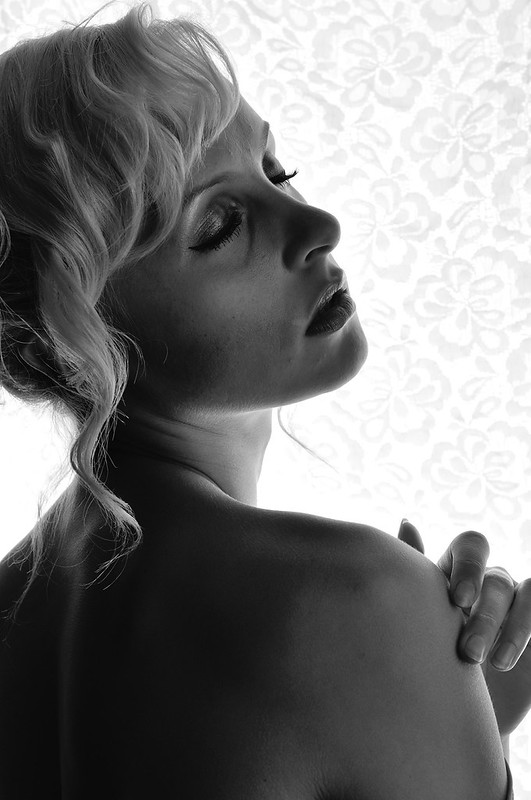
I don't have a Hi-Lite, but we used something very similar (in effect) in my studio on Sunday (see this thread) - a fake window with a couple of lights inside it and a lace curtain over its front.
This shot, by Anand, was "correctly" exposed - I'm guessing f/11 at 200 ISO.
9412537194_4d0fea4637_c.jpg

There was no lighting on the subject, the light you see is all just wrap.

And there's this one, by Phil V. Here, he has overexposed the shot, exaggerating the effect. I would guess f/5.6 - f/8 ISO 200, and has processed the image to amplify the effect.

DaniBW.jpg
This one does have a little added frontal light, from a reflector

 
...

And there's this one, by Phil V. Here, he has overexposed the shot, exaggerating the effect. I would guess f/5.6 - f/8 ISO 200, and has processed the image to amplify the effect.

DaniBW.jpg
This one does have a little added frontal light, from a reflector

:thumbs:
Cheers Garry :thumbs: - that illustration makes it look like I know what I'm talking about.

That backlit shot was interesting, I think Garry's plan was more of a silhouette, but I added the reflector early on, because I like the use of highlights to show form in a semi sihouette kind of way (there's probably a proper name for it).

And by the time I finished shooting it, it was almost a backlit portrait. (I prefer my earlier darker one though).
 
Last edited:
Why is it a nightmare?, TBH I find it a bit hard to fathom why anyone running a studio wouldn't offer it?

It's not about offering it or not, it's being able to get a good result.

I just don't have a space big enough :(

Bounce back and flare being the biggest problems for me.

I have just got 2 large polyboards in to use as gobo's but not had a real chance to set them up yet, need someone to help make a stand for them, if I can get that to work then great, much cheaper than a hilite.

H
 
Last edited:
'thatnikonguy' on youtube has some good tutorials (he covers all camera makes, not just Nikon). I only discovered him a couple of days ago and his info on lighting a model against a white background really helped.

Garry Edwards from this forum also has a few videos up that were very helpful explanations indeed. You can find them from his profile page here:

http://www.talkphotography.co.uk/forums/member.php?u=6830

PS sorry, did not realise Garry had already shown up on this thread, as was in a hurry when writing. Thanks loads for the excellent videos Garry.
 
Last edited:
Many thanks for a more lot replies than I expected. :thumbs:

I've decided to start at the bottom and work up. That is to say, I will try to learn how to use non-white backgrounds with a single light (with reflector etc) and develop things from there. When I can confidently and consistently do this I will get another light and carry on the process.

Hopefully, it won't be too long before I can post on the forum photos that I have taken using artificial light.

Cheers,

Ged
 
It's not about offering it or not, it's being able to get a good result.

I just don't have a space big enough :(

Bounce back and flare being the biggest problems for me.

I have just got 2 large polyboards in to use as gobo's but not had a real chance to set them up yet, need someone to help make a stand for them, if I can get that to work then great, much cheaper than a hilite.

H

These are what you need and they work perfect! :thumbs:

http://www.maplin.co.uk/rolling-bike-stand-510677
 
Back
Top