Lens/Camers storage - Dry Cabinets

Messages
7,077
Name
Rob
Edit My Images
Yes
I’m thinking about my camera/lens storage. Currently I store my camera kit in some F-Stop ICU’s in a cupboard in our lounge. It’s the main area that stays a relatively stable temperature in our house.

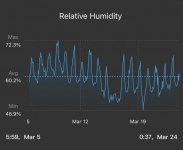
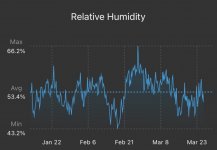
I have a few Govee temperature sensors dotted around the house so I have an idea of humidity levels around our home.

Lounge:
IMG_0551.jpeg

Bedroom:
IMG_0552.jpeg

I don’t yet have data for the summer months.

How do you store your camera kit? Would you consider a Dry Cabinet? Is it worth the expense?

I’d like to move my camera kit upstairs as I plan to change our small bedroom into a study for working from home (we’ve had a desk in our dining room since COVID so it would be nice to get the dining room back as it was pre 2020). I’m just aware it may not be the best area of the house to store it,

My only thought of one of these dry cabinets is it’s probably good for longer term storage but do you need to take some precautions like taking it out and let it get to room temperature before leaving the house your your camera kit?
 
I keep mine in a couple glass fronted cupboards with a small clear tub of colour changing silica beads on every other shelf and a hydrometer/ thermometer at the top and bottom of each cupboard. They normally sit at around 50-55% humidity and around 19-22C through the winter and similar humidity during the summer but it can get a lot hotter depending on the ambient.

I change the silica out when it changes colour which is usually every 4-5 months. I think 1kg of beads was around £20. A dry cabinet large enough for everything would be astronomically expensive.

Beyond that I don't give it much thought and have never had a fungus problem develop.
 
This is something I've never even contemplated - doesn't this matter for weather sealed gear in a typical home?
 
This is something I've never even contemplated - doesn't this matter for weather sealed gear in a typical home?
Probably less so with weather sealed kit but I suspect even that could be susceptible to fungus or other temp/ humidity related problems if the conditions are right(wrong).
Having lived in deserts, the tropics and everywhere in between the typical home varies.
 
This is something I've never even contemplated - doesn't this matter for weather sealed gear in a typical home?
Several years back I bought a 300 f2.8 used that I unfortunately found did have fungus inside. That ended up being an expensive lesson.

I keep mine in a couple glass fronted cupboards with a small clear tub of colour changing silica beads on every other shelf and a hydrometer/ thermometer at the top and bottom of each cupboard. They normally sit at around 50-55% humidity and around 19-22C through the winter and similar humidity during the summer but it can get a lot hotter depending on the ambient.

I change the silica out when it changes colour which is usually every 4-5 months. I think 1kg of beads was around £20. A dry cabinet large enough for everything would be astronomically expensive.

Beyond that I don't give it much thought and have never had a fungus problem develop.

When kit cost can add up I find it’s something I should at least think about.

I’m not saying dry cabinets are definitely needed, but thinking about how and where camera kit is stored isn’t a bad thing. It’s good to know how you store it though.

We are thinking about getting a dehumidifier for drying clothes in our spare bedroom during winter so perhaps I could use that downstairs to control humidity if really needed.
 
You don't really need anything more than conditioned living space.
Sadly that is not an option for some, living in the fens our house is terrible for seasonal humidity and temp fluctuations (its ancient with out of date insulation , retrofitted heating and double glazing the house was not originally designed for). Throw in some dust and its the perfect breeding ground for mould at certain times of year. We have to run a dehumidifier 24/7 in the loft with internal vents just to keep mould off the walls and had to fight like hell for years to get the landlord to acknowledge and do something about it. Even with that we can see 65%+ humidity at times. I installed AC and extra insulation in the bedrooms but most of the house is not conditioned or very well insulated. Frankly its a crap house but affordable and conveniently located.
 
I keep my gear in a couple of those big plastic boxes designed to keep bedding in under the bed
Use silica gel sachets , 50 or 100g , one in each and a humidity meter inside
When the level of moisture gets above 55 % i change the sachets
We have had a lot of rain this winter at the moment the house is 69% humidity downstairs and probably higher upstairs
We have recently also got a dehumidifier which makes a difference
Its costs hardly anything to use the silica gel sachets and is peace of mind
I did recently find a couple of film era lenses in the bottom of the wardrobe that I had forgotten about and had a look at them and one had slight fungus a real shame but my own fault
 
Fungus on a lens has never caused me any problems, quite the reverse in fact. I've got a few marvellous bargains over the years, often from dealers who just wanted rid of the things, which were presumably bought as part of a large lot.
 
Humidity here in the house is 37% at the moment. Never goes above 45%.
We do have de-humidifiers, not for cameras though it is good for them, and they cost about £1 a day over the year.
First 6 month was more, but for the last couple of years, they are not on very often.
 
Fungus on a lens has never caused me any problems, quite the reverse in fact. I've got a few marvellous bargains over the years, often from dealers who just wanted rid of the things, which were presumably bought as part of a large lot.
Same here, I've bought many a film era lens with mild fungus at a fraction of the normal price. As long as its not right in the middle of one of the rear elements more often than not it either has no discernible effect on the end image or can be cleaned without too much effort. If it doesn't affect the IQ I tend to blast it with a UV lamp for a few days to kill and stop the spread and then just leave it.
If it does and I can get to the infected element a soak in hydrogen peroxide and a polish usually fixes things as long as the fungus hasn't etched the coatings, even with mild etching it usually only reduces its flare resistance.

That said I wouldn't touch a modern AF lens with fungus.
 
Back
Top