I've invented a new "push button" leg lock for tripods... your thoughts?

sk66

Suspended / Banned
Messages
9,557
Name
Steven
Edit My Images
Yes
And for anything else using folding pin hinges.

A while ago I got to thinking about tripod versatility when it comes to leg positioning. Currently there are two varieties of leg angle adjustments... the "three step" version which is most common, and the unlimited "clamp version." IMO, both have their issues.
The stepped version has the obvious limitation of limited adjustability. It's also not that secure/strong in that it depends on limited contact area (it's not that uncommon for the point of a step to break/round) and a floating plate which only partially locks the leg in place.

The clamp version has unlimited adjustability but lacks indexing, this makes it very hard to precisely position the legs repeatedly/uniformly. It is also dependent on clamping force for security, which involves levers with pinch points or clamping knobs which need cranked down. And it is still more likely to slip if not secured adequately (on a Benbo it can be a real PITA). And I don't think anyone needs truly "unlimited" positioning.

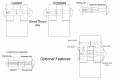
So this got me to thinking about a "happy medium" and I came up with this idea... and now that the initial paperwork is filed I can ask for other's thoughts/opinions. The basic idea is a keyed pin with matching keyed passageways in the hinge. The smooth portion of the pin will spin within the keyed passageway similar to how a stripped bolt spins in a socket. Up to a point, the more faces/surface area there is in contact the stronger and more secure the interface will be (similar to Torx vs Phillips) . The number of faces can be tailored to the desired security/strength/adjustability. The shorte throw version (the reason I'm calling it "push button") is slightly more complex in that it requires the pin to have a floating keyed section that can spin on the pin when in the unlocked position. It is a compromise in strength between the first two versions, but with the added benefit of being the least obtrusive. What isn't shown in the drawing is a bevel on the ends of the keyed sections to make them more "self aligning"/easier to move, and an index scale/pointer which would be helpful.

The typical through bolt in all current designs sets the friction in the joint. With tight machining tolerances I don't think that would be necessary, especially when you consider that it eliminates the "free space" occupied by the sliding leaf mechanism in the common step version. And the locking pin mechanism could be used to secure the legs in the closed/carry position as well. But if it is desired, a secondary tensioning bolt could be added through the outer tabs. i.e. where the sliding tab is now on most tripod legs, or if the outer ears were part of the tripod top ring/plate the ears could be extended inwards/underneath and a tensioning bolt placed there.

Personally, I think a pin/keyway profile that allowed steps between 10-15* increments would be more than enough. And depending on how the ears/tabs are designed, a leg could easily have as much as 270* of total positioning range (using the first 90* would be unusual, but I've done something similar before in order to tilt the top plate of a normal tripod).

So, what do you think of the idea?
legLock.jpg

And if anyone has contacts w/in the industry/tripod companies, please PM me... I'd rather sell or license the idea as I have no intention of going into tripod manufacture and I'd rather not go through the whole international patent process/maintenance/expense.
 
Last edited:
I think I get it, you're suggesting replacing the hinge pin at the top of the leg with a splined pin?

My observations..
  • Potentially vulnerable to dirt/grit between the splines
  • The legs are either locked or loose, unlike a step versions there's no obvious means of adjusting the stiffness of the swing of the leg when loose, which lead to..
  • How might the pin be locked in a travelling position? (without the pin moving and the leg coming loose)
  • As the pin shortens the locking contact area decreases, but with the full-length pin the snag risk increases
 
Last edited:
I think I get it, you're suggesting replacing the hinge pin at the top of the leg with a splined pin?

My observations..
  • Potentially vulnerable to dirt/grit between the splines
  • The legs are either locked or loose, unlike a step versions there's no obvious means of adjusting the stiffness of the swing of the leg when loose, which lead to..
  • How might the pin be locked in a travelling position? (without the pin moving and the leg coming loose)
  • As the pin shortens the locking contact area decreases, but with the full-length pin the snag risk increases
Thanks for the feedback. Yes, a splined/keyed pin in place of the existing hinge bolt.
  • Yes, potentially vulnerable to grit. I don't think it's any more "exposed" to grit than the current step/leaf or clamp designs, but tighter tolerances/greater contact. I think the short throw version could easily be booted (now shown), or maybe o-ring type gaskets if necessary (much more complex to incorporate).
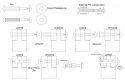
  • I think that with significant mating surface contact the pins are unlikely to move easily on their own, but a ball detent can easily be incorporated (I've updated the drawings to include). Or a secondary tensioning bolt outside of the pivot itself.
  • Yes, but the short throw pin (shortest) actually has more contact area than the short pin does. I'm pretty sure there would still be more than enough to handle very heavy loads assuming reasonable pin diameter (they would probably be larger than the standard bolt current).
 
Last edited:


Hi Steven,

If I imagine your idea on my tripods,
I would chose the shorter throw with
the weather seal.
 
I would go with the shorter throw, the trouble is with things that stick out is clothing, camera straps all can get snagged on things that stick out. Nice clear drawings by the way.
 
Last edited:
would it stop it being knocked accidently if it was worked the other way.
so it sat flush when locked and you pull out/hold against spring pressure to move it then release to lock. that would also make weather sealing easier.
 
Since you seem to be looking to sell this idea I'm wondering if I should offer free advice ;) but the thing that strikes me is that you could do the same thing with a pull-push approach rather than what you seem to have at the moment which is push from either side. So the splined element would slide in and out but the opposing part would be fixed into the tripod leg. That way, when locked nothing significant would be sticking out other than a grip to pull the splined part out to unlock.

The other thing I miss on my clamp type tripods is the ability to easily spread the legs when collapsed to stand the tripod on the ground when not in use. With the three step ones it is easy to just spread the legs a little so that the tripod can just stand up, I can even do this one handed. I think your idea could incorporate this if it included a bit of leg friction so the legs didn’t flop around when the spline was disengaged.

All that said I'm not convinced it solves the problem though, either it wouldn't have enough posiitons to replace clamp types or it would be hard to judge that all legs were at the same angle
 
Last edited:
I get that it could be susceptible to grit etc but could it be dismantled and cleaned at home? I'd imagine that many of us wouldn't mind cleaning the thing now and again, actually we may quite like it :D

I have a Benbo but mostly shoot handheld. I agree with the comments about slippage, you have to be sure it's tight, and no one really needing every possible degree of positioning and I think that a way of setting it by degree/notch or whatever could be useful.

The main thing I'd look for would be centre column (or whatever it would be called) positioning as I don't like column through the legs designs and much prefer the flexibility that tripods such as the Benbo allow.

Would your design have a multi positional column?
 
Rather than a push / pull mechanism to release, would a short lever mechanism similar to that on 'quick release' bike mechanisms (wheels, seats stems, etc) be easier (lever closed, leg is 'locked', lever open leg can be adjusted)?
 
I think that with more than about 4 or 5 leg position notches it's going to be hard to tell if the legs are all out at the same angle when working on flat ground. If you put an index scale on the end of the bolt/leg interface then it's potentially going to prevent a weather seal boot being fitted, as this would probably obscure the leg marking scale/index. A scale/index might also be hard for people to read in poor lighting conditions and/or for those who don't quite yet need reading glasses for every day tasks.

Also, the bolt/lock spline mechanism would have to be made from a pretty hard and durable material to prevent it stripping and/or wearing out and the tripod collapsing, which might add to manufacturing and machining costs. Hard and durable metals are often quite heavy, so this might also add weight to the tripod? In all, I think it's a good idea for something, but I remain to be convinced that it's right for tripod legs? Mind you, I've been wrong before, so best of luck with your project.(y)
 
Last edited:
would it stop it being knocked accidently if it was worked the other way.
so it sat flush when locked and you pull out/hold against spring pressure to move it then release to lock. that would also make weather sealing easier.
Thanks.
It sticks out in either position... I'm not clear on what you are suggesting.
 
Sorry, there are other ways of achieving multiple positions for tripod legs that require less fiddling and less complex machining. This is a non starter as far as I can see.
 
Since you seem to be looking to sell this idea I'm wondering if I should offer free advice ;) but the thing that strikes me is that you could do the same thing with a pull-push approach rather than what you seem to have at the moment which is push from either side. So the splined element would slide in and out but the opposing part would be fixed into the tripod leg. That way, when locked nothing significant would be sticking out other than a grip to pull the splined part out to unlock.

The other thing I miss on my clamp type tripods is the ability to easily spread the legs when collapsed to stand the tripod on the ground when not in use. With the three step ones it is easy to just spread the legs a little so that the tripod can just stand up, I can even do this one handed. I think your idea could incorporate this if it included a bit of leg friction so the legs didn’t flop around when the spline was disengaged.

All that said I'm not convinced it solves the problem though, either it wouldn't have enough posiitons to replace clamp types or it would be hard to judge that all legs were at the same angle
Thanks. Interesting thoughts.
I thought about fixing the one end and incorporating a spring latch type of function so it acts like a push/push button. But that kind of stuff is finicky and it requires removal of more material which means parts have to be made larger or they are weaker. I also think that the simplicity of current design would make it easy to operate with gloves on and the like.

Because the splines will only engage when lined up it should be much easier to ensure the legs are at the same angle... almost like "counting clicks." But I envision a scale on the swinging ear (leg) and index mark on a fixed ear. Even at 5* increments it should be pretty easy to align and lock. The only thing I can't quite envision is where the index mark should be placed so as to be useful when the leg is above 90*.
 
I get that it could be susceptible to grit etc but could it be dismantled and cleaned at home? I'd imagine that many of us wouldn't mind cleaning the thing now and again, actually we may quite like it :D

I have a Benbo but mostly shoot handheld. I agree with the comments about slippage, you have to be sure it's tight, and no one really needing every possible degree of positioning and I think that a way of setting it by degree/notch or whatever could be useful.

The main thing I'd look for would be centre column (or whatever it would be called) positioning as I don't like column through the legs designs and much prefer the flexibility that tripods such as the Benbo allow.

Would your design have a multi positional column?
It could be user serviceable depending on manufacture.
I prefer designs where the top plate is interchangeable to different mechanisms (no column/column/leveling bowl/boom)... but that wouldn't be up to me.
 
Rather than a push / pull mechanism to release, would a short lever mechanism similar to that on 'quick release' bike mechanisms (wheels, seats stems, etc) be easier (lever closed, leg is 'locked', lever open leg can be adjusted)?
Possible to incorporate, but that would add additional catch points (lever arms) and parts (springs/etc).
 
Sorry, there are other ways of achieving multiple positions for tripod legs that require less fiddling and less complex machining. This is a non starter as far as I can see.


The system on my Gitzo seems to work very well and is infinitely adjustable for each leg's angle of dangle independently. The 3 position system on my other tripods works very well too. Both look far simpler to use and manufacture than your proposed system but if you'd like to send me a free sample for testing, I'd do it at mates' rates!!!
 
I think that with more than about 4 or 5 leg position notches it's going to be hard to tell if the legs are all out at the same angle when working on flat ground. If you put an index scale on the end of the bolt/leg interface then it's potentially going to prevent a weather seal boot being fitted, as this would probably obscure the leg marking scale/index. A scale/index might also be hard for people to read in poor lighting conditions and/or for those who don't quite yet need reading glasses for every day tasks.

Also, the bolt/lock spline mechanism would have to be made from a pretty hard and durable material to prevent it stripping and/or wearing out and the tripod collapsing, which might add to manufacturing and machining costs. Hard and durable metals are often quite heavy, so this might also add weight to the tripod? In all, I think it's a good idea for something, but I remain to be convinced that it's right for tripod legs? Mind you, I've been wrong before, so best of luck with your project.(y)
I envision the scale/pointer on the ears. But having it on the pin head is a good idea if there is room to scale it out to be readable.

It would require construction that is at least as durable as currently used... I don't know if it would add weight.
 
Sorry, there are other ways of achieving multiple positions for tripod legs that require less fiddling and less complex machining. This is a non starter as far as I can see.
Then why hasn't it been done? Any reference to such a mechanism? If you are referencing serrated clamping faces (similar to a boom clamp), I don't think I would want that.
 
Last edited:
The system on my Gitzo seems to work very well and is infinitely adjustable for each leg's angle of dangle independently. The 3 position system on my other tripods works very well too. Both look far simpler to use and manufacture than your proposed system but if you'd like to send me a free sample for testing, I'd do it at mates' rates!!!
Yes, both designs work well. The explorer lever lock works well if adjusted to your specific needs so it doesn't require excessive force to clamp. But both designs require a lot of metal removal to make space for the locking mechanisms which requires more/larger metal components to compensate or they become weak points prone to failure. The Gitzo version has been discontinued... I think the only remaining option for more adjustability than the 3 steps is Benbo/Uni-Loc.
 
Solution to a non-problem IMHO. There is nothing wrong with the pretty much universal 'three-step' method that is simple, easy to use, effective and cheap to manufacture. I would like five positions and a few tripods offer more than three (eg Manfrotto, Berlbach) but there doesn't appear to be any overwhelming demand. It would be simple to incorporate more, and they could easily be made as robust as necessary.

Tripods with infinitely variable leg angles are few and far between. The Benbo* design, despite it's merits, has just not caught on. The Gitzo Explorers (as you know, I have one and like it a lot) have an excellent design though - tellingly - Gitzo has just discontinued the Explorer range. Explorers have proved to be durable, but they're a very old design and I'm sure could be improved with new materials and manufacturing techniques - if there was a market. But the opportunity, if there is one, is surely for infinitely variable leg angles rather than just a couple more notches?

Also, with due respect to your undoubted talent in these inventive matters, I find it hard to believe that nobody else has tried your basic design idea before. The likes of Manfrotto and Gitzo have generations of expertise and Manfrotto in particular is forever reinventing the wheel with a 'new' range of tripods that, apart from a bit of red anodising, is no different to the old range. They would jump at the chance if it was doable.

*I would love one of the major tripod brands to put some serious thought into the Benbo/Uni-Loc design. Modern materials and manufacturing could, I think, maximise the many upsides and minimise the disadvantages.

ps Patents mean nothing to the Chinese ;)
 
Solution to a non-problem IMHO. There is nothing wrong with the pretty much universal 'three-step' method

And there's the problem right there, it's three step only.

This might be a niche thing and may never take over the world but being niche can be an advantage as you can do it with style :D for the few who see the advantages.

Sort of agree about Benbo and the like but I'm not sure about not catching on as AFAIK they do have a following of people who like me see the advantages. My Manfrotto and what preceded it frustrated me to death whereas the Benbo is just... liberating.

Keep at it Steven, there may well be a niche for this.
 
Solution to a non-problem IMHO. There is nothing wrong with the pretty much universal 'three-step' method that is simple, easy to use, effective and cheap to manufacture. I would like five positions and a few tripods offer more than three (eg Manfrotto, Berlbach) but there doesn't appear to be any overwhelming demand.

I get what you are saying. The standard 3 step system is adequate for most in most situations. That's part of why the unlimited models haven't caught on. That and the fact that the bent-bolt types are a mess to set up with all 3 legs and the center column loose at the same time... I've never gotten completely comfortable using mine. The reason the 3 step is standard is because it's generally adequate, and because if you cut more steps into it each one becomes smaller/more fragile. And because you are dependent on a single contact point that's a problem. To overcome this would require an increase in size/material.

The potential benefits of this design are several, at least for some. And I don't think the manufacturing costs would be significantly higher, if at all. Here's my thoughts...
  • Ease/cost of manufacture- CNC is CNC, there's not going to be much difference there. But there is a potential material costs savings as less material needs to be removed and fewer processing steps are involved.
  • Strength- up to a point, increasing the number of steps does not reduce the inherent strength. By increasing more surface area with additional faces (designed correctly) increases strength (i.e. a 12pt bolt head in a 12point socket can tolerate more force than 6pt). If you look at the top of a tripod leg you will see that the tabs are quite long in order to make space for the locking leaf mechanism, and to provide clearance. That inherently makes them weaker. It also means more material costs and machining steps (to drill/tap for the locking mechanism). Similar is true for the fixed tab(s) on the tripod head... those steps have to be machined into it (much less significant for cast manufacture, but that's loosing favor and is inherently weaker to begin with).
  • Greater flexibility w/o significant increase in hassle- The fewer steps incorporated, the more similar to the 3 step system in ease of use. I.e. you raise the leg to the approximate angle, put a little pressure on the pin and when it lines up it pops into place. Adding a step or two w/in the standard 25-80* wouldn't increase the difficulty in estimating/aligning position significantly. But more significant is the ability to include stops beyond the standard range, primarily 90*+ (i.e. macro/table top) which is less feasible with the step design. Plus it provides the ability to lock the legs in the closed position for transport... no need for a tripod bag or strap that confines all three legs, or firm friction applied so the legs don't flop. (I suppose that's more of a tradeoff... friction doesn't prevent you from opening the legs when desired). Personally, I think setting the stops at somewhere around 15* would be ideal (5 positions between 30-90*)... more versatility and still a significant enough change in leg position to be easy to estimate/align, even 10* might work reasonably easy (7 steps between 30-90*). Beyond that, adjustability/versatility increases but so does the difficulty in aligning... but still a bit easier than a non-indexed clamp style (at that level, non-indexed might be preferable).
I know it's a bit of a hard sell... but if it does increase versatility w/o increasing hassles/cost like I think it could, there's no big reason not to do it.
ps Patents mean nothing to the Chinese ;)

I know, I've done this a few times before...
 
I've updated a drawing to incorporate a simple tensioning bolt mechanism and 10* scale.

Most of these little details are more manufacture decisions... my patent only covers the locking pin aspect as new/unique. But all of these questions/concerns are valid in terms of "usability/marketability." I do appreciate the discussion!

preferred.jpg
 
Last edited:
Sorry but I must be thick, I don't get what's being proposed here.
Is it to be able to open the legs to a secure position without them slipping open further?
 
About 2 minutes in shows a very easy automatic three step operation
 
I get what you are saying. The standard 3 step system is adequate for most in most situations. That's part of why the unlimited models haven't caught on. That and the fact that the bent-bolt types are a mess to set up with all 3 legs and the center column loose at the same time... I've never gotten completely comfortable using mine. The reason the 3 step is standard is because it's generally adequate, and because if you cut more steps into it each one becomes smaller/more fragile. And because you are dependent on a single contact point that's a problem. To overcome this would require an increase in size/material.

The potential benefits of this design are several, at least for some. And I don't think the manufacturing costs would be significantly higher, if at all. Here's my thoughts...
  • Ease/cost of manufacture- CNC is CNC, there's not going to be much difference there. But there is a potential material costs savings as less material needs to be removed and fewer processing steps are involved.
  • Strength- up to a point, increasing the number of steps does not reduce the inherent strength. By increasing more surface area with additional faces (designed correctly) increases strength (i.e. a 12pt bolt head in a 12point socket can tolerate more force than 6pt). If you look at the top of a tripod leg you will see that the tabs are quite long in order to make space for the locking leaf mechanism, and to provide clearance. That inherently makes them weaker. It also means more material costs and machining steps (to drill/tap for the locking mechanism). Similar is true for the fixed tab(s) on the tripod head... those steps have to be machined into it (much less significant for cast manufacture, but that's loosing favor and is inherently weaker to begin with).
  • Greater flexibility w/o significant increase in hassle- The fewer steps incorporated, the more similar to the 3 step system in ease of use. I.e. you raise the leg to the approximate angle, put a little pressure on the pin and when it lines up it pops into place. Adding a step or two w/in the standard 25-80* wouldn't increase the difficulty in estimating/aligning position significantly. But more significant is the ability to include stops beyond the standard range, primarily 90*+ (i.e. macro/table top) which is less feasible with the step design. Plus it provides the ability to lock the legs in the closed position for transport... no need for a tripod bag or strap that confines all three legs, or firm friction applied so the legs don't flop. (I suppose that's more of a tradeoff... friction doesn't prevent you from opening the legs when desired). Personally, I think setting the stops at somewhere around 15* would be ideal (5 positions between 30-90*)... more versatility and still a significant enough change in leg position to be easy to estimate/align, even 10* might work reasonably easy (7 steps between 30-90*). Beyond that, adjustability/versatility increases but so does the difficulty in aligning... but still a bit easier than a non-indexed clamp style (at that level, non-indexed might be preferable).
I know it's a bit of a hard sell... but if it does increase versatility w/o increasing hassles/cost like I think it could, there's no big reason not to do it.


I know, I've done this a few times before...

I see where you're coming from, but it's hard to imagine exactly how it might actually work in practise from your drawings. I think you'd need to knock up a demo leg and quick video to sell the idea, both to potential users like us, and manufacturers. Less on the mechanics, more on the practical benefits.

I like the idea of more angles/positions, but only if ease and speed of operation is not compromised. If that could even be improved, then that'd be cool :thumbs: though as I'm sure you're aware there are a lot of variations on the classic three-step design.
 
I think a three leg lock is more than sufficient . However It might be handy if you could de couple the lock, and lock it freely in any position when the need arose.
The trouble with all such systems is that you are locking the legs close to their pivot points, where the maximum torque is applied, so what ever you do needs to be exceedingly robust.
 
My favourite is still the clamp system on my Manfrotto. It is either on or off. It gives a visual clue whether it is on or off. It is incredibly secure, it is robust and indestructible.
 
I see where you're coming from, but it's hard to imagine exactly how it might actually work in practise from your drawings. I think you'd need to knock up a demo leg and quick video to sell the idea, both to potential users like us, and manufacturers. Less on the mechanics, more on the practical benefits.

I like the idea of more angles/positions, but only if ease and speed of operation is not compromised. If that could even be improved, then that'd be cool (y) though as I'm sure you're aware there are a lot of variations on the classic three-step design.
I'm hoping to avoid building a prototype... I don't have that level of machining capabilities in-house.
 
My favourite is still the clamp system on my Manfrotto. It is either on or off. It gives a visual clue whether it is on or off. It is incredibly secure, it is robust and indestructible.
Isn't it just a hinged blocking plate instead of a sliding one?
They do break...anything can.
 
Last edited:
I think a three leg lock is more than sufficient . However It might be handy if you could de couple the lock, and lock it freely in any position when the need arose.
The trouble with all such systems is that you are locking the legs close to their pivot points, where the maximum torque is applied, so what ever you do needs to be exceedingly robust.
Three is enough for a lot of uses, but more is better :) (especially if combined with a "boom" column). You know, I don't know why no-one has made a combination... it would be easy to replace the existing bolt with a clamping bolt (ala Berlbach). But small clamping surfaces means low clamping forces...
 
Last edited:
The problem I see with the lock/unlock is that it can be easily pushed to unlocked. Where as with a clamp or even a twist, it takes purpose PULL or an active unscrew to unlock it. A knock on the side to this bolt with loosen the leg.

Not to mention I hate things sticking out.
 
Last edited:
I think a three leg lock is more than sufficient . However It might be handy if you could de couple the lock, and lock it freely in any position when the need arose.
The trouble with all such systems is that you are locking the legs close to their pivot points, where the maximum torque is applied, so what ever you do needs to be exceedingly robust.

Using struts attached to the centre-column is one way around that, video-pod style. Check out this beast, the Manfrotto Triaut. Leg lengths adjusted by a top-mounted lock, with individual leg angle adjustment (variable) on the struts. It's a clever piece of design, but having borrowed one for a while it's a big and clunky thing and not nice to use, plus it weighs several tons.

There's a lot of innovation in some small corners of the tripod business, but what seems to be lacking is a market that's willing to consider something different. Everyone seems pretty happy with what we've got.

View: https://www.youtube.com/watch?v=knVcx1aM6B0&t=2s
 
Back
Top