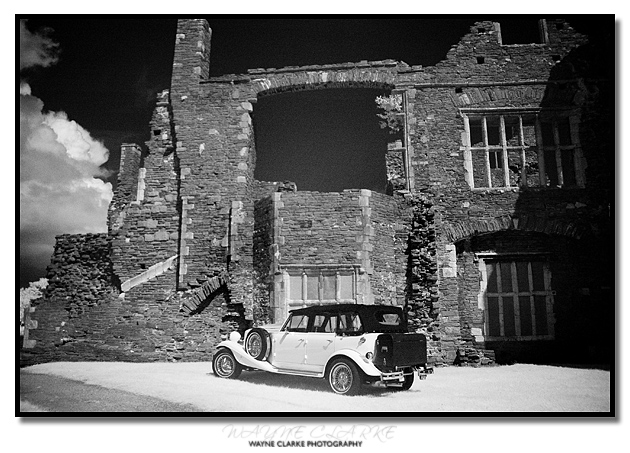
Is this really Infra-red?

GateKiller

Suspended / Banned
Messages
79
Name
Stephen Hill
Edit My Images
Yes
I've just watched this video from Gavin Hoey and he said he used an Infra-red Filter. I thought you had to modify a normal camera or buy an Infra-red Camera to do this. Isn't the filter just an ND with a red tint?

http://www.youtube.com/watch?v=zMP3C3y8o_E
 
I've just watched this video from Gavin Hoey and he said he used an Infra-red Filter. I thought you had to modify a normal camera or buy an Infra-red Camera to do this. Isn't the filter just an ND with a red tint?

http://www.youtube.com/watch?v=zMP3C3y8o_E

No some cameras will work very well with just an IR filter (nikon d70 for example) most will work to some extent, but some are better than others.
 
No some cameras will work very well with just an IR filter (nikon d70 for example) most will work to some extent, but some are better than others.

If you could explain how it would be much appreciated.

The way I see it is most camera's have a filter over the sensor which removes IR light. So only visible light reaches the sensor. So any type of filter will only be able to tint in coming light.

So the only real way to shoot IR is to either have the filter removed or buy a camera like the Canon 20Da.
 
The older cameras tend to work best: D40, D50, D70 on the Nikon side. Exposures on later cameras will be many seconds.

The early cameras have the weakest IR blocking filters and so let a reasonable amount of IR light through. You're still talking of fairly long exposeures -- but still usable for static subjects.

The lens filters just block visible light leaving the IR and some red. Now depending on how purist you want to be, you might be ok with an R72 or you might want to go for filters that block out more of the red.

But you are right in that, if you want to be able to use a camera to capture anything but relatively static subjects you'll need to have the IR blocking filter replaced.
 
The older cameras tend to work best: D40, D50, D70 on the Nikon side. Exposures on later cameras will be many seconds.

The early cameras have the weakest IR blocking filters and so let a reasonable amount of IR light through. You're still talking of fairly long exposeures -- but still usable for static subjects.

The lens filters just block visible light leaving the IR and some red. Now depending on how purist you want to be, you might be ok with an R72 or you might want to go for filters that block out more of the red.

But you are right in that, if you want to be able to use a camera to capture anything but relatively static subjects you'll need to have the IR blocking filter replaced.

Thanks :)

I think that answers my question perfectly :thumbs:
 
I haven't seen any really convincing IR images taken using just a lens filter - there seems to be more visible light than IR, which is only to be expected if the sensor filter is doing its job. I dare say some cameras are better than others, but not much.

Certainly nothing like you get with a converted camera, plus you can see through the thing, and shoot at hand holdable speeds. I think some conversions have the focus adjusted for IR and even have a stab at metering - place in Norfolk does it.
 
I haven't seen any really convincing IR images taken using just a lens filter - there seems to be more visible light than IR, ...

The most common lens filter, the R72 does let some red through -- you'd need to use something like an RM90 to reduce that.

--and you have the same wavelength cut off decision if you have the IR blocking filter replaced.
 
The older cameras tend to work best: D40

The filter on the D40 is pretty strong so needs annoyingly long exposures.


I haven't seen any really convincing IR images taken using just a lens filter

You can still shoot decent IR shots with filters, but it requires much better lighting conditions and more patience. Here is one I shot with a Hoya R72 filter;

20080910115042_dsc_0103-3.jpg
 
^^^ :thumbs: I take it back! That's a pretty convincing IR effect just with a filter. Nice :)

Camera, exposure?
 
Heres a shot from a bog standard Nikon D70 with a Kodak 87 filter over the lens.

3199828032_8e5618ae14_o.jpg
 
If you could explain how it would be much appreciated.

The way I see it is most camera's have a filter over the sensor which removes IR light. So only visible light reaches the sensor. So any type of filter will only be able to tint in coming light.

So the only real way to shoot IR is to either have the filter removed or buy a camera like the Canon 20Da.

Actually the 20da is sensitive to ha (Hydrogen Alpha) opposite end of the spectrum and still blocks most IR....
To shoot IR you need a filter that will only pass light in the 700 to 1200nm range. These type of filters don't 'tint' light! they only allow it to pass through (filter) the light within the given range.. It only looks tinted because the camera is more sensitive than your eyes, if you could see IR then it would look like that i.e pink...
 
Technically it's not infrared, but near infrared ;)

The early Nikon cameras, D70s and earlier are best for using both with a screw-on filter and for converting. Later cameras, like the D40 have stronger low pass filters and, as the company who converted my D40 found out (to their expense) it is easy to #{@++~£ up the circuit board if you don't know what you're doing.....
 
Technically it's not infrared, but near infrared ;)

Maybe wrong, but my understanding is that it is Near Infra Red, as in nearest to the visible, and is the first sub division of IR.
 
I haven't seen any really convincing IR images taken using just a lens filter - there seems to be more visible light than IR, which is only to be expected if the sensor filter is doing its job. I dare say some cameras are better than others, but not much.

I tested the IR filter on my Nikon D100 when I started experimenting with infra red film. It does work quite well.

The in camera filter allows visible light in and blocks IR and the external filter works the other way round. As neither filter can have an abrupt cut off point but have a curve of diminishing output in either direction, it seems to me that both filters working together will just allow a narrow band of the light spectrum through. Possibly some of this is still visible (perhaps deep red).

Kodak's HIE film worked on infra red and red visible light and Ilford's SFX is known as a near infra red film as it is more sensitive to the deeper reds with some IR sensitivity.


Steve.
 
Back
Top