Is there a crop factor on AF-S lens

GSXR1

Suspended / Banned
Messages
44
Name
Kenny
Edit My Images
No
Just wondering. I am keeping my eye for new lens to work on my d3100.

I bought the af-s nikon 18-200 VR , the Tamron 17-50 2.8 and I m on the lookout not for the Tokina 11-16.
For me this combo seems to be everything I need.

Im new to Nikon by the way.

Does the crop factor have to be considered on the length of these lens.

I read that they are designed for a crop sensor and not full frame.

So im thinking for instance on the Tokina 11-16.

Am I getting a true 11-16mm focal length or a crop factor of 16.5- 24mm.
 
sorry. I dont understand.

I had a sigma 70-200 last year and I was getting an over 300mm picture because I was designed for a full frame cam. Or so I thought.

Is this not what happens with a crop factor ?
 
Your lens does not produce the crop factor, it is the sensor, which does this.

A 70-300 on a full frame sensor will be 70-300mm, but on a nikon crop sensor, there is a crop factor of 1.5, therefore the 70-300 becomes a 105 - 450mm.
 
Last edited:
But for a lens designed for use with a crop sensor like the list I give above, does the 1.5 rule still apply.
 
The lens does not affect the crop factor, only the sensor. Your camera dictates crop not your lens. If you want a 70-200mm lens to be 35mm equiv "proper" 70-200mm you need to change your camera to a full frame camera.
 
Last edited:
Ok.

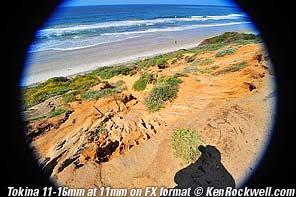
So an ultra wide like the Tokina 11-16 which wont work on a full frame because this would happen
11-D3R_4295.jpg


does work on a DX camera that it is designed to do . But is not ultra wide anymore because it produces 16-24mm pictures.

Why not just market it at 16-24 as that's the result any buyer will get. I know it is not a 16-24, but I hope you get my point.

This is all very complicated.
 
Last edited:
It is a bit, but for someone buying a (crop) DSLR having never used a 35mm, a 70-200 is a 70-200.
 
It's only complicated if you make it so. Just take the focal lenth and adjust by the crop factor for you sensor. The corp factor is different for different camera models.Even from the same manufacturer.
 
nothing changes. the lens is still a 11-16mm. only you are cropping the image in the middle, hence the term crop factor. physically the lens is still 11-16mm.

do you realise at 16mm on full frame, it is still ultra wide? you can see over 90deg from side to side!

what you should do is forget about crop factor. just use the focal length on your camera. crop factor only comes into play when you are comparing shots with full frame cameras.
 
the fact is that all manufacturers have gone down the same route...thankfully.
however, a 11-16 would never be sold as such, but it's the nomenclature as in canon EF can be used on both, and EF-S on only cropped DSLRs.
If the EF was full frame only and EF-S cropped only then the matter would be different and I think that EF-S only lenses would include the crop factor in their specification.

So for the OP; with the Tokina, you will effectively have a 16.5-24mm lens for all intents and purposes of how wide your viewing angle is visible in the frame.
 
Try this.

A crop-format camera has a sensor that is roughly half the area of full-frame. So imagine taking a full-frame camera and putting masking tape around the four sides, leaving an area in the middle. The camera now has a cropped sensor.

Obviously, with the sides of the image now cropped off, the sensor captures a narrower field of view, so to restore that you must use a wider angle lens, and the measure needed for that is the crop factor.

Now there's another thing. Because a crop-format camera can never make use of the image area cropped off around the sides (by the masking tape in this example) lens designers simply do away with it. This allows them to make EF-S and DX lenses smaller and lighter, and they can also do things that would not be possible with full-frame. That Tokina 11-16mm for example, could not realistically be made for full-frame - it would be huge, extremely expensive, and not very good quality.
 
Last edited:
A 50mm lens is a 50mm lens is a 50mm lens...........

The differences in the captured image are down to the camera that the lens is being used with - more specifically the size of the sensor or the film format that the camera uses.

So that Tokina, set to 16mm will always be a 16mm lens - end of.

The true way to think of all this equivalence stuff is that if I were to take a photo with a camera with a 1.5 crop factor using a 16mm lens then the field of view (the amount of "stuff" in the picture) is the same as if I had got hold of a full frame camera and used a 24mm lens.

That is why focal lengths are not expressed differently for different lens ranges because they don't change - it's the camera that causes the difference in the resulting image view. My nifty fifty doesn't change when I take it off my FF camera and put it on my mate's 40D even though the resulting field of view does.
 
this has become really complicated!!
^^^ this guy has the answer

How to make something simple, very complicated... that's this thread :)


AF-S is a focusing system using a silent wave motor, and both FX and DX lenses use it.

A 200mm lens on a crop sensor camera will behave like a 30mm lens on a FX camera whether it's AF-S or not, or even whether its a DX or FX lens or not.
 
It's not complicated, some of the answers given just aren't the answer to your question.

if the lens is sold as a 50mm, it will give a 50mm focal length on a full frame sensor.
if a lens is sold as a 50mm (even if AF-S) it will give a 75mm focal length on a crop sensor

basically, what ever lens you want to buy, you have to multiply that by 1.5 to get the effective focal length.

the 1.5 rule applies to all lenses you wish to buy.
 
But for a lens designed for use with a crop sensor like the list I give above, does the 1.5 rule still apply.
YES : the lens manufacturer does not change their quoted focal lengths which are written on the lens.
They might stick a cheesy sticker on saying "equivalent to", which is stupid, but also rare.

Your sensor is the 'crop' bit, as everyone else has said.
 
Ash. said:
It's not complicated, some of the answers given just aren't the answer to your question.

if the lens is sold as a 50mm, it will give a 50mm focal length on a full frame sensor.
if a lens is sold as a 50mm (even if AF-S) it will give a 75mm focal length on a crop sensor

basically, what ever lens you want to buy, you have to multiply that by 1.5 to get the effective focal length.

the 1.5 rule applies to all lenses you wish to buy.

There are 2 different opinions coming up which is why it is getting complicated. Lets get and summary and sort this out, I know I'm getting confused and I thought I understood this

Is it

A. The crop factor only affects the field of view not the focal length. Ie a 50mm lens will have a magnification range of a 50mm lens, however the field of view (width of the scene) will be that of a 75mm lens.

Or is it

B. the crop factor effects both the focal length and the field of view. Ie a 50mm basically becomes a 75mm lens.

My understanding is answer A.
 
The 11-16mm will always be 11-16mm even if you shove it up your jacksy and smear it in butter and then glue it onto a telescope.
 
There are 2 different opinions coming up which is why it is getting complicated. Lets get and summary and sort this out, I know I'm getting confused and I thought I understood this

Is it

A. The crop factor only affects the field of view not the focal length. Ie a 50mm lens will have a magnification range of a 50mm lens, however the field of view (width of the scene) will be that of a 75mm lens.

Or is it

B. the crop factor effects both the focal length and the field of view. Ie a 50mm basically becomes a 75mm lens on a full frame.

My understanding is answer A.
A.

Ash described B, which cannot be more wrong. crop factor only changes field of view, giving impression of 75mm lens.
 
A. The crop factor only affects the field of view not the focal length. Ie a 50mm lens will have a magnification range of a 50mm lens, however the field of view (width of the scene) will be that of a 75mm lens.
This
 
There are 2 different opinions coming up which is why it is getting complicated. Lets get and summary and sort this out, I know I'm getting confused and I thought I understood this

Is it

A. The crop factor only affects the field of view not the focal length. Ie a 50mm lens will have a magnification range of a 50mm lens, however the field of view (width of the scene) will be that of a 75mm lens.

Or is it

B. the crop factor effects both the focal length and the field of view. Ie a 50mm basically becomes a 75mm lens.

My understanding is answer A.

A.

Ash described B, which cannot be more wrong. crop factor only changes field of view, giving impression of 75mm lens.

Sorry, that's my fault on the wording. I did mean field of view.

As you say, (and what I intended to mean) is that it gives the impression of a longer focal length, not an actual longer focal length.
 
if the lens is sold as a 50mm, it will give a 50mm focal length on a full frame sensor.
if a lens is sold as a 50mm (even if AF-S) it will give a 75mm focal length on a crop sensor

No.. a 50mm is a 50mm.. you can't change that. It will give the same field of view as a 75mm on a FF camera, but it's still 50mm.


[edit]. we're going around in circles it seems.

http://lmgtfy.com/?q=What+is+APS-C+crop+factor?

There.
 
Last edited:
Noted. Responses to this thread were coming in thick and fast.
 
LOL.

Opened a can of worms .. Cant get it shut now!
 
Aye... that be the interwebz!!11
 
Back
Top