is it my equipment or is it me??

Antwillis

Suspended / Banned
Messages
3
Name
Anthony
Edit My Images
No
Hi there, I'm fairly new to photography and I'm currently on a college course to learn basic skills, we have been asked to create a portfolio of pictures that we really like. The pictures I find most appealing are that of wildlife, specifically birds, so this morning I got my equipment up together and headed down to the local nature reserve where I spotted 3 waders just accross the estuary. The lens I was using was a 70-300mm tamron 1:4-5.6 tele-macro, the idea was to zoom in as far as I can and then crop the picture down later, however, when I zoom in, the birds are not in focus at all, is there something that I'm not doing? Or is the lens that I'm using not adequate? Pls help!! :-)
 
Hi Anthony

It's going to be a little difficult to know for sure unless we see a picture ;)

Post one up and I'm sure someone would be able to see what the problem is.

The other other exposure settings would also have a bearing on the end result, especially if you're shooting at high ISO and then cropping the image. Also if you're using a large aperture and not quite nailing the focus then you would get this problem.
 
Hand held or tripod? Long zooms without a tripod (or IS) is difficult to say the least!
 
You didn't have manual focus on did you?
 
I did have a tripod, my iso was set to 400, should this be lower? And i had it on auto focus, i did switch to manual but that made it worse. I'll try and pop a picture on here in the next hour, still haven't really mastered this site yet, may struggle with it:-)
 
There is a guide to posting pics in the tutorials section
 
as above, it would be nice to see the images. But i find 300mm for waders a bit short. Better to find a hide somewhere
 
Antwillis said:
Hi there, I'm fairly new to photography and I'm currently on a college course to learn basic skills, we have been asked to create a portfolio of pictures that we really like. The pictures I find most appealing are that of wildlife, specifically birds, so this morning I got my equipment up together and headed down to the local nature reserve where I spotted 3 waders just accross the estuary. The lens I was using was a 70-300mm tamron 1:4-5.6 tele-macro, the idea was to zoom in as far as I can and then crop the picture down later, however, when I zoom in, the birds are not in focus at all, is there something that I'm not doing? Or is the lens that I'm using not adequate? Pls help!! :-)

You need to get your focus points spot on the bird. And if this is done, try shooting at f8, usually most telephoto lenses have a sweet spot, and I think for this one and u r going 300mm, try f8. Hope this helps.
 
You're still not going to see the kind of shots you see from top quality glass though, so prepare to be a little underwhelmed.
 
How far?

"I spotted 3 waders just accross the estuary"

What many people don't realize is how close you have to be even with a quite long focal length.

The standard lens for nature photographers (those who can afford it) is 500mm f4 and you would be surprised at how close you need to be even with that chunk of glass.

The truth is you can't beat good field craft. You really do have to creep and crawl and sit for hours to get close enough. The lens just gives you a bit of clearance between you and the subject.

If you read some of Andy Rouse's stuff you will see just what efforts he goes to get his shots.

Even with big lenses you still need to be within a few yards to get good shots, especially of birds which are small and won't bloody well sit still. They're always shuffling about and fidgetting. They'd be out on their ear if they were in my class.
 
Last edited:
bittern.jpg


This bittern picture was taken using a 400mm lens BUT it was taken from a hide at Leighton Moss and the bird was no more than 30 feet away.
 
Last edited:
I did have a tripod, my iso was set to 400, should this be lower? And i had it on auto focus, i did switch to manual but that made it worse. I'll try and pop a picture on here in the next hour, still haven't really mastered this site yet, may struggle with it:-)

Anthony,
I have a Tamron 70 - 300 (Macro, very basic model), and it is very soft at the long end, and also when you have it wide open. So, there could be a combination of things going against you here. As you were using 400 ISO, then this should be fine, however, if you were using it wide open (f5.6), at 300mm, with a shutter speed under 1/250, then all of this adds up in terms of movement, noise and lens quality.
I would suggest a teleconverter, but to be honest, I think that it would be wasted on the Tamron. You could try a prime lens, single focal length (200,300,400), and then adding a teleconverter.
However, Greywolf is right, you need to get closer to the subject matter, and try to fill the screen as much as possible.
Andy
 
Hi Anthony,

It's quite possible you will get camera shake as well even though you had your camera mounted on a tripod just pressing the shutter button can cause the camera to move just at the point of click.
 
For now, stick to big birds that you can get close to. Ducks and gulls make ideal subjects. Distant waders is really pushing it. For more accurate focussing at long distances, mount the camera on a tripod, andn use live-view (does the 300 have that?) zoomed in manually focussing. You will be amazed how inaccurate autofocus is!
 
Hi Anthony

Just to echo the point above. My advice is to go to the local park or nature reserve where wildlife is abundant, people-friendly and close. Use this opportunity to practice angles, exposure etc... and take it from there.

Bear in mind that good wildlife photos are a heady combination of gear, know-how and luck. As the bittern shot above illustrates. When shooting really wild, wildlife the greatest of these three is luck !
 
How far?

They're always shuffling about and fidgetting. They'd be out on their ear if they were in my class.

I agree, this made me chuckle
Dave
 
With my 350D & Sigma 70-300 in poor light conditions I was having the same problem, even with a tripod. I bought a Hahnel wired remoted shutter release (£20) and this helped a lot.

I have now had the camera for over 4 months and am starting to to understand the settings more and adjust the white balance to suit conditions. AWB is not that great so I take a few comparison shots in Cloudy WB mode and that often helps. I'm now not so afraid to up the ISO when needs must.
 
The more you stretch the cameras capabilities the more you need to keep it steady. So tripod + remote release (timer release) + mirror lockup + big heavy weight hanging under the tripod, + no wind (atmospheric or otherwise) is the only sure way of eliminating camera movement.

If at all possible, I always substitute a good beanbag for a tripod, especially if there is any wind. With a tripod there is just so much more risk of vibration.
 
The more you stretch the cameras capabilities the more you need to keep it steady. So tripod + remote release (timer release) + mirror lockup + big heavy weight hanging under the tripod, + no wind (atmospheric or otherwise) is the only sure way of eliminating camera movement.

If at all possible, I always substitute a good beanbag for a tripod, especially if there is any wind. With a tripod there is just so much more risk of vibration.


:lol:
 
A bean bag is a lot less of a maul to carry and you can always sit on it instead :)
 
I noticed you said 'across the estuary'

They are usually quite wide so I get the feeling we are talking quite a distance here. How much of original frame do the waders fill?
 
I aggree with grey wolf re distances and focal lengths - it came as an unpleasnt suprise to me when i started out how little reach a 300 gives you even on a cropped sensor.

by way of illustration this one (which was maybe 30ft away from my car in the buffalo enclosure at HWP) was taken with a 170-500 at 500 and a 2xtc on a 300D (so thats 1600mm equivalent in full frame terms) the shot is essentially uncropped apart from a little tweak to composition, but it does show how close you need to be to get a frame filler even with long glass

 
Its a combination of several things, I'll try and illustrate each point.

Firstly, 300mm focal length even with the crop factor isn't as long as it sounds like it should be. Several examples here already but heres another one;

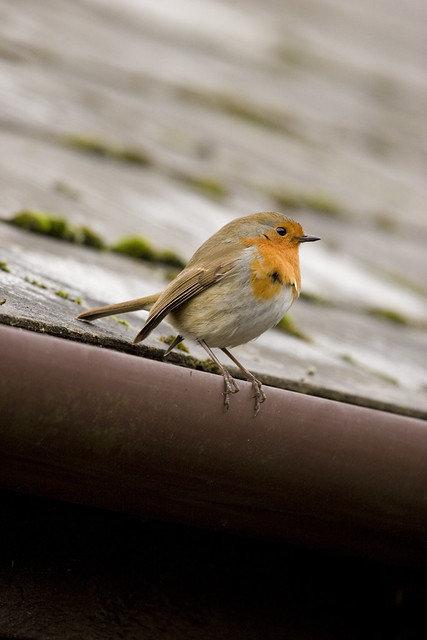
5650739785_58014679a2_z.jpg


Robin, taken from about 12 feet away at 400mm, thats a resized uncropped image but its not very big is it.

Next problem, the focus. Its very very hard to focus properly over such a long distance. I would recommend using just the center focal spot and ensuring its bang on the bird for AF, preferably the eye. If you are using manual focus pre focus on a spot where you know the bird will be and go from there, should just require a minute adjustment to get it spot on. Keep focus assist on - dunno what you shoot with but with a Canon the AF square in the viewfinder will go from black to red. Now you can understand how hard it is to focus over great distances, this underlines the need for a tripod. That minute adjustment to get the shot in focus can be equaled by cold hands moving the lens slightly - even with IS on. Best bet is on a tripod and IS off.

Now the lens. As has been mentioned its a bit soft wide open. Image softness can be perceived as an out of focus shot when its actually the lens at fault. If you do a search on here you'll find some tips to find out how sharp your lens is, then you can work with it a bit more. Short term you may be able to up the iso and shoot with a smaller aperture but keeping the speed. This is not a solution as aside from noise you get into all sorts of problems - but it should tide you over until you decide to invest in new glass.

Finally fieldcraft as mentioned will play a big part. If you can't get the birds to come to you, go to the birds. Study and learn behaviour patterns, eating habits etc and scout out the same location over a period of a week or longer to find out whats where and a when. Camo yourself up and get there before the birds do. Wild bird photography can be incredibly boring, sat in a hide staring at the same spot you know a bird will go to at some point, freezing your toes off desperate for the loo but not wanting to miss the shot. You've only to got to ask the kingfisher posse. That said the shot if composed right it will look fantastic with a natural ambience that cannot be substituted for any captivity shots.

Good luck!
 
everything else has been covered really so im not going to repeat things ( hopefully) one thing i will say however is that in nature you do not need to fill the frame with the animal. its good to have some of the natural habitat surrounding hte animal so dont worry too much if its not covering the whole frame.
you dont want it that small you cant see details tho.
the other thing is throw the lens away.
I had one of those lenses and to be honest its the biggest pile of Kack you will ever have in your camera back.
There are better budget lenses - in fact ANY budget telephoto would be better than that - not sure what camera u are using but if its canon the canon 70 - 300 basic telephoto would leave the tamron standing.

try using the 2 second self timer which will eliminate camera shake from pressing the shutter,

and practice practice practice. ( i hate shooting animals they are so inconsiderate! lol)

Remember in all of this have fun as that by far the most important thing.
 
Fiona has been harsh about your lens, but speaks the truth, got one as part of a job lot and it was dire, sold it for about 40 or 50 quid I think.

Many people rate the Canon 100-400mm IS, but they are best part of a grand, perhaps have a look at the Sigma long zoom range which are stabilised, think they are about 500 quid or so

As everyone has said you need a long lens to end up with anything of decent size although the new 18mp 1.6x sensor cameras would take a good cropping

Afraid its not going to be cheap to get nice wildlife photos, but can be very satisfying (or so I'm told :))
 
Last edited:
perhaps have a look at the Sigma long zoom range which are stabilised, think they are about 500 quid or so

in the sigma range at the bottom end you have the non stabilised 135-400 which is okay but nothing special, then you have the non stabilised 170-500 ( aka little bigma or coffee grinder) which ive got and which is again okay but not really comparable to the canon lenses (both of these are now discontinued but can be picked up for circa 300 second hand)

then you get the 150-500 OS which is reputedly nice but I've no actual experience of it - about 500 notes new i think

then you have the 50-500 (the bigma) which comes in both stabilised and non stabilised - and is the lens of choice for many amateur nature togs (that costs about 700 new but can be had second hand for 4-500)

the above are all f5.6 lenses

Then in the silly money range you have the 120-300 f2.8 OS which is a fantastic lens (ive hired one before) and works well with a matched tc both 1.4 and 2 x about 1.5k

and the 300-800 f5.6 (the sigmonster) which is a nice lens to use - but only from a static hide - its an absolute bitch to cart about all day (they also do an 800 prime to which the same provisos apply) - about £3.5k

(dont buy an old sigma 400 prime second hand - they dont work with most DSLRs and sigma charge a fortune to rechip them unless you've had them from new and can prove it)

Also dont be tempted by the cosina 100-400 , it has the optical quality of the bottom of a milk bottle and the build quality of a yugo car.
 
Last edited:
Lens correction in the view finder?

If the image in the viewfinder is blurred but the image sharp i'd check that

Edit: Diopter, thats the word I forgot
 
Last edited:
You will often hear it said, and for the most part it is true, that it's not the equipment that makes a good picture but the photographer.

There are are two caveats to that statement.

1 Good pictures are made better by good quality lenses.

And
2 wildlife photography can be bloody hard without good telephoto lenses, and these can be expensive.

if you look at the equipment used by many wildlife photographers the lens that crops up most frequently is the 500mm f4, especially for small mammals and birds.

Most times when you are photographing people they are either neutral about it or actively co-operative. In nature photography the very reverse is the case. The subject jumps about, fidgets, wanders off, sits down, dives under water, flies off, ***** (good photo opportunity there!) and generally makes life difficult for you in a thousand different ways and to cap it all it always manages to do this just beyond the range of whatever lens you happen to be using. I really do believe that wildlife photography requires two things...

1 excellent fieldcraft
2 good quality lenses especially telephotos as these enable you to get better shots with less disturbance.

so start saving for the new Canon 600mm now!

Virtually all my wildlife shots are taken with the Canon 400mm f5.6 which is a good place to start.
 
Last edited:
You will often hear it said, and for the most part it is true, that it's not the equipment that makes a good picture but the photographer.

There are are two caveats to that statement.

1 Good pictures are made better by good quality lenses.

And
2 wildlife photography can be bloody hard without good telephoto lenses, and these can be expensive.

a few years back i was on a photography course at Marwell with Andy Rouse and in a quiet spell we tried a little experiment

first we each took the best picture we could of the lemurs with our own gear (IIRC mine was a 300D and 170-500, and he had a 1DS mk1 with a 100-400IS)

then we swapped cameras and each took another best possible pic

on reviewing the pictures it didnt come as a massive suprise that his were better than mine, but what was interesting was that with his pro gear there wasnt that much in it , where as with my strictly not pro gear his was massively better.

also my pic with his gear was a lot better than my pic with my own, but there wasnt much to choose between his two pictures

the two lessons I'd take from that were that

a) although gear in itself doesnt make you a better photographer certain elements of expensive gear such as IS and better metering and AF can compensate for your shortcomings to an extent

b) However if you have ability, experience, and talent in spades you can make up for the short comings of less expensive gear and still get great shots in some circumstances without breaking the bank.

Obviously you cant make up for it in all circumstances or people like Mr Rouse wouldnt buy the expensive stuff - but his advice to me at the time was not to rush out and buy a top spec camera , but to wring every possible lesson out of my cheap gear aand only upgrade when it was only the camera holding me back.
 
apart from equipment Andy Rouses's fieldcraft is excellent with seemingly limitless patience.
 
apart from equipment Andy Rouses's fieldcraft is excellent with seemingly limitless patience.

It certainly is - not that feild craft was particularly in demand in the lemur enclosure at marwell IIRC I spent much of that shoot trying to persuade them to stay far enough away to photograph rather than sitting on our heads
 
With a 300mm the bird isn't going to be too big in the picture so it is often going to be hard to focus right on it.
Also if you have the lens wide open, (low aperture) zoom in quite a bit and then crop it down, you really have to be focusing on the eyes. Always focus on the eyes, unless you dilibaretely don't want to.
 
Back
Top