Beginner I want to receive a recommendation on which camera to choose for night photography.

Messages
22
Name
Anisa Lewis
Edit My Images
Yes
I would like to get a recommendation on which camera to choose for night photography. I have been wanting to start learning this for a long time. I am just starting out, so my budget is up to $1000.

 
What sort of night photography? Landscape? Astro?

Any camera with bulb setting CAN do night photography to a point.
Something like night city or people in night city, something like that. Thank you for the advice!
 
Not quite as simple as that. Bulb setting may be ok for something not moving but nothing else. Have an undestanding of aperture and sensor size first as well as shutter speed -ISO etc would be worth studying before making any decisions you might regret later.Head on over to youtube for a lot of help.
Only then go on a search for the right camera and lens
 
Last edited:
Pretty much all modern cameras can be used for night photography. You are working in low light conditions which generally means slow shutter speeds, high ISO and possible lenses with large apertures (small f stops). Slow shutter speeds generally means mounting the camera on a tripod or similar to eliminate camera shake, but slow shutter speeds also mean that moving subjects, including people and foliage can still be blurred.

What camera and lenses do you currently use?
 
Pretty much all modern cameras can be used for night photography. You are working in low light conditions which generally means slow shutter speeds, high ISO and possible lenses with large apertures (small f stops). Slow shutter speeds generally means mounting the camera on a tripod or similar to eliminate camera shake, but slow shutter speeds also mean that moving subjects, including people and foliage can still be blurred.

What camera and lenses do you currently use?
Thanks for the reply. I'll look for details on YouTube. I'm currently taking photos with my iPhone and just looking for a camera to buy.
 
If you are just starting out, I'd want a camera and lenses that gave me a reasonable chance of getting something pleasing in all genres of photography, and then to refine your equipment once you've discovered which genre you find yourself most drawn to. Fortunately pretty much all recent dSLRs and mirrorless cameras will do this, you just need to find the camera which feels the most intuitive to hold and use.

To get the best out of a modern digital camera, some sort of editing computer will be needed as well, either a traditional PC/Mac computer or an ipad type device.

Good luck with the hunt, and come back and post some photos.

Photography is a rewarding hobby, with plenty of different facets, so you'll always have things to try and techniques to master.
 
Last edited:
Don't forget the glass that goes on the front of the camera. Ideally as wide as 16mm on APS-C or 24mm on FF. Wider even better.

Compatible remote release and steady tripod too.
 
You'll also want a camera support for night photography

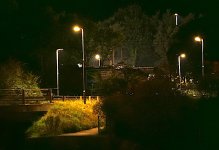
A tripod is the default but, for portability, a monopod will work well with many modern cameras. Here's a night shot made by mounting the camera (a Panasonic G9) on a Benbo Monopod. Despite my using a very high magnification lens (A Panasonic 100~400mm) the picture is reasonably sharp...

Road lighting by the River Clyst Evening walk G9 P1014591.jpg
 
If you are just starting out, I'd want a camera and lenses that gave me a reasonable chance of getting something pleasing in all genres of photography, and then to refine your equipment once you've discovered which genre you find yourself most drawn to. Fortunately pretty much all recent dSLRs and mirrorless cameras will do this, you just need to find the camera which feels the most intuitive to hold and use.

To get the best out of a modern digital camera, some sort of editing computer will be needed as well, either a traditional PC/Mac computer or an ipad type device.

Good luck with the hunt, and come back and post some photos.

Photography is a rewarding hobby, with plenty of different facets, so you'll always have things to try and techniques to master.

Don't forget the glass that goes on the front of the camera. Ideally as wide as 16mm on APS-C or 24mm on FF. Wider even better.

Compatible remote release and steady tripod too.

You'll also want a camera support for night photography

A tripod is the default but, for portability, a monopod will work well with many modern cameras. Here's a night shot made by mounting the camera (a Panasonic G9) on a Benbo Monopod. Despite my using a very high magnification lens (A Panasonic 100~400mm) the picture is reasonably sharp...

View attachment 448916
I thank everyone for the advice! I'll try to take some photos and share them with you!
 
Just another thing I have thought of Anisa. A flippling LCD screen at the back of the camera, saves you from cricking your neck when composing or inspecting your images....Sometimes with a tripod the default position is for the camera to be raised as high as possible so that you can frame your image, this makes the platform less stable, for some compositions it helps for the camera to be as low as possible, close to the floor - this is where the flippy LCD screen comes in very useful.
 
Back
Top