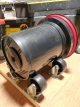
I have too much time on my hands. DIY tank roller.

MrDrizz

Suspended / Banned
Messages
1,782
Name
Mark
Edit My Images
No
Recently starting using Cinestill Df96, loving the simplicity of it. But it needs constant agitation so I thought, what about a tank roller.
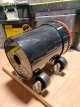
So a cobbled one together from a bit of ply and some casters [emoji28]

I am now thinking that I should attach a motor and then someway to have it automatically reverse after every 3 rotations.

Now I have no idea if it's a good idea to develop film in a rotating tank.

Couple pictures showing a Paterson and AP tank on the contraption.

Please tell me this is a terrible idea [emoji23] and developing film this way will ruin my film. [emoji848][emoji44]PHOTO_20200707_145556.jpgPHOTO_20200707_145539.jpg
 
I had a similar system for my jobo tank, only thing to watch for is processing times for b&w need to be reduced 10-15% for continuous agitation.

Might want to see if you can get away with less chemicals so there is some air to encourage the fluids to mix as the tank is rotated.
 
Watch out if you use a drum where the film holder can rotate freely inside the drum as you are likely to spin the drum while everything inside stays effectively stationary.
 
I seem to remember seeing that constant agitation with black and white film is not recommended as it increases the visible grain, however I had a jobo processor that I used for colour film and that turned constantly with no obvious detriment to the grain.
 
Heh, reminds me of my dad's tumble polisher when he was into lapidary. A quick eBay search shows that they still make them! I wonder if they would work...

[rabbit hole]
 
I had a similar system for my jobo tank, only thing to watch for is processing times for b&w need to be reduced 10-15% for continuous agitation.

Might want to see if you can get away with less chemicals so there is some air to encourage the fluids to mix as the tank is rotated.

Only a small air pocket will be required to ensure mixing - I would definitely fill the drum quite full, since otherwise sections of film may be outside the liquid.
 
I seem to remember seeing that constant agitation with black and white film is not recommended as it increases the visible grain, however I had a jobo processor that I used for colour film and that turned constantly with no obvious detriment to the grain.
I think generally that right but Cinestill Df96 requires constant agitation at the 27° temp.

I'd only use this method with Df96
 
Only a small air pocket will be required to ensure mixing - I would definitely fill the drum quite full, since otherwise sections of film may be outside the liquid.

That's the beauty of continuous agitation you don't need to cover the film the whole time as long as the film is put through the soup ever few moments.
 
That's the beauty of continuous agitation you don't need to cover the film the whole time as long as the film is put through the soup ever few moments.

Exactly this!

The orbital processor will develop one 10x8 or four 5x4 sheets of film with just 100ml of solution .
Continual agitation with a 15% reduction time is recommended as mentioned earlier in this thread.

The development is even as the emulsion is in contact with the chems every few seconds.

The amount of air in the tank when compared to the amount of liquid is , without actually measuring, probably at a ratio of about 6:1
 
The amount of air in the tank when compared to the amount of liquid is , without actually measuring, probably at a ratio of about 6:1

On that note some developers, mainly pyrocatchenol based, oxidise too quickly with continuous agitation but I wouldn't worry about that @MrDrizz the standard ones you'll likely to use will be fine.
 
With 35mm film and continuous agitation you can get some weird effects caused by the sprocket holes channelling the developer through them this can result in regular patches of darker streaks leading from the sprocket holes.. This can also happen with vertical rotation of the spiral.

A better strategy is for it to reverse rotation every couple of turns with a pause between each. to break up the agitation pattern. much like a washing machine does.
generally the best form of agitation of film is by intermittent inversion.

Developing sheet film in deep tanks is usually done by removing the basket completely and tapping it downward a couple of times when you replace it to dislodge any bubbles
This tapping is also advisable when doing inversion agitation.

With Rotation agitation this is not possible nor usually necessary as it does not help with streaks.
 
That's the beauty of continuous agitation you don't need to cover the film the whole time as long as the film is put through the soup ever few moments.
That's fine if the film holder is locked to the drum and rotates with the drum
 
That's the beauty of continuous agitation you don't need to cover the film the whole time as long as the film is put through the soup ever few moments.

Pretty sure if your film requires continuous motion then short periods of no-developer would not be ideal. I agree it works for for conventional films and prints, but in this particular case I'd have thought it would be a no-no.
 
Only a small air pocket will be required to ensure mixing - I would definitely fill the drum quite full, since otherwise sections of film may be outside the liquid.

I have a Rondinax and a Lab-Box, both of which work with continuous agitation, and in both cases most people choose to only half fill the tank (200 ml for the Rondinax, 300 ml for the Lab-Box). Seems to work well for me; no evidence of sprocket hole issues, and only occasional bromide drag... however, I am now pretty gentle. I make small part turns every second or so.

Good idea about reversing direction, I might try that...
 
Dunno about doing negs in a tube but I used to use a long plastic tube for dev very large prints and that worked ok as I didn't have very large trays (or the space) for dev and fixing..
 
That's basically the BTZS developing tubes (for film).

Edit to add:

Hand rolled in a water bath to maintain temperature.
 
Last edited:
Back
Top