


Garry Edwards
Moderator
- Messages
- 13,475
- Name
- Garry Edwards
- Edit My Images
- No
A different type of thread, which I thought might make a change from the usual run of threads about which latest gadget to buy . . .
The background.
A very capable photographer, photography degree, experience with one of the packshot factory type of high volume product photography companies followed by working in a high volume, high pressure portrait photography job, none of which was the best background for someone who needs to use light well, so I was asked to provide him with training in product photography lighting, which took just two days to get to a pretty high standard.
Right at the start of the second day I handed him this subject to light, asking him to light it as if it was a product that needs to be sold. I then interfered and what you see here is the final result.
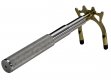
What is it?
Not that it matters, but I have a few different interests and last year decided to take up playing pool for the first time, with the target of reaching my local pub pool league standard in just over a year and to be accepted into the team. This was achieved but I have a problem – at the age of 74 the arthritis in my left hand makes it impossible for me to create a high bridge, which is essential when “Chinese snookered” by a ball behind the white ball, so I needed to find a solution. I bought the brass-coloured spider, then a solid piece of aluminium rod was machined on a lathe and ended up as our subject, complete with knurling and a mirror finish.
It looked good but turned out to be over-engineered and too bulky and heavy for practical use so sadly it had to go back on the lathe for a slimming cure, a pity because the original looked so much better
Your challenge
All studio photographers should be able to look at any shot and see exactly how it was lit – where the lights were placed, their direction, what types of modifier were used, where any reflectors were used, so your challenge is to tell us how it was lit.
Disregards:
The background. Disregard the background because, as is normal for product photography, it was done in PP.
Light on the underside of the rod. Disregard this, we placed it on a piece of white cloth to act as an environmental reflector.
DOF. It needed to be positioned at the angle that showed it best, so I told my trainee that if this required more DOF than the laws of physics allowed we’d get around that by using a tilt shift lens to shift the plane of sharp focus as necessary. All that you need to think and comment about is the lighting.
So, how was it lit?
The background.
A very capable photographer, photography degree, experience with one of the packshot factory type of high volume product photography companies followed by working in a high volume, high pressure portrait photography job, none of which was the best background for someone who needs to use light well, so I was asked to provide him with training in product photography lighting, which took just two days to get to a pretty high standard.
Right at the start of the second day I handed him this subject to light, asking him to light it as if it was a product that needs to be sold. I then interfered and what you see here is the final result.
What is it?
Not that it matters, but I have a few different interests and last year decided to take up playing pool for the first time, with the target of reaching my local pub pool league standard in just over a year and to be accepted into the team. This was achieved but I have a problem – at the age of 74 the arthritis in my left hand makes it impossible for me to create a high bridge, which is essential when “Chinese snookered” by a ball behind the white ball, so I needed to find a solution. I bought the brass-coloured spider, then a solid piece of aluminium rod was machined on a lathe and ended up as our subject, complete with knurling and a mirror finish.
It looked good but turned out to be over-engineered and too bulky and heavy for practical use so sadly it had to go back on the lathe for a slimming cure, a pity because the original looked so much better
Your challenge
All studio photographers should be able to look at any shot and see exactly how it was lit – where the lights were placed, their direction, what types of modifier were used, where any reflectors were used, so your challenge is to tell us how it was lit.
Disregards:
The background. Disregard the background because, as is normal for product photography, it was done in PP.
Light on the underside of the rod. Disregard this, we placed it on a piece of white cloth to act as an environmental reflector.
DOF. It needed to be positioned at the angle that showed it best, so I told my trainee that if this required more DOF than the laws of physics allowed we’d get around that by using a tilt shift lens to shift the plane of sharp focus as necessary. All that you need to think and comment about is the lighting.
So, how was it lit?




 .
.

