How to meter properly

theshortstack

Suspended / Banned
Messages
23
Name
Simon
Edit My Images
Yes
Morning all - a proper noobie question here to get the week started.

I've been reading a few books and magazines and most of them talk about metering against a particular part of the image (the sky, sunset, rocks etc).

What do they actually mean by this and more importantly how do I do it on a Canon camera? Is this something that should be done before every picture or just in difficult light?

Thanks a lot in advance for your help!
 
Morning all - a proper noobie question here to get the week started.

I've been reading a few books and magazines and most of them talk about metering against a particular part of the image (the sky, sunset, rocks etc).

What do they actually mean by this and more importantly how do I do it on a Canon camera? Is this something that should be done before every picture or just in difficult light?

Thanks a lot in advance for your help!

Tell us what model you have Simon and hopefully you will get model specific answers too.
 
Thanks for the response all - I've got a Canon 650D.

I get the automatic metering thing I think ... I just don't know how I meter against a specific part of what's in my frame. In other words, when someone says they're 'taking a reading from the sky', what are they actually doing?
 
...they'll be pointing the camera at the sky, and looking at the exposure settings through the viewfinder.
You can try this yourself... point at the sky and you'll find the shutter speed should be faster than when pointing it to something darker like the ground. (that'll be the automatic metering working out what's best).
 
Understanding exposure, of which metering is a part is fundamental to getting a good shot. Most cameras have a variety of metering modes, Evaluative, where it looks at the whole frame, spot, where it picks a small area for example, also partial or perhaps centre weighted.

Now cameras despite their sophistication are quite stupid and have no idea what you want. So say you are using spot metering and have it pointed at a white bird against a dark background. The camera thinks it is bright so underexposes to try and get some detail in the white bird, hence the bird looks grey and the background so dark that there is no detail at all.

So what is going on, the camera guages things by what is called 18% grey, so point at 18% grey and it will get the exposure correct, point it at white and it will underexpose, and point to something dark and it would overexpose. So you need to think about what is the camera seeing. The other metering methods, evaluative for example takes an average of the scene, but that can be thrown off by large areas of dark or light.

A good rule of thumb is green grass or tarmac ( which is usually grey) give a pretty good approximation of 18% grey and thus a fairly decent reading. This is fine if you subject is in the same light level as the grass or tarmac.

Take your camera out set it up on a scene and change the metering modes and see what differences you get, then pick very light and very dark parts. Then think about, has the light changed (i'm assuming it's steady), no, but what the camera thinks it is seeing has. That's why when you shoot a bird that suddenly moves from the bush up into the sky the camera suddenly thinks it's a lot lighter as the background sky overwhelms the meter (assuming the standard grey sky here ;) )

Hopefully this will have given you an insight into what is going on.

 
Last edited:
Now cameras despite their sophistication are quite stupid and have no idea what you want.

Except that they're not as stupid as they used to be and they can often have a very good idea as to what you want. Modern evaluative metering can often give surprisingly good results. It used to just be an average meter, but now it does a bit more thinking. It knows where your subject is (well it assumes that it's the thing you've focused on). It looks at focus points near your subject and if any of them are looking at something the same distance away then it assumes that they, too, are part of the subject. So it knows where, on the image, your subject is.

Now it tries to figure out how bright it needs to make your subject and background. It looks at the whole scene (divided up into 63 different zones) and compares that with a big database of various scenes, with the required exposures for each. It uses the closest match to determine the correct exposure.

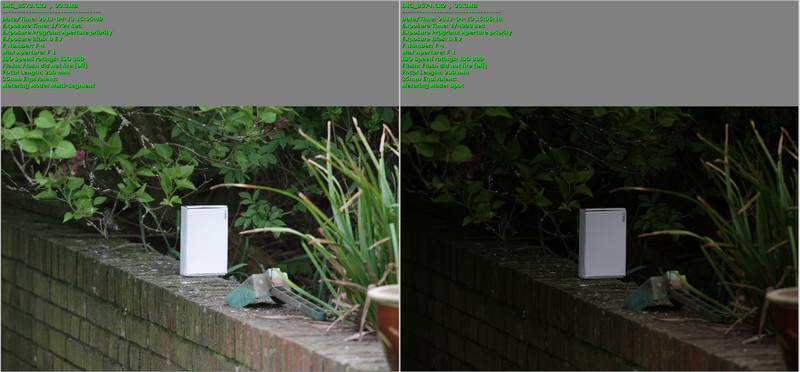
Here's a comparison between spot and evaluative.

Eval%20vs%20Spot.jpg


The spot metering (on the right) has looked at the white box, thought 'Hmm, I need to expose to make that bit grey' and underexposed the whole image.

The evaluative metering (on the left) had identified the subject and looked in its database. Presumably that database has no entry for 'grey subject of a field of black' but it does have an entry for 'white object on a field of various levels of grey'. So it chooses the latter and gets it pretty darn close.

Of course, if you understand how the different modes work then you'll know when you have to intervene (like adding some exposure compensation in the above spot metering).
 
A good rule of thumb is green grass or tarmac ( which is usually grey) give a pretty good approximation of 18% grey and thus a fairly decent reading. This is fine if you subject is in the same light level as the grass or tarmac.

I have heard this before about grass being grey? In the u.s. our grass is either green or brown if it needs water. I do not understand the comparison.
 
shaylou said:
A good rule of thumb is green grass or tarmac ( which is usually grey) give a pretty good approximation of 18% grey and thus a fairly decent reading. This is fine if you subject is in the same light level as the grass or tarmac.

I have heard this before about grass being grey? In the u.s. our grass is either green or brown if it needs water. I do not understand the comparison.

Ditto here - or it's shiny and hugely reflective!
 
I have heard this before about grass being grey? In the u.s. our grass is either green or brown if it needs water. I do not understand the comparison.

Ah, but your exposure meter is colour blind.
 
ive never really thought too much about metering really, mine is all ways set to evaluative....if it gets it bit too wrong bit of extra time in PP to sort it out, might give all the different metering modes a test shoot tomorrow :)
 
A good rule of thumb is green grass or tarmac ( which is usually grey) give a pretty good approximation of 18% grey and thus a fairly decent reading. This is fine if you subject is in the same light level as the grass or tarmac.

I have heard this before about grass being grey? In the u.s. our grass is either green or brown if it needs water. I do not understand the comparison.

You should! the reading from green grass is almost the same as a grey card. It's not hard to work out is it! Try reducing the Prozac.:lol:
 
They are taking an exposure reading from something other than the subject they are photographing.. They dont trust that the camera will get a good exposure from the subject they are photogrpahing.. so they get a reading from somehting more nutural and lock that exposure into the camera themselves based on the readings they got pointing elsewhere..

example.. if I have two football teams ..one in black/dark kit and one in white/bright kit.. its easier if i point at the pitch.. see what the exposure is and use that instead of what my stupid camera tells me..


Dont believe the ones telling you your camera is clever.. it isn't.. its easily fooled and thats not clever :)
 
The camera is very clever, being able to work out an exposure and get it right for the thing you are pointing at or what is in overall the scene or part of the scene.
It is how the user uses the technology that determines what the image comes out like and to use it well you need to understand it - which luckily is not difficult and explained in this thread. :)
 
Back
Top