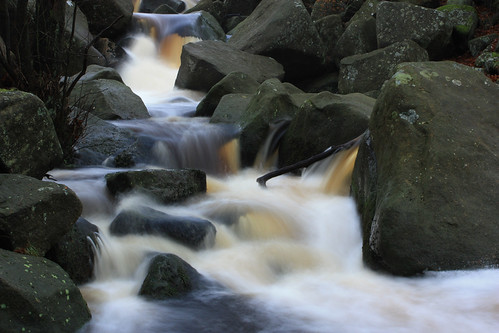
How to achieve the silky milky water look?

jeniveeev

Suspended / Banned
Messages
1,407
Name
Mac
Edit My Images
No
Hi - Im into taking landscape images at the moment and i love the silky water look. Can anyone advise on how to achieve this look? Ive read up a bit about it and would i need to buy an ND Filter? What would be the best way forward with this?
thanks
J
 
You might not need a ND filter to achieve this. Set your slowest ISO and smallest aperture to see what shutterspeed you're getting. If the water is flowing quickly or you are under a tree canopy then you should get slow enough speeds. Alternatively, wait until last light.
If you do want to go down the filter route, then a 3 stop ND is probably the best option.
Bear in mind that you want to retain some detail in the water, so don't go too slow with the shutterspeed.
 
Thanks HH and Gary for your advice. Can i also ask - i normally use manual mode, should i set it to ap priority to get the cameras suggested shutter speed? when i take the images say at sunset will they not come out dark ? if so then when i lighten them in PS should they look clear? sorry for all the Q's!
 
There is an article in this months Digital SLR User magazine. The guy was using a really dark ND filter (ten stops I think) and got some really good results but the shutter speeds where counted in minutes.

Gary, those are some nice pics.
 
3210150789_1af70e1ffc.jpg


Dunno if this is what you're after - F29 at 2 seconds shutter.
 
You have to use manual setting for good results, a long shutter speed and large f number (small aperture) is the correct way to do it. I have a 105 micro lens that stops down to f32, this would give a very long shutter speed due to almost pinhole aperture.
eg: small aperture = less light entering and greater depth of field; long shutter opening to compensate less light = silky water.

I hope that makes sense ;)

Gary
 
yes - thanks Gary that all makes sense. i will try it out this week and see what happens. your landscape images are great BTW.
 
There is an article in this months Digital SLR User magazine. The guy was using a really dark ND filter (ten stops I think) and got some really good results but the shutter speeds where counted in minutes.

Gary, those are some nice pics.


I know what your on about like this:
3315345753_223d6a9d2a.jpg


Above is 5 minute exposure, you`ll need a b + w 110 filter (10 stop), wokingham photographic sell them. any more info you need just pm me.
 
Aye, that's the sort thing I was meaning. Probably a bit more extreme than Jeniveev was meaning though.

I'm gonna order one of those filters I think.

Nice pic, where is that?
 
Green/PhilX - that is a little bit too extreme, would like to keep some detail in the water. il get the mag tomorrow for a sketch.
thanks to all for their comments and guidance - il post my images later in the week.
 
Hi - i attempted to shoot long exposure and small aperture at a nearby waterfall. most images were blurred and it didnt help having sunlight directly into camera but i was able to shelter under canopies of trees. what do you think of this one, maybe not enough silky water but the background is in focus.

a>


sorry but i cant seem to get the pic showing only the link.
 
You were really making things difficult for yourself with that lighting. A very high contrast shot where perhaps, you would have been better off targeting a more evenly lit part of the scene.
You mention that most of the shots were blurred. Were you using a tripod? For longer exposures its really essential to use a tripod and preferably a remote release, although the self timer is a good alternative. Mirror lock up is also recommended.
You've succeeded in blurring the water (River Almond shot, right?) much slower and you would probably have burnt out the highlights, leaving a large area of white with no detail.
Try again perhaps earlier or later in the day when the sun is not so high.
Keep practising, its fun and you will get some great results, I'm sure. :)
 
Hopefully your image will show here:
3330449941_231d0e893b_b.jpg


As HH says, everything was against you but a tripod or a "sit the camera on a brick-pod" is essential.
Keep trying, you'll get it!

Gary

PS, there's no EXIF attached to the image, this would help to help you ;)
 
i had my tripod but the mud was near up to my ankles so i rested my camera on the old stone wall which wasnt very flat. i take all your points on board and il try to get down there at sunset (wellies on this time!). i knew when i was taking the pictures that the direct sun was going to be a problem. also, sorry for confusing you all with the other thread but i didnt think i was allowed to post images on "equipment forum", after id done it! cheers
 
Can anyone advise, is the following set a good start for ND filters?

Warehouse Express

Am I correct in assuming, that when someone here says ND6, they really mean (as in this set) ND 0.6? (0.6 meaning, [T/(10^0.6)] equivalent to T with filter.)
i.e. a 0.6 ND is equivalent to allowing (1/3.98) of the light through (25%)

Currently wide end I only have the Canon kit 17-55 (400D) [this kit fits] and 28-135 IS [this kit don't fit]. My question is ignoring the size of the filter ring.

Although I am considering hiring the canon 10-22 for a play at some point.
 
Can anyone advise, is the following set a good start for ND filters?

Warehouse Express

Am I correct in assuming, that when someone here says ND6, they really mean (as in this set) ND 0.6? (0.6 meaning, [T/(10^0.6)] equivalent to T with filter.)
i.e. a 0.6 ND is equivalent to allowing (1/3.98) of the light through (25%)

Currently wide end I only have the Canon kit 17-55 (400D) [this kit fits] and 28-135 IS [this kit don't fit]. My question is ignoring the size of the filter ring.

Although I am considering hiring the canon 10-22 for a play at some point.


A 0.6 ND is equivalent to 2 stops , so yes, you're right, it lets a quarter of the light through!

But are you sure you're not looking for Graduated ND filters?
 
So far it seems that the advice in here is pretty much spot on. Aside from one thing...

On Nikon's the lowest ISO they do is 200, which can be further extended to ISO 100. This makes ISO 200 the Base ISO. It should be noted that if you go below this base ISO, you risk loosing dynamic range on in image. Therefor the best way to get a longer exposure once at the base ISO and the smallest aperture, is to use a ND filter.
 
But are you sure you're not looking for Graduated ND filters?

Thanks I am considering getting a graduated filter as well, but I think I can get a similar effect at the mo with my linear polarizer, if water isn't involved.

However, I am hoping to go on holiday somewhere nice and bright, and [hope to] have a bit of time to just mess with the camera. Whilst I am away I won't be able to get any kit, so I want to get what would be probably suitable, so as not to waste the oportunity. Don't know where I am going yet either, so that doesn't help much. I'll get this set and see how I get on.
Thanks
 
Back
Top