Help with my sunsets

TomHollo

Suspended / Banned
Messages
111
Name
Tom
Edit My Images
Yes
Hi All,

I tend to take quite a lot of photos of sunsets but I'm having some trouble with some flaring.

As in the images below, I'm seeing some flaring around the sun:
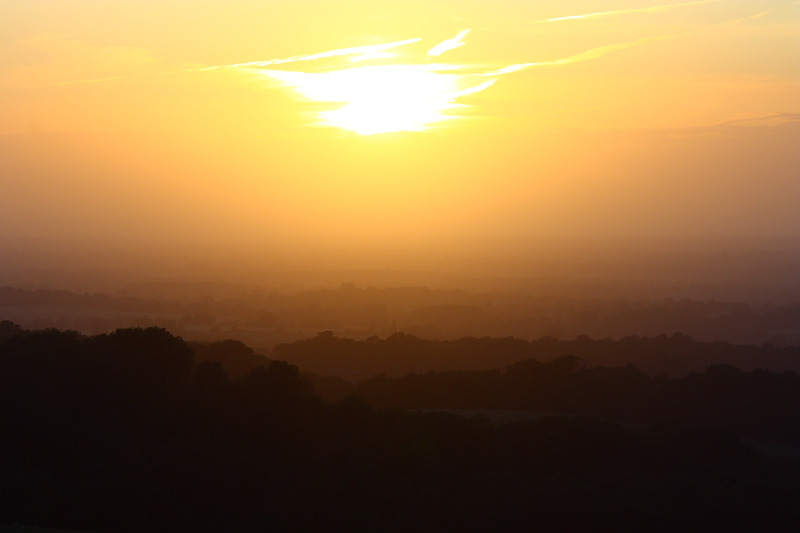
3725016894_f93384ffe0_o.jpg

1/100, F11, ISO 100, 96mm (taken with my sigma)
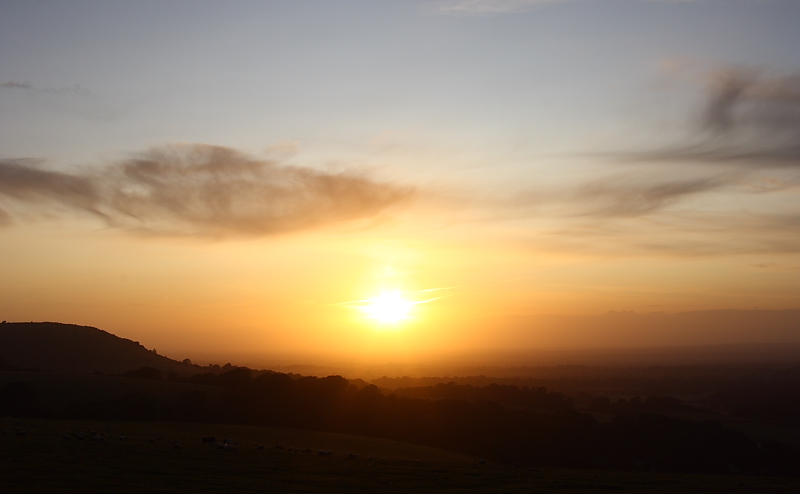
3725016412_6d00e323ff_o.jpg

1/100, F16, ISO 100, 28mm (taken with my sigma)

One the second photo, to keep the foreground sharp, I shot at f/16 but wondered whether this was making the issue worse? would a wider aperture reduce the flare?

Can anyone give me any tips on how to avoid this? or is this just par for the course when shooting directly into the sun?! :thinking:

Many thanks,

Tom
 
It's not flare, it just over exposure of the sun and surrounding clouds. Shooting at a higher f/number has reduced it, but you've still got a way to go. It's just bleaching out to absolute white.

Try a Neutral Density Graduated filter to darken the whole sky relative to the forground, or try merging a set of differently exposed frames with High Dynamic Range (HDR) technique in post processing.

You will always get some flare when shooting into the sun like that, but it's not the major problem here.
 
are you dropping your exposure when you're shooting into the sun?
 
Sorry guys, I should have been clearer :bonk:

It's not so much the bleaching out of the clouds (i quite like the irregular shape it makes), as it has to be that bright to keep the detail in the foreground (I have an grad ND on the way to sort that out), it was more the orange 'halo'/ring around the sun that bothers me.

Is it light reflecting (or refracting?) off the lens(es) that is causing the halo? There were no filters on the lens when I took these.

Even if I reduce the brightness and the contrast I can still see the halo, so I was leaning against exposure and more towards a 'mechanical' issue such as the aperture or reflection/refraction.

Many thanks,

Tom
 
Sorry guys, I should have been clearer :bonk:

It's not so much the bleaching out of the clouds (i quite like the irregular shape it makes), as it has to be that bright to keep the detail in the foreground (I have an grad ND on the way to sort that out), it was more the orange 'halo'/ring around the sun that bothers me.
Is it light reflecting (or refracting?) off the lens(es) that is causing the halo? There were no filters on the lens when I took these.

Even if I reduce the brightness and the contrast I can still see the halo, so I was leaning against exposure and more towards a 'mechanical' issue such as the aperture or reflection/refraction.

Many thanks,

Tom

That looks like a JPEG artifact, due to high compression to a low level file.

It's common with skies that have large areas of subtle tone. It happens on skin tones a lot, too.

Save to a higher standard JPEG and it should disappear.
 
Try exposing your shot just above or just below the setting sun,also a ND filter :thumbs:
 
You are probably looking at trying to cope with a 8-10 stop exposure range, depending on how well you need the foreground to be exposed. If you are shooting jpeg then this a bit much to ask. RAW would struggle as well.

You've a couple of alternatives. Use a grad ND filter to help reduce the intensity of the sun.
Better still do a bracketed exposure. When I do this I quickly take a couple of test exposures to see what exposure the foreground needs and then the sun exposure. This is done in manual mode and adjust the exposure time not the aperture. Don't be surprised if you are shooting at 1/25 @F8 for the foreground and 1/2000 for the sun. Shoot at about 2 stop intervals

Now you could if you want produce an HDR result, but you could simply select the the images you want ( probably you'll only select 3 ) . Now you can use layer masks to to simply to revel the parts of the image from each layer. If you've never done it before it can sound complicated, but trust me it isn't . Google Layer masking in Photoshop to see how its done. A tablet does help, but if you take your time a mouse is fine.

Layer masking is a good skill to learn and as I said not that difficult, just takes a bit of practice, like most things
 
Hi all,

Many thanks for all your answers - I have to say that I didn't initially think it was an exposure issue but I had nothing to back the theory up! You were all, of course, correct ;)

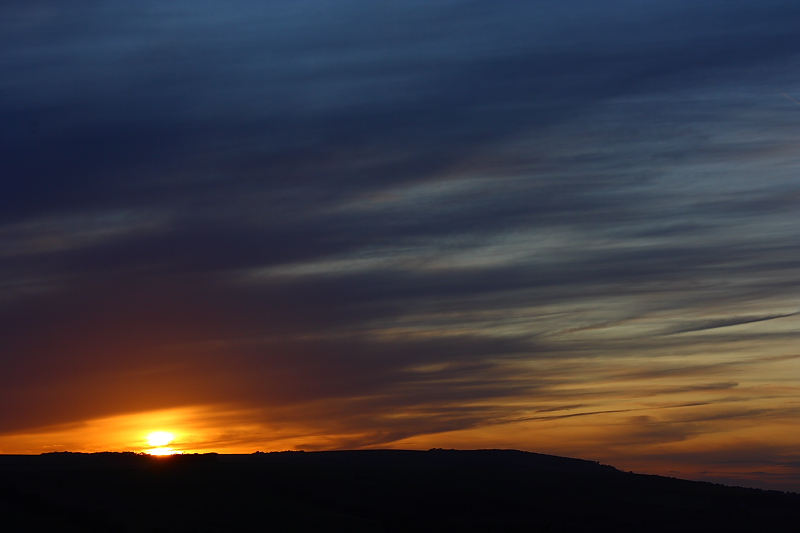
I went out today to try again and gave up attempting to get any detail in the foreground and concentrated on the sky. The result.....success, with no halo!

3773275186_1cbc78a351_o.jpg


I have a grad ND filter on the way so I'll just have to be patient.

Many thanks all!

Tom
 
Back
Top