Gorilla Safari

Greenninja

Suspended / Banned
Messages
420
Name
Paul
Edit My Images
No
Next month I'm heading out to East Africa, overlanding from Nairobi to Kigali. There are countless highlights on this trip - but the two key ones for me are The Masai Mara and a visit with the Mountain Gorillas in Rwanda.

I'm pretty familar with African travel, having undertaken a similar trip a couple of years back (Kenya-Tanzania).

I'm keen to get some general advice on shooting the Gorillas - interested in exposure advice (assume dial in compensation for dark subject, brightish background). Also interested in focal lengths and types of shot possible (if you've done something similar of course!).

Kit is deliberately simple 50D wearing a 100-400L and 5D wearing a 24-105L. I'm debating taking a 70-200 F4L - which would break my no lens change rule, but I have a gut feeling this may be the optimum length for the gorillas.

Any thoughts and advice welcomed.
 
Oh, I'm so envious. I went to Rwanda in 2007 and it was fantastic. My pics are here - LINK. I took a 100-400 on a 40D and the majority of my shots were taken between 100 and 200mm. I was quite lucky in that the weather was bright, so having a slow lens wasn't too bad. When I go again I think I'd take a 70-200 f2.8 (or the new Sigma 120-300 f2.8 would be perfect).

When you get to the gorillas you can only take the stuff you can carry on your person - no bags are allowed. So if you're going to be doing lens-swapping you'll need a big pocket. You've also got to experience the moment while it's happening. My friend took about 20 pictures in the hour we were there - the tears made photography a bit difficult.
 
Thanks Frank - the only carry on your person rule is a vital bit of info which I will definitly need factor in, wasn't aware of that.

I have pondered fitting one lens and carrying the second on a belt pouch, however all this seems to result in is a loss of trousers, which my result in some bemusement from gorillas and guides alike.

Going to check out your images shortly.

Out of interest what metering method did you choose? A lot of guides I'vde read seem suggest spot meter and ETTL by a stop or find something in the forest that's mid tone and lock from that. There's probably a whole load of jokes about chimping that could be rolled out at this point!!
 
Out of interest what metering method did you choose? A lot of guides I'vde read seem suggest spot meter and ETTL by a stop or find something in the forest that's mid tone and lock from that.

I expected exposure to be a bit of a swine, and it was. Manual exposure wasn't going to work because the light was changing quite a bit as the clouds thickened, then thinned again. In the end I chose spot metering - with zero exposure compensation. I reckoned that if the metering algorithm tried to expose the gorilla's fur as medium-grey that would give a little bit of over-exposure - in effect ETTR. One thing I really didn't want to do was underexpose and have to recover in post-processing, a sure-fire way of introducing noise.
 
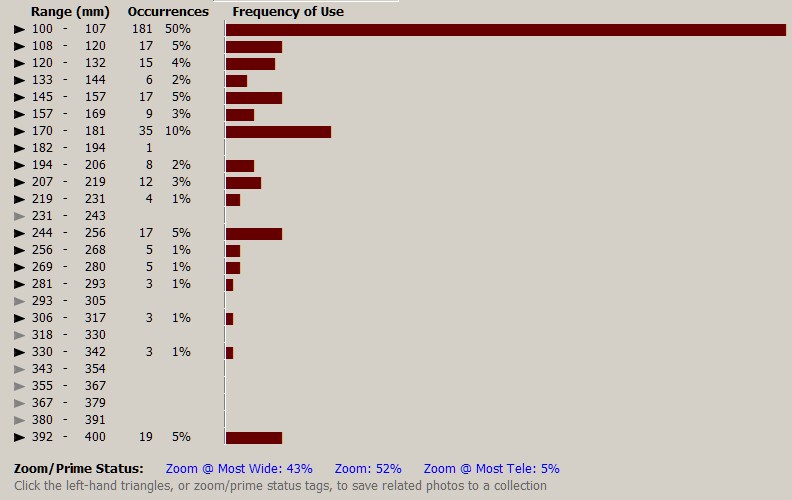
I thought an exact breakdown of focal lengths used may be helpful -

Gorilla%20Focal%20Plot.jpg


Only 16% were longer than 200mm, confirming my guess that a 70-200 would be ideal.
 
Hi Frank - apologies for not coming back sooner - been experimenting. I think your findings on exposure are spot on (no pun intended!!). I played with exposure a bit at the weekend and found very similar findings - I was also quite impressed at how well evaluative metering handled my test subjects (although would generate some odd results at times).

The lens chart is really interesting - it tallies with my thinking on how I currently use my lenses.

I've done some unscientific testing involving my kids in the garden and found that the 24-105 on the crops sensor and 100-400 on FF made best use of both lenses, but I think based on that and the chart the 70-200 does warrant serious consideration.

Completley off topic (but useful!) how do you generate a chart of that type - that sort of data is really interesting.
 
Yeah, used to have some software that did that but for the life of me can't remember.

Would find it very useful as I can't decide whether to upgrade to the 24-70mm or 70-200mm first :shrug:

Cheers
 
Oh forgot to mention, if you can you might wanna check out Port Lympne Wild Animal Park - it's near Kent. As quoted from their site...

"We're also home to the largest gorillarium in the world, "The Palace of the Apes", home to a family group of Gorillas fed at 12 noon and 3:00pm daily offering an un-paralleled view of this mightiest of apes.".

Last time I was there I was watching a load of gorillas. Then I felt some raindrops on my head. Looked up to see what the sky was like and saw a Gorilla on the wired fence above me taking a P*ss.

Great place though!
 
I was also quite impressed at how well evaluative metering handled my test subjects (although would generate some odd results at times).

Yes, if I were to repeat the trip tomorrow I'd probably have a go at evaluative metering, because I feel it has made great progress over the last few years.

Completley off topic (but useful!) how do you generate a chart of that type - that sort of data is really interesting.

I used to use something called focal plot (later renamed Exposure Plot, if I recall correctly). But that only worked with jpeg images. Now I use a Lightroom plugin by Jeffrey Friedl - LINK.
 
Next month I'm heading out to East Africa, overlanding from Nairobi to Kigali. There are countless highlights on this trip - but the two key ones for me are The Masai Mara and a visit with the Mountain Gorillas in Rwanda.

Sorry for the thread resurrection but do you have any shots from this trip? I'm off to Uganda to see the gorillas at the beginning of October and keen to get a feel of what the opportunities are like and to pick up any pointers, particularly with regard to exposure settings as being fairly new at this it's an area I need to work on.

Also, kit is somewhat limited but I'm planing on taking a 450D and a 40 or 50D plus 18-135mm and 150-500mm lenses. The last is obviously a bit long but between them they'll cover most focal lengths that I'm likely to want. Any thought or comments on this based on your experience?

Seeing hollis_f's chart further down I expect the bulk of the work will be done by the smaller lens but if I'm going to carry the big beast up the mountain I'll make sure to get some use out of it too :)
 
Last edited:
Back
Top