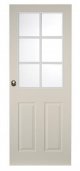
Gloss external wood door with glass panes

DorsetDude

Spud
Suspended / Banned
Messages
7,018
Name
Keith
Edit My Images
Yes
Any decorators in?

I've sanded back and wiped clean and put two coats of undercoat on my front door and surround. In a couple of spots on the woodwork brushmarks are still visible. am hoping I can lightly sandpaper them out before glossing.

Any tips for glossing?

Am using Dulux weathershield undercoat and gloss. White.

the upper half of the door has 6 panes in it in a 3 x 2 arrangement, cutting in round these is a pain (no pun intended). And I was thinking bringing the gloss onto the glass for say 1 or 2mm all round would actually help keep moisture from getting in behind the putty anyway. No idea how to do it accurately though.

Grateful for any tips basically. :thumbs:
 
I use masking tape if I need a precise edge. I've found the blue stuff (can't remember brand, 3m I think) is best. Use a mini roller for the gloss, for an absolute mirror finish use very fine sandpaper between coats. Make sure to flatten the undercoat before applying gloss. You can use a mini roller with undercoat too. You will need to use a brush for the frame between the pane and any recessed panels in the door.

I try not to paint on putty, it repels water anyway being oil based.

ETS: I'm not a decorator btw ...
 
Cutting in is a PITA! So much so that despite having been a decorator, I now prefer to pay someone else to do it!!! A mm or 2 overlap onto the glass is the way to go. NEW putty is pretty waterproof but when it dries out, it can absorb water into all the little cracks that develop and let it get into the wood underneath (as well as potentially freezing and blowing off). I was taught to do the cutting in first, then any panels and finally the frame of the door (as opposed to the door frame if that makes any sense...) Good (unfortunately usually expensive) brushes will help get a good finish but getting a perfect finish is unlikely - accept that brush marks will be visible and don't examine the final finish too closely. Runs are far more visible anyway!

Good luck.
 
When the paint is dry go over the glass with a razor blade (if you can still buy them!) or a Stanley knife blade and carefully scrape away the excess paint. You won't damage the glass and you can cut a better line than with a brush.
 
When the paint is dry go over the glass with a razor blade (if you can still buy them!) or a Stanley knife blade and carefully scrape away the excess paint. You won't damage the glass and you can cut a better line than with a brush.

Plus 1 - if you run the knife down the side of the edge to you want remove the paint to, you cut the paint and when you scrape the excess of the glass, you end up with a (normally) good edge.

Best tip is to use a new / very sharpe Stanley knife blade and you can buy a holder for the blade to scrape the glass, so it's mush easier and safer.
 
Yep, pack of Stanley blades and a bit of patience. Also, blue masking tape (the green stuff is also good).
 
Thanks for the input gents. I already have some low tack white masking tape so may as well use that. I also have a holder thing for stanley blades so reckon that and the tape could be the answer. I may need a small metal ruler to use when scoring the edge lines round the paint on the glass I imagine

Not sure about the mini roller thing, am I not likely to get small spots of gloss flying everywhere using one?

I though about using an artists brush for the cutting in round the putty onto the glass as it might offer more precison. Not sure wilkinsons sell them though. :D

Any tips for cleaning the brush/roller thoroughly after glossing so its useable again later?
 
You can get brushes with angled heads specifically for cutting in window corners. Cost next to nothing and we'll worth having.
 
Use an appropriate solvent (IIRC, the Dulux Weathershield glosses are oil based so white spirit will do the job) and keep rinsing until the stuff's almost clear (several changes of solvent in a suitable sized jam jar then tip the dirty stuff into a bigger one, let it settle [can take ages {weeks!}] then reuse for early stage cleaning) then use washing up liquid neat, working it well into the bristle base without using too much pressure then rinse well in warm water. Spinning the brush by rolling it between the palms of your hands will get most of the water out but then let it dry thoroughly before putting it away. Roller sleeves are generally cheap enough to bin rather than try to clean. We used to wrap the ones we used with emulsion in cling film - they'd stay useable until the next job, keeping them to the same colour, of course! (95% of the emulsion was either white or magnolia and after the first coat, any change in finish [matt to silk] would be complete.) We did have the advantage of having a firm's apprentice to do the brush cleaning for us - it's a PITA but good brushes aren't cheap (but are worth the extra IME!)
 
good brushes aren't cheap (but are worth the extra IME!)
But where does one go to purchase these good brushes? B&Q? Online? And indeed, how do you know when selecting one that it will be a good one? Purely on price?
 
The very best brushes used to be Leyland Black. From the Leyland Paint store, but that's going back 40+ years. I've still got a load in the garage. If you want good brushes go to a trade store - paint only - and ask them

TBH if you are only a very occasional painter then it's hardly worth the expense unless you are fussy. I am, that's why I've got good brushes! You have to look after them but they will last a lifetime if you do.

A really good brush needs breaking in. You need to use it on a few jobs that don't matter too much such as painting the gutters etc. This rubs the loose edges off the hairs and gives you a nice shape to the brush. Not sure if anyone bothers with that anymore!
 
We used to use Hamilton Perfection brushes and they can be had from Screwfix http://www.screwfix.com/c/decorating/brush-singles/cat850148 among other places. A 2" one would be MY choice for a door like yours (sounds like) but you might prefer a different size.
Cheers Nod. I always forget about Screwfix and there's a depot a stones throw away as well.

the door looks a lot like this ,except there are 3 panels along the bottom row, not 2.

door.jpg
 
Last edited:
Another vote for the Hamilton brushes. I've found the new synthetic ones are better too. As for the roller you will get spatter if you go at it like a mad man, but go steady and there is no spatter, the trick is to load the roller but not over load it (the paint shouldn't drip from the roller) and roll it out, i.e. don't try and do it in one coat.. It takes me around 20 minutes to do a standard six panel door on both sides. I remove the furniture (door handles and catch). I cut in the panels and do the edges with the brush then roll the flat parts, if necessary I use the brush to tidy if needed (rare).

If you mask the glass then cutting in around the panes is dead easy as the masking tape is there and that is what it meant for ;).

Like Nod if I'm doing a lot of decorating or will be re-coating then any rollers get wrapped in plastic, carrier bags in my case, make sure to get all the air out though. Brushes get cleaned between uses as a brush keeper is too expensive for casual use. Use white spirit or a proprietary brush cleaner for oil based paints, many now are water based so just wash out under the tap. I suspect external paints are still oil based though.
 
I suspect external paints are still oil based though.
I thought they would be but the dulux w/shield undercoat I had washed out under the tap. The gloss is oil based as it calls for brush cleaner on the tin instructions.
 
OK, Keith. The order I would paint that in is cut in glass, paint panel surrounds then flats, next up do the 2 struts that separate the panels, then the horizontals and after all that, the long bits up the sides. Finally, do the hinge edge. Of course, for a proper job, you might want to take the door off its hinges so you can do the bottom and top edges as well... ;) While you're at it, take off all the door furniture (handles, escutcheons, letter box etc. so you reduce the points at which water can get in behind the paint. If you want to make a really nice finished job, consider replacing the bits with new.
 
While you're at it, take off all the door furniture (handles, escutcheons, letter box etc. so you reduce the points at which water can get in behind the paint. If you want to make a really nice finished job, consider replacing the bits with new.
:thumbs:

Funnily enough I have already done all that. And of course the new letterbox/handle doesnt *quite* fit the holes left by the previous one. :mad: Id like to replace the hinges as well but I know I'lll end up with a door that wont shut or something.

Thanks again.

Has ST4 been banned yet?
 
I doubt it. I think he's got photos of Marcel and the other adminnies in "compromising positions" - it's the only logical explanation.

Oh, as long as the new letterbox/handle is slightly larger, it's not a problem - stretch the holes. OR, polish the old one up to look like new.
 
I think he's got photos of Marcel and the other adminnies in "compromising positions" - it's the only logical explanation.
The logical explanation is, others keep baiting him, so he'll bite, we are just not sure yet who else is going down :p
 
By the look of that tongue, you're about to (just check for a peeping lens...)
 
I doubt it. I think he's got photos of Marcel and the other adminnies in "compromising positions" - it's the only logical explanation.
Funnily enough I thought along very similar lines.
 
I've been thinking of doing this to our front door since the previous owners painted the door and then didn't let it fully dry before closing. Now when you open the door, there's a long vertical strip on the hinge side where it's been in contact with the frame and the paint's come off.

How long do you need to leave paint to dry before you can close the door?
 
Depends on the paint, the weather, the temperature, the humidity etc.! As long as possible, really. We used to "do" outside doors as early as practicable in the mornings so they would be as dry as possible by lock-up time. Of course, part of the problem you have is that successive layers of paint have made the door thicker, so what used to be a slight gap is now a contact area. It really needs to be sanded back through a few coats of paint to get the clearance back. The sharp edge (compared to the flat panel of the door) of the frame will tend to collect a thicker bead of paint too - worth addressing that issue as well as the door thickness.
 
Back
Top