Fuel price cap are we being taken for mugs

the black fox

Suspended / Banned
Messages
17,082
Name
Jeff
Edit My Images
No
I cant get my head around these price increases we live in a 3 bed semi , and earlier this year our supplier ( Scottish power ) doubled our direct debit to just under £200 per month . Yeah fine I read the news and know power gas and electric is going up this year , but like other pensioner households we will be getting lump sums off our bills .
This week I have been checking the dual fuel smart meter before going to bed it’s averaging between £2.00 and £2.50 per day which in my book averages around £75 per month , yes it will increase as winter draws on ,but we will by then have built up a good balance and then the gov. Payments will be added to the balance ..
It looks to me that the power companies are just building up a huge nest egg on which there obviously earning interest instead of us mere mortals who are fed b******t and gobblegook and asked to pay more
 
Don’t forget the standing charge is added on to your fuel consumption figures.
 
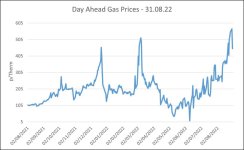
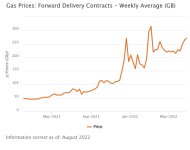
you use words like "prices are going up" like its 10% or maybe 20% at a push have you any idea actually how much wholesale gas prices have risen?

gg.jpg
 
I pay quarterly by direct debit. I have a fixed contract until Dec 2023. at that time the rise. will come as quite a shock.

However my direct debit is not a fixed sum, It is the actual used in that Quarter but at a fixed price per therm.
I have always paid that way since the 60's
I do not like the fixed monthly payment method, as it always benefits the Power company who make sure they are running up a generous, to them, balance.
In reality they re always owing you money. My way I am always owing them money. they simply take what I owe at the end of the quarter. Which means I must do my own budgeting... it works for me.

I always take up the fixed price contracts, even though you almost always pay more than the standard rate for the initial few months. but in 60 years of doing so, It has always benefited me over the contract. Inflation is inevitable, the higher it is the greater the benefit. And you have the additional benefit of knowing what you need to budget for over a two or three year period.

However they may not be offering any fixed term contracts next time around. we will have to wait and see. ( it may be the rare occasion when prices will actually fall back) they will certainly need to.
 
I cant get my head around these price increases we live in a 3 bed semi , and earlier this year our supplier ( Scottish power ) doubled our direct debit to just under £200 per month . Yeah fine I read the news and know power gas and electric is going up this year , but like other pensioner households we will be getting lump sums off our bills .
This week I have been checking the dual fuel smart meter before going to bed it’s averaging between £2.00 and £2.50 per day which in my book averages around £75 per month , yes it will increase as winter draws on ,but we will by then have built up a good balance and then the gov. Payments will be added to the balance ..
It looks to me that the power companies are just building up a huge nest egg on which there obviously earning interest instead of us mere mortals who are fed b******t and gobblegook and asked to pay more
Simple fix.

Get them to change your payments to a variable direct debit.
ie. You pay whatever your bill is

I've never let an energy company dictate to me what they're going to take out of my bank account.
 
Simple fix.

Get them to change your payments to a variable direct debit.
ie. You pay whatever your bill is

I've never let an energy company dictate to me what they're going to take out of my bank account.

all well and good if you have and maintain a huge cash reserve , the calculation squad are saying the average user will burn £500-£700 in gas for January alone add in the other cold months and you could be looking at a quarterly bill of £1200 , some people can only afford this if they spread the cost over the year.
 
Martin Lewis has come close to suggesting that the right to use fuel to heat and cook is akin to the right to have somewhere to live.

So why not provide it free of charge, perhaps up to a limit, funding the cost by increased taxation? Then the richest people can pay for the poorest people.
 
all well and good if you have and maintain a huge cash reserve , the calculation squad are saying the average user will burn £500-£700 in gas for January alone add in the other cold months and you could be looking at a quarterly bill of £1200 , some people can only afford this if they spread the cost over the year.

Exactly this, for some it's just a budgeting decision. Sometimes easier to budget for the same amount every month than have huge bills for 3 or 4 months of the year.

Easy for those of us who can afford it to say just pay for what we're using, but lots don't have that option.
 
Exactly this, for some it's just a budgeting decision. Sometimes easier to budget for the same amount every month than have huge bills for 3 or 4 months of the year.

Easy for those of us who can afford it to say just pay for what we're using, but lots don't have that option.

exactly and the amount of people that simply will not be able to find this money is staggering , the utter pomposity of some people is just very grim.

Old people will die this winter because of the price of gas and that is awful
 
You generally get a discount for paying by monthly DD. On the cap rate it makes about 7% difference which is higher than any deposit savings rate.
 
exactly and the amount of people that simply will not be able to find this money is staggering , the utter pomposity of some people is just very grim.

Old people will die this winter because of the price of gas and that is awful
Pompous? Screw you!

I was simply pointing out that you do not have to allow these energy companies to take what they want, when they want and you can pay only what's due.
If you can't afford it, that's a different story and nothing to do with what I was talking about.
 
Exactly this, for some it's just a budgeting decision. Sometimes easier to budget for the same amount every month than have huge bills for 3 or 4 months of the year.

Easy for those of us who can afford it to say just pay for what we're using, but lots don't have that option.
If budgeting is an issue then you have that option but from what I see, these energy companies seem to pluck any old number from the sky and up your direct debit whenever they see fit. How does that help budgeting?

There isn't a single other company / utility that works this way.

You should try budgeting when using oil. I've just had to fill a 2.5l litre tank at nearly a £1/litre. I don't get the option of spreading my costs and neither do millions of poor people that use oil. Nobody seems to be talking about that.

At the end of the day, it doesn't matter how rich or poor you are, what fuel you use, we are all being royally shafted up the backsides.
That's the cost of net zero.
 
Last edited:
You generally get a discount for paying by monthly DD. On the cap rate it makes about 7% difference which is higher than any deposit savings rate.
I'm not suggesting you stop paying by direct debit, you just change the direct debit to a variable type. No extra charges this way.
 
Martin Lewis has come close to suggesting that the right to use fuel to heat and cook is akin to the right to have somewhere to live.

So why not provide it free of charge, perhaps up to a limit, funding the cost by increased taxation? Then the richest people can pay for the poorest people.

Define the poorest people.
We have a problem in this country where many think that benefits is a lifestyle.

I have no problem helping out those in genuine need but stuffed if I want to pay for somebodies energy because they are to bone idle lazy to get off their backsides and work.
 
If budgeting is an issue then you have that option but from what I see, these energy companies seem to pluck any old number from the sky and up your direct debit whenever they see fit. How does that help budgeting?

There isn't a single other company / utility that works this way.

You should try budgeting when using oil. I've just had to fill a 2.5l litre tank at nearly a £1/litre. I don't get the option of spreading my costs and neither do millions of poor people that use oil. Nobody seems to be talking about that.

At the end of the day, it doesn't matter how rich or poor you are, what fuel you use, we are all being royally shafted up the backsides.
That's the cost of net zero.

They don't pluck a number out of the sky, they look at your average usage and try to charge slightly more than you'll use over the year. Because they'll never guess correctly, less people will complain at the end of the year if the energy company owes you money, than if you owe them money.
 
I am with Scottish Power, they recommend a DD amount but allow me to change it. If I choose an amount higher than recommended they say that I will be in surplus, if I set a lower amount they warn me that I may get into arrears and have to pay more later. At present I am paying £50/month higher than recommended because it is paid from my Santander 123 account which gives 2% cashback on energy bills (4% in Oct & Nov)
 
I have no problem helping out those in genuine need but stuffed if I want to pay for somebodies energy because they are to bone idle lazy to get off their backsides and work.
The problem with that approach is it allows you to define "genuine need" in whatever terms suit you.

Many people have physical or mental problems which prevent them from working but which are not obvious to others. I suppose you could require them to hang an official notice on their front doors, describing those problems in sufficient detail for you to make a personal decision as to whether your excess wealth should be shared with them, on a case by case basis. Doesn't seem efficient to me...

:tumbleweed:
 
Pompous? Screw you!

I was simply pointing out that you do not have to allow these energy companies to take what they want, when they want and you can pay only what's due.
If you can't afford it, that's a different story and nothing to do with what I was talking about.

you are so disappointing
 
Why would anyone pay DD to these parasites giving them free credit to then make billions of that on top? Never have done, never will. I will rather make life as difficult to them as I can starting with official complaints, late payments and so on. Screw them
 
I will rather make life as difficult to them as I can starting with official complaints, late payments and so on.
Fair enough: everyone needs a hobby. :naughty:

Other people just go fly kites...

3 men 3 kites Wroughton airfield Swindon Eos 5.jpg
 
Why would anyone pay DD to these parasites giving them free credit to then make billions of that on top? Never have done, never will. I will rather make life as difficult to them as I can starting with official complaints, late payments and so on. Screw them
Way mine works I owe them money for the first half of the year, then for the next three months I go into credit which reduces to zero by the time the year ends. For the sake of a couple of hundred quid either way that cancels itself out in the end, I can't be arsed to froth myself into outrage about it.
 
It's quite easy really everyone that can pays the way that suits them best, for me that's by DD because for any given company that's the cheapest way to pay, even the price cap allows the companies to charge a different rate depending on how you pay and where you live and the saving to me for paying by DD is about £250 a year.
 
Yes I fully understand the for and against DD ..that’s down to individuals though ..but I also understand that on top of real useage we have a standing charge to add to the bills ..but why ? The electrics supply is already there as is the gas supply ,if the standing charge is to pay for alleged repairs/ maintenance to these why is that not being taken out of there profits not our payments .. the whole system to me needs a re.vamp and brought into the 2020’s .
 
.. the whole system to me needs a re.vamp and brought into the 2020’s .
That's almost certainly true but...

Ever hear of "old Spanish customs"?

Once things are working in a particular way, it can be a godawful business to change them. I've been involved in a lot of different organisations' attempts to change things as apparently simple as the standing charge. By the end of the first month, you realise that it isn't going to happen. A couple of months later you get to the review point and the project has ground to a halt because Doris in accounts has done it this way for 40 years and isn't going to change now. Then the union wants a guarantee that no jobs will be lost, which is a road block because the reason for the change is to reduce the headcount.
Change is seldom easy. :tumbleweed:
 
Yes I fully understand the for and against DD ..that’s down to individuals though ..but I also understand that on top of real useage we have a standing charge to add to the bills ..but why ? The electrics supply is already there as is the gas supply ,if the standing charge is to pay for alleged repairs/ maintenance to these why is that not being taken out of there profits not our payments .. the whole system to me needs a re.vamp and brought into the 2020’s .

the standing charge is there because the gas network is managed by a completely separate company , all the smaller companies do is sell gas over that network this allow smaller companies to get involved as they know the cost is taken care of, also as has been stated earlier the standing charge now contains an amount which is helping out the companies that took on all the customers from the failed crappo cheap companies , when they took on those costumers they essentially had to sell gas to them at a loss so this is a compensation scheme.
 

What is a standing charge?

The standing charge is a fixed amount that you pay on your energy bill every day, regardless of your usage.

The charge covers those ‘non-energy’ costs that suppliers have to pay on behalf of customers. These include but are not limited to: the costs of using and maintenance of the energy networks (the infrastructure that gets electricity and gas to your home), costs of government support schemes and the costs of carrying out meter readings.

Standing charges are applied to both electricity and gas tariffs. They can also vary slightly by the region of the country you live in.

The energy regulator Ofgem’s rationale for why these costs should be included in the standing charges is to distribute the amounts evenly across everyone. If they were added to the kWh usage costs, it could lead to vulnerable households with high energy costs paying proportionally larger sums.

So, why are standing charges increasing?

Here are the main factors that are driving the increases.

Costs of the failed suppliers

The largest driver in the recent increase has come from the costs of the 29 suppliers who have exited the market in recent months (excluding Bulb).

As we explained in a previous blog, the total costs (roughly £2bn) are shared across all remaining suppliers in the market through ‘Last Resort Supplier Payments’. These are added to the electricity standing charges as the costs are ultimately recovered on a flat rate basis per customer. For gas, they are being recovered via a volumetric charge, meaning the costs are added to unit rates.

Good Energy campaigned hard for these costs to be spread over a longer timeframe. However, Ofgem decided differently and accelerated the claims process instead, which means the cost recovery began from April this year over a 12-month period, with further rises also likely.

Warm Home Discount Scheme

The Warm Home Discount Scheme started in 2011 and is the primary government initiative to provide relief to vulnerable households for their energy bills. Like other energy related social and environmental policy schemes, the Warm Home Discount is paid for through energy bills, rather than general taxation.

And to ensure the schemes are paid for evenly amongst consumers, the costs are added to standing charges on energy bills.

The additional increases came earlier this year when the government announced an expansion of the scheme spending to a total of £475m.

Good Energy, and a few other suppliers, have been enrolled in the scheme for the first time this year, as the government recently lowered the threshold for suppliers that need to participate. This means this is a new additional cost for Good Energy customers from 1st April this year.

Network charging reforms

The way we all pay for using the network has been under reform by the energy regulator for a number of years now.

From April this year, the first of many decisions came into effect – moving distribution network residual charges to a fixed cost (which is added to standing charges).

In simple terms, this means where previously a portion of the network costs (the costs for using and maintenance of the network infrastructure) were included in your unit rates, Ofgem has decided this should move to a fixed charge and collected via standing charges.

Again, Ofgem’s rationale for this change relates to fairness – so we all contribute to network costs in a way deemed proportionate by Ofgem’s new fixed charging bands. Finally, on top of this, network costs have been increasing because of the need to upgrade and expand our energy infrastructure. This has recently been compounded by inflationary pressures with rising costs for materials and wages

 
You generally get a discount for paying by monthly DD. On the cap rate it makes about 7% difference which is higher than any deposit savings rate.
What's that got to do with anything, who suggested not paying by direct debit?

It's quite easy really everyone that can pays the way that suits them best, for me that's by DD because for any given company that's the cheapest way to pay, even the price cap allows the companies to charge a different rate depending on how you pay and where you live and the saving to me for paying by DD is about £250 a year.
Again no one as far as I can see has suggested not paying by direct debit.

I pay by direct debit, but I pay for what I use each month. My account is always £0.
 
Last edited:
What's that got to do with anything, who suggested not paying by direct debit?


Again no one as far as I can see has suggested not paying by direct debit.

I pay by direct debit, but I pay for what I use each month. My account is always £0.


i think some people seem to be assuming DD is the spread your bill over the year but as you say you can choose to pay by DD for your usage , i guess that means you input a reading or it is taken by a smart meter , this is certainly a valid way of doing it but the danger is for people without considerable amounts of spare cash they are going to get a big shock in the cold months , the calculations mob are saying Jan could be £500 - £700 for the average user .
 
What's that got to do with anything, who suggested not paying by direct debit?


Again no one as far as I can see has suggested not paying by direct debit.

I pay by direct debit, but I pay for what I use each month. My account is always £0.
Which may well work for you but for many, me included who are on a fixed monthly income, I find it easier to budget with a fixed monthly expense rather than some months paying £100 or knower days £200 a month in the warmer months and £700 maybe £800 in the colder months. Currently my forecast bills for the coming year are around £750 in January and £250 in June.
 
i think some people seem to be assuming DD is the spread your bill over the year but as you say you can choose to pay by DD for your usage , i guess that means you input a reading or it is taken by a smart meter , this is certainly a valid way of doing it but the danger is for people without considerable amounts of spare cash they are going to get a big shock in the cold months , the calculations mob are saying Jan could be £500 - £700 for the average user .
Already calculated mine and worst case with a really cold winter it will be around £350 a month.
What I do is pay an amount into my Starling account each month that covers all my bills. It's built up a decent amount since beginning of this year, and the account earns me interest.
 
Last edited:
Which may well work for you but for many, me included who are on a fixed monthly income, I find it easier to budget with a fixed monthly expense rather than some months paying £100 or knower days £200 a month in the warmer months and £700 maybe £800 in the colder months. Currently my forecast bills for the coming year are around £750 in January and £250 in June.
I'm on a fixed income as well.
See my post advice but I pay into an account each month that earns interests my bills go out of that so basically the same as your doing except im earning the interest not the energy company.
What ever you pay now, pay into an account with interest. Then pay your bill from that.
 
I'm on a fixed income as well.
See my post advice but I pay into an account each month that earns interests my bills go out of that so basically the same as your doing except im earning the interest not the energy company.
What ever you pay now, pay into an account with interest. Then pay your bill from that.
Hmm I can see a pitfall in that, in the shape of a nice new shiny lens. :ROFLMAO::ROFLMAO:
 
Hmm I can see a pitfall in that, in the shape of a nice new shiny lens. :ROFLMAO::ROFLMAO:
And that’s my problem to Steve . I thankfully have a wife that’s a very good money manager , she deals with all finances I just have a small personal pension for my own use
 
Already calculated mine and worst case with a really cold winter it will be around £350 a month.
What I do is pay an amount into my Stirling account each month that covers all my bills. It's built up a decent amount since beginning of this year, and the account earns me interest.

but why would average Joe want to do that?
I'm a highly experienced network engineer and i can't even think of wasting my time with that kind of pathetic budgeting
most people just get on with there lives and just DD the average
 
Back
Top