Focus issues with photographing the Moon

Nabukodonosor

Suspended / Banned
Messages
7
Name
Marjan
Edit My Images
No
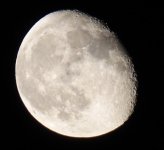
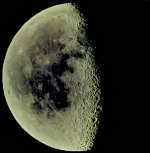
Hey guys. So, I'm having issues with focusing on the Moon. I've attached 2 photos exported from the Lightroom. The camera used is Nikon D3100 with Nikkor 55-200, used at 200mm. I used my tripod, VR was OFF, and I used 10 seconds timer. The first one was taken with Iso 200, F11 and 1/200 sec. The second one at Iso 100, F8 and 1/125 sec. The sky was very clear.

As you can see, the moon is blurry and out of focus. I tried learning focusing to infinity, but that didn't help either. I did that a few weeks ago, I can't find that photo, but I will try it again tonight and attach the result too. Any ideas what am I doing wrong?

 
Last edited:
Hi and welcome to TP

A little in haste but can I suggest you read this article (no doubt many others 'out there ' too)

 
I looked at that article, and it wouldn't work for me !

Start at 100ASA and 1/100 second at f8, then repeat at 1/125, 1/250 and 1/500, and the same speeds again at f11.

The moon is actually very bright.

The autofocus should have no problem, as the moon against the dark surroundings is easy for the camera to focus on.

The timer is good, a remote is the alternative, but wait a few seconds before pressing it.
 
I normally find that my camera focuses best if I set my focus area to the edge of the moon. I still usually find that some of my shots won't be in focus.
 
  • Like
Reactions: Nod
Have to tried focusing at something a long way off in daylight? I'm wondering if your lens isnt focusing to infinity.
 
I will try to focus at something a mile away or something at 200mm and attach it here.
 
Do you have the same problem if you focus in live view, if the D3100 has that?

If you've not calibrated the focus on that lens, that could well be the issue given it's a DSLR. Live view will force CDAF from the sensor rather than PDAF via the mirror (which may need some micro adjustments).
 
It has the live view. I will also try that tonight and post the result. I've never calibrated the focus on the lens. Have no idea how to do that.
 
Iso 200, F11 and 1/200 sec. The second one at Iso 100, F8 and 1/125 sec.


Try going the other way with the ISO. IME the d3100 can stand being pushed up to at least ISO800 without too much noise and the 55-200 is sharper at f/8 than at f/11. I'd turn VR on and shoot hand held, bracing my body against a door frame or similar.
 
For what it's worth, the full moon is probably the least interesting of it's phases and the fully lit areas do look fuzzy, even if the image is actually quite sharp.

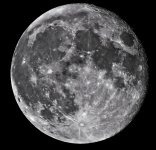
200mm on a crop body is quite a short focal length for detail shots of the moon - the one I've posted below was shot with what would equate to a 400mm lens on your D3100 (it was shot using a bridge camera at it's maximum zoom.)

NOD07064c.jpg
 
Err, can't you just select MF and turn the focus ring to infinity?
Even if it had infinity, lenses often focus past infinity.
 
For what it's worth, the full moon is probably the least interesting of it's phases and the fully lit areas do look fuzzy, even if the image is actually quite sharp.

200mm on a crop body is quite a short focal length for detail shots of the moon - the one I've posted below was shot with what would equate to a 400mm lens on your D3100 (it was shot using a bridge camera at it's maximum zoom.)

View attachment 436664


I agree, best when not full

1moon.jpg

1amoon2.jpg
 
Surely the depth of field would cover that?


Or similar articles around the web.
 
Your first example isn't too bad... it's decent enough with a little additional sharpening.

54077993508_3a2e4f271c_o.jpg


IMO, there are a couple of primary issues... the fist is that the lens is pretty marginal; it is not capable of resolving nearly down to the level of the D3100; especially at 200mm.

The second is that at 200mm the moon is quite small in the composition, which means the finer details are even smaller; too small for the camera to focus on. If you zoom in using live view you will have a better chance of focusing on the details. Of course that will make the image much shakier; you would probably want to use a remote release. Also note that the D3100 uses contrast detection for focus when in live view mode, which is generally more accurate than the normal phase detection AF.
 
Last edited:
The other problem I find with the moon is that it moves surprisingly fast. With a 10-second exposure, you will get a decent amount of movement blur which can look like OOF.
 
eGTwuol.jpg


I used one of those cheaper 1300mm lenses with a doubler to get this

Opteka 650-1300mm with doubler and for nikon fit​

working at2600mm I had to go in front of the moons path and wait until it appeared in the viewfinder . the moon this closer travels so fast it is the only way to get the shot. then only the moons edge as a full front shot would hav e been OOF
 
Last edited:
Hey guys. So, I'm having issues with focusing on the Moon. I've attached 2 photos exported from the Lightroom. The camera used is Nikon D3100 with Nikkor 55-200, used at 200mm. I used my tripod, VR was OFF, and I used 10 seconds timer. The first one was taken with Iso 200, F11 and 1/200 sec. The second one at Iso 100, F8 and 1/125 sec. The sky was very clear.

As you can see, the moon is blurry and out of focus. I tried learning focusing to infinity, but that didn't help either. I did that a few weeks ago, I can't find that photo, but I will try it again tonight and attach the result too. Any ideas what am I doing wrong?

You could use Manual focus, and put it on a tripod if you have one.
 
I don't understand Nikon's advice to use an aperture of f/11 or f/16, except in the rare case where there is a foreground that you want to have in focus. At f/11, and even more so at f/16, diffraction causes pictures to be blurred.

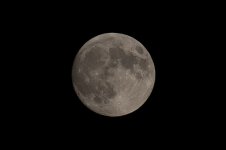
I take pictures of the moon at full aperture. Last time I did, I used my 500mm f/5.6 lens at f/5.6, 1/320, ISO 200, hand-held, VR on.
 
Just to throw more ideas into the mix, I've wondered if there's a difference between sharpening on the edge of the moon and the centre. The moon's radius is 1,079.6 miles according to google!
 
Just to throw more ideas into the mix, I've wondered if there's a difference between sharpening on the edge of the moon and the centre. The moon's radius is 1,079.6 miles according to google!
When you sharpen something, it has nothing to do with the size of the object???
 
Dammed slide keyboard was supposed to say focusing.
OK, at that distance, it will make no difference on what part you focus on, the only difference will be whether the camera finds it easier to find focus on the edge on in the middle, which will probably be the edge.
 
The moon is very bright and is moving very quickly across your picture frame.

There is no "best setting" but some guidelines would be :
Use an exposure of 1/500th sec or even 1/1000th sec. Up the ISO to get the shutter speed higher.
Also, underexpose slightly to stop the bright parts from blowing out.

There are very few shadows when the moon is full so its more interesting to take shots at other times.
I know the media make a big deal of naming the full moons, but unless you have something of interest in the background, it's a really boring, flat image.
The autofucus on most cameras will work if you target the edge.

As others have said it's best to focus on the edge where the crater tops are creating shadows.


Have fun.
 
The moon is very bright and is moving very quickly across your picture frame.

There is no "best setting" but some guidelines would be :
Use an exposure of 1/500th sec or even 1/1000th sec. Up the ISO to get the shutter speed higher.
Also, underexpose slightly to stop the bright parts from blowing out.

There are very few shadows when the moon is full so its more interesting to take shots at other times.
I know the media make a big deal of naming the full moons, but unless you have something of interest in the background, it's a really boring, flat image.
The autofucus on most cameras will work if you target the edge.

As others have said it's best to focus on the edge where the crater tops are creating shadows.


Have fun.


I have never found any motion blur even at low shutter speeds, and with a camera lens I don't think you would. With a telescope and adaptor it may be more of an issue.
I do think it is important to keep the ISO at the cameras base level, as even with an 800mm (FF eq) the moon fills only a small part of the frame, so the chances are you will want to crop, and noise can then become an issue.

The only time I would use fast shutter speeds would be when I was not using a tripod.
 
Concern about noise is a thing of the past IMHO.
Using ISO above 2000, or even above 5000 is not an issue.
The latest noise reduction software just removes it.

At slow shutter speeds you don't necessarily see motion blur but you do lose fine detail.
 
Concern about noise is a thing of the past IMHO.
Using ISO above 2000, or even above 5000 is not an issue.
The latest noise reduction software just removes it.

At slow shutter speeds you don't necessarily see motion blur but you do lose fine detail.

Our opinions and experiences differ :)

I also find you lose fine detail when removing any significant noise, there's always a balance to be found.
 
Sorry for highjacking the thread, but wanted to ask - what cheaper tele lens would be good for photographing moon? Some 500mm would be fine to get fill at least 50% of the frame? then crop to see nice craters etc...
Or should I also get some 1.4x TC to get even closer?
 
Sorry for highjacking the thread, but wanted to ask - what cheaper tele lens would be good for photographing moon? Some 500mm would be fine to get fill at least 50% of the frame? then crop to see nice craters etc...
Or should I also get some 1.4x TC to get even closer?
500mm on what camera?

A cheap lens will give cheap results, I've tried them in the past, and they are not worth anything, the only one that was any good at all was a 500mm mirror lens.

I use a 400mm on an M43 camera, that give a FF eq of 800mm, and it does not fill 50% of the frame.

If you are using Canon, and a Canon converter, they are not bad, but many converters are very poor quality.
 
They have a Zf in their sig, so full frame?

This is a significant crop from 500mm on full frame, not going to fill 50% of the frame, maybe with a 2x on it too…


EDIT: checked the details, it’s a bit over 1Mp crop from a 33Mp full frame. If you want to fill the frame with the moon it’s a telescope you want not a lens!
 
Last edited:
OK, at that distance, it will make no difference on what part you focus on
I find it does... or maybe it is that very small changes in focus ring position make a very large difference in focus distance.
While everything at that distance is at "infinity" according to a calculator; it's not actually true. And there's something like 1000 miles difference between the nearest face and the farthest edge you can focus on.
 
I find it does... or maybe it is that very small changes in focus ring position make a very large difference in focus distance.
While everything at that distance is at "infinity" according to a calculator; it's not actually true. And there's something like 1000 miles difference between the nearest face and the farthest edge you can focus on.
And how far is it to the moon? :)

You always appear very good with the technicalities and theory, so if you can prove it with the math, then I will take your word for it :)

I seriously think that if one part of the moon is in focus, it all will be. Infinity in terms of angles but nothing to do with the infinity marked on the lens (if it has an indicator) as I don't believe they are all accurate, and many will go past "infinity" and out of focus on the moon or similarly distant (in terms of a camera lens) object.

It's an interesting one, and one I would love to be proven incorrect!
 
Back
Top