Fish eye lenses

bionicsherpa

Suspended / Banned
Messages
532
Name
Ken
Edit My Images
Yes
Can anyone enlighten me as to why the Nikkor 16mm is called a fish eye lens when the wider 14mm is called a super wide angle lens? As far as I can see they both fill a FF sensor.
 
Fish-eye is a colloquial term that seems to have stuck, without any formal definition.

It refers to a lens with 180 degrees angle of view that is uncorrected for linear distortion, ie straight lines towards the edges of the picture are strongly curved outwards.

Focal length and angle of view get mixed up with fish-eyes.
 
Fish-eye is a colloquial term that seems to have stuck, without any formal definition.

There is is formal definition of 'Fish Eye' because it looks like this:-

main.php


Fish eye lenses produce a circular image within the frame which looks like the eye of a fish

There are several types of "fisheye" and not all produce views like the one above. That shot was clearly taken with a "hemispherical" fisheye whilst I believe the Nikkor 16mm is 180 degrees horizontal FOV. There are also fisheyes with 180 degrees vertical FOV (orthographic fisheye).

As Richards stated....the term fisheye needs additional qualification before the resultant view can be determined.

Bob
 
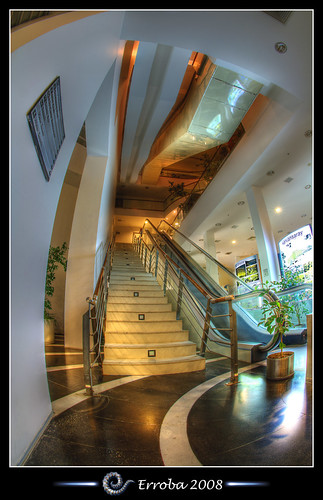
So this would be an orthographic??

Picture courtesy of Flicr contact Erlend...

2655347424_f5c66bec33.jpg
 
That looks like a normal fisheye rotated 90degrees to me.
 
:agree:....just a horizontal fisheye used in portrait orientation.

Bob
 
Thanks you for all your replies. I must confess I am still a bit confused. If you consider a full frame camera then it seems that a lens of about 5 to 8 mm will produce a circular image giving an angle of view approaching 180 degrees; that is what I called a fisheye image (rightly or wrongly). The 16mm lens is called a frame filling fisheye and, so far as I can tell, will produce a rectangular image but with distortion like the circular image from the 5-8mm lens. These seem to give an angle of view approaching 180 degrees but measured across the diagonal of the rectangle. The 14mm lens should give a wider view but Nikon say that angle of view is 114 degrees. How come the shorter focal length gives less angle of view? Is it something to do with the distortion correction?
 
yeah on a full frame 8mm will give a circular image whereas 8mm on a 1.6x crop will still give a pretty fishy image. a 15mm on a crop camera will still show straight lines as distorted but it won't be that "fishy". It's ALL about the distortion correction, as you say.
 
Size of image circle is partly determined by the amount of glass involved. Hence why you can get a 50mm lens for medium format cameras and you can get a 50mm lens for small format cameras (35mm, half-frame digital etc).

Put simply (as it only needs to be really, plenty more information in links already posted) a fisheye is not rectilinear, which is what a non-fisheye lens is. You can have an ultrawide rectilinear lens (this is to do with the rendering of horizontal and vertical straight lines) with a shorter focal length than a non-rectilinear fisheye lens, but the fisheye will (by virtue of its non-rectilinearness) have a wider angle of view, which is the crunch in all of this.
 
you can probally get a 40mm fish eye, to me fish eye just adds distortion, i have a 16mm with very little distortion on FF but i assume somepeople class 16mm as fish eye
 
..... i have a 16mm with very little distortion on FF but i assume somepeople class 16mm as fish eye

The focal length has no bearing on whether the lens is "fisheye" or not. I have Canon's EF15mm fisheye and also their EF14mm which isn't....it's rectilinear. As the focal length gets shorter then rectilinear correction becomes more difficult and expensive to achieve.

Bob
 
Back
Top