First Commercial Gig - Still Game Fans?

Frame

Suspended / Banned
Messages
24
Name
Ramone
Edit My Images
Yes
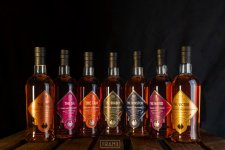
Happy to have whipped up my first batch of commercial shots for the guys behind Chewin the Fat and Still Game for their Jack & Victor Whisky Limited Edition releases.

I had one day to churn them out between working another job but happy with how they turned out for what im working with, ie limited equipment in my parents garage and an old pallet from my pa's work! Not the luxurious set up most imagine when they think of a studio.

Im still finding my way with Lightroom and using a flash really so its a good starting point for me to work on in the future as, no doubt, there's plenty to critique here...
DSC00882-2.jpg

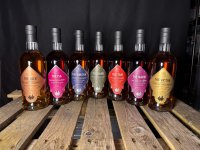
What my iphone saw for reference (not a final submission by any stretch):
IMG_7223.jpg

A few more posted on my instagram and their socials if you want a nosey.

Equipment:
Sony A7RIV
Sony 16-35mm G Master
K&F polariser
Godox AD300 Pro
Godox Softbox 30x120 i think (with glossy labels i held up another softbox cover close to the bottles for extra diffusion and edited myself out of the glass reflection (gotta do what you gotta do))
Some white light thing from Temu haha (shows on the left side of the bottles)
Lightroom

Have a class weekend everyone.
 
Last edited:
I love it. Sadly, I’m not a whisky drinker

Still Game was brilliant, funny and at times poignant. Every main character was priceless.

Great shots, (pun intended).
 
Last edited:
Well, it isn't an easy subject, but I think that the background and pallet are OK in the first shot, due to editing.
Beginner guides here https://www.talkphotography.co.uk/threads/lighting-challenge-1-coffee-cup.759315/ and here https://www.talkphotography.co.uk/tutorials/creating-diffused-specular-highlights.137/
thanks, the purpose of the 2nd shot was just to show it from what it was like through my eyes at the time, it's not a picture that was submitted.
 
I get that, but my point is that you're over-relying on PP to produce a result that can be produced much more easily, and much better, just by understanding the basics of lighting.

The shot you've tried to create is, frankly, impossible to do well without understand the principles involved, and with just a single light - forget that extra light that you bought from Temu, it's a problem not a solution.

This thread may help, it's basically the same challenge, even if the subject looks very different https://www.talkphotography.co.uk/threads/advice-needed.769840/

And the solution is the same too. In your case, you need a second light. Your choice of a strip softbox was correct, but you need two, one each side of the subject.

Having those lights positioned a long way from the subject (to minimise the fall-off of light due to the inverse square law) is the traditional approach, and the only approach that would work without PP), but requires more skill. As I pointed out in the thread I linked to, each bottle would need to be on a different plane to the others, so that each would be separately lit by the lights, that's an easy fix, you simply take the shot from a long distance, to compress and flatten the perspective, so that they all end up appearing to be on the same plane.

The other option is of course to photograph each bottle separately and then comp the shots together, which will produce an even better result - this is what post processing is really for, doing things that simply can't be done in camera, not for rescuing shots that really should be moved to the bin. Sorry if that sounds harsh, but that's the situation as I see it.

Of course, whichever solution is chosen, it will take extra time and, when a client is paying for it, the costs will be higher, but that's the reality of commercial shoots. My view is that if the client isn't prepared to pay the going rate then that's their problem, not yours.

So, if you want to improve your skills, do that shot again, using either of the methods suggested above (or both) using any transparent or translucent subject, that's how we learn.
 
I get that, but my point is that you're over-relying on PP to produce a result that can be produced much more easily, and much better, just by understanding the basics of lighting.

The shot you've tried to create is, frankly, impossible to do well without understand the principles involved, and with just a single light - forget that extra light that you bought from Temu, it's a problem not a solution.

This thread may help, it's basically the same challenge, even if the subject looks very different https://www.talkphotography.co.uk/threads/advice-needed.769840/

And the solution is the same too. In your case, you need a second light. Your choice of a strip softbox was correct, but you need two, one each side of the subject.

Having those lights positioned a long way from the subject (to minimise the fall-off of light due to the inverse square law) is the traditional approach, and the only approach that would work without PP), but requires more skill. As I pointed out in the thread I linked to, each bottle would need to be on a different plane to the others, so that each would be separately lit by the lights, that's an easy fix, you simply take the shot from a long distance, to compress and flatten the perspective, so that they all end up appearing to be on the same plane.

The other option is of course to photograph each bottle separately and then comp the shots together, which will produce an even better result - this is what post processing is really for, doing things that simply can't be done in camera, not for rescuing shots that really should be moved to the bin. Sorry if that sounds harsh, but that's the situation as I see it.

Of course, whichever solution is chosen, it will take extra time and, when a client is paying for it, the costs will be higher, but that's the reality of commercial shoots. My view is that if the client isn't prepared to pay the going rate then that's their problem, not yours.

So, if you want to improve your skills, do that shot again, using either of the methods suggested above (or both) using any transparent or translucent subject, that's how we learn.
Thanks for the pointers. I haven't invested much in product photography materials myself as I think it'll largely be swallowed by the shift in technology...a whole other can of worms no doubt. But end result was the client was happy with the price and turn around time, so all in a good result for me and something to build on from there. :D
 
That's fair enough - your client, your subject, your decisions.

But, you don't need to invest much in product photography materials, what you need to invest in is knowledge, which trumps gear every time, and frankly you haven't.

And as for the "shift in technology", this is irrelevant. We now have brilliant post-processing software, which makes it possible to turn good shots into outstanding ones, but which is pretty lousy at rescuing bad shots.

We also now have the ability to shoot at high iso settings, but that's irrelevant with shots like these.

Technology has not and never can change the immutable laws of physics, and people who don't understand the basics of physics simply cannot produce good (or adequate) shots that involve controlled lighting, it's as simple and basic as that.

I'm just one of many site members who've learned how to light, you can learn a lot here if you want to improve. You're perfectly entitled to ignore the advice of other people, but I assumed that you posted this shot in order to learn and improve, and you did ask for critique . . .
 
As others have said these could be much improved.

However you should be very pleased that your client is happy, at the end of the day thats all that really matters.
 
Karl Taylor isn't everyone's favourite - and remember he's selling either his own courses or Broncolor kit - but this is a nice way to do a whisky bottle shoot and demonstrates a lot of the relevant techniques.

Yes, quite a few people are critical of Karl Taylor - but the fact remains that he is both knowledgeable and truthful which, in my book, counts for a lot - just ignore the sales patter.

A major problem with his videos is that it all looks so easy, but that applies to my videos too, and to all others. Video compresses time, people simply won't watch long videos so the final videos never show the mistakes, the experiments, the test shots that didn't work etc., but that isn't a bad thing.
 
Yes, quite a few people are critical of Karl Taylor - but the fact remains that he is both knowledgeable and truthful which, in my book, counts for a lot - just ignore the sales patter.

A major problem with his videos is that it all looks so easy, but that applies to my videos too, and to all others. Video compresses time, people simply won't watch long videos so the final videos never show the mistakes, the experiments, the test shots that didn't work etc., but that isn't a bad thing.

Yep. I know how long it would take me just to get those pieces of card fettled the way he did, let alone the other details.
 
You actually did quite good, for starters. Getting better will require the minimization of the harsh reflection off the bottles, especially the reflections off the labels, as showing every bit of the labels is very important with product shots.

There is a Youtube website called "Camera Club Live" where he does many "Still Life" and "Product" shots with quite a few of these demonstrations involving wine bottles. He shows you the end result and then takes you step by step through the positioning and lighting required for each, one step at a time. He is a great teacher and shows you everything needed in step by step fashion to achieve the best results. You don't need the high dollar equipment that he uses. I use Godox lights and DSLR cameras, but employ many of his DIY methods and reflectors made from foam core and matte boards, and sometimes even mirrors to achieve the desired results. Go to his site and click on "Videos" to see all of his videos and then select those that you are interested in. He has put several hundred up on Youtube and is one of the best instructors that I've ever watched, as he takes you step by step through the entire setup and then through the shoot to the final minor editing in Photoshop. You will learn a lot of this type of photography from him. You can do what he does using most any adjustable camera and speedlites. Again, you don't need what he uses in camera and lighting equipment. The more budget friendly photo gear works fine for this too, but may require a little more effort sometimes as the better gear tends to do some things more automatically. His $4,000 camera is something to dream about having, but a DSLR or mirrorless camera will do fine for this as well.

Though not of wine bottles, the attached photo is one that I have done recently using a Canon DSLR, 24-70 lens, and a studio strobe, though a Godox speedlite or other and careful use of the Inverse Square law of Light (not the math, but how it works) you can do this with what you have and a few DIY reflectors from foam core or matte board you can do this type of shot too.

Charley
 

Attachments

  • IMG_0385LoRes.jpg
    IMG_0385LoRes.jpg
    37.2 KB · Views: 7
Back
Top