Filters on Panasonic Lumix M43 lenses

Sangoma

Suspended / Banned
Messages
2,951
Name
Steve, Coventry, England
Edit My Images
Yes
Some time ago I found that a UV filter on the 100-300 Mega OIS lens reduced definition slightly, but it could be seen.

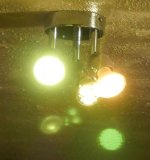
The other night playing with the GX9 outside I noticed I was getting "reflections" near the moon or street lights.

Been testing this morning, and it happens with any filter, and on the 14-140 is not visible near the 140 end.

The exact same filters have no effect on Canon lenses (tried the 19-55, the 18-135 and the 18-200)

I can only guess that it is to do with the mechanical construction of the lenses, and maybe also the size reduction on M43.

I have now taken all the UV filters off, and will have to watch carefully when using a polarizing or graduated filter (about the only two I use often)


This shows the effect, where the reflection occurs depends on where the bright light is in relation to the centre of the frame.

I've called it a reflection as it is inverted and reversed

fil.jpg
 
I have Hoya HD Protector filters on most of my lenses and I've not seen that issue in any of my photos.
 
I have Hoya HD Protector filters on most of my lenses and I've not seen that issue in any of my photos.
I had never noticed it before either.
One of the UV filters was a Hoya, but it didn't make any difference what make or price the filter was, only the colour was different depending on the coating on the filter.
 
The degradation in IQ is based on a number of factors inc. lenses, aperture, focal lengths and focus distances etc.
Also m43 due to the crop factor has more "magnification" than possibly your canon.
A 20mp m43 sensor has the same pixel pitch as a 80mp FF sensor, so are bound to notice it more.

Not sure if you used canon lenses on a canon body or m43 in your comparison but it wouldn't surprise me m43 lenses performed better on m43 bodies (sharpness wise) hence you are able to see the degradation than the canon lenses in your tests. The canon lenses you mentioned aren't the greatest quality optics to begin with (by which i mean they won't be breaking any sharpness charts).

also it all depends on your testing scenario i.e. was it like for like, or were the aperture different, perhaps the atmosphere tested in were different etc.

Reflections are also lens dependant, possibly aperture dependant too and focal lengths etc. More complex optical formulas will probably have more issues with the reflections.
Tbh using UV filters against a bright light source, you almost always run this risk.

This is an interesting article from lensrentals everyone who uses filters should probably read

The cheaper hoya filter seems better than the more expensive one!

Having said all that I use UV filters on my lenses in cases where it warrants one. Like while transporting, or while shooting inclimate conditions or where I feel I need to protect the front element. Normally I just take them off while shooting and screw them back on. I almost use them like a screw on/off lens caps that can also stay on if needed.
 
Last edited:
I used a 650D for the tests on the Canon lenses, and those are just the lenses and camera I have left over, I sold the rest a year ago..

I shot the same things at the same time, I didn't bother with the finer details, the only reason to try the Canon was to see if I saw the same thing taking shots of the same thing in the same manner as I was when I noticed it, ie nothing special on P

I did get the same effect using M outside, didn't check settings, again the technicalities of it weren't the point of interest.
Simply with a filter on the problem was there, without the filter the problem was gone :)

I am aware that aperture and focal length make a difference (I commented on the focal length part), but I have no interest in finding out how, as I will simply remove the filters, and with them goes the problem.

Only time I will put them back is when travelling.

I feel certain that although I have seen no signs of the issue in normal use, it will still be there to a lesser extent, and probably affecting the image quality.
 
As per the lensrentals article they will affect image quality, there is no doubt.
The question is if it's discernible. Unless I am planning on printing something big most likely it will be inconsequential.
Of course I do not know what I will end up printing and hence I prefer to take it off unless its needed for protection.
 
As per the lensrentals article they will affect image quality, there is no doubt.
The question is if it's discernible. Unless I am planning on printing something big most likely it will be inconsequential.
Of course I do not know what I will end up printing and hence I prefer to take it off unless its needed for protection.
I found on the 100-300 there was a visible loss of definition/ fine detail, but not on other lenses.
This was only noticeable on heavy crops, but that is where I was looking.

Until the latest find :)
 
Back
Top