

You are using an out of date browser. It may not display this or other websites correctly.
You should upgrade or use an alternative browser.
You should upgrade or use an alternative browser.
extension tubes?
- Thread starter Mick616
- Start date

Snapsh0t
Suspended / Banned
- Messages
- 2,709
- Name
- Jonathan
- Edit My Images
- No
It depends on how much extra magnification you want. Assuming your 100mm lens focusses down to 1:1 then 50mm of tubes will give you 1.5:1. More than 50mm and you could run into mechanical and electrical problems. After that you'll need to look at add-on close-up lenses but you'll need quite a high dioptre to get useful magnification with a 100mm lens. The Raynox DCR-250 is very popular but not easy to use. It's one of those areas where you need to experiment to see what suits you best.

chrism8
Suspended / Banned
- Messages
- 305
- Edit My Images
- No
I use ext tubes a fair bit, they are a manual set so exposure is guess work initially but works well and gives decent results, imho the electrical connections are not worth having because macro is generally easier with manual focus anyway.

john.margetts
Suspended / Banned
- Messages
- 2,996
- Name
- John
- Edit My Images
- Yes
If you use the extension tubes with an adapter for a "proper" lens with an aperture ring, then auto-exposure should work just fine with the advantage that you can control depth of field.I use ext tubes a fair bit, they are a manual set so exposure is guess work initially but works well and gives decent results, imho the electrical connections are not worth having because macro is generally easier with manual focus anyway.
john.margetts
Suspended / Banned
- Messages
- 2,996
- Name
- John
- Edit My Images
- Yes
If you use a digital lens with plain extension tubes it is not possible to adjust the aperture and every shot will be at maximum aperture and shallow depth of field. Of course, if you buy expensive tubes with electrical contacts, you can still adjust the aperture but I was responding to chrism8 who mentioned using manual tubes.Not sure what you mean John?

Garry Edwards
Moderator
- Messages
- 13,475
- Name
- Garry Edwards
- Edit My Images
- No
Extension tubes are extremely useful, but many modern lenses don't allow the aperture to be set on the actual lens. Because of that, you need auto extension tubes, these include a mechanism that transmits the aperture-closing instruction from the camera, through the tubes, to the lens.
Technically, they don't magnify. What they do is to act as a spacer between the lens and the body, which allows the lens to be much closer to the subject.
Technically, they don't magnify. What they do is to act as a spacer between the lens and the body, which allows the lens to be much closer to the subject.
Snapsh0t
Suspended / Banned
- Messages
- 2,709
- Name
- Jonathan
- Edit My Images
- No
That's a good choice. There are much cheaper sets available from JJC, Meike, etc. but Kenko is the nearest to a gold standard. The one irritation with them is that they don't come with end caps. Well, my M43 set didn't and I can't remember if the Nikon ones did or not.Thanks, I was looking at the kenzo set of tubes on Amazon for 130 quid.

LCPete
Suspended / Banned
- Messages
- 9,785
- Edit My Images
- Yes
I’ve used Jessops auto extension tubes and they work well but have to remember that using tubes reduces light so have to increase the ISO or use flash
They worked well but I now use a quality screw on close up lens the advantage for me is that I can get higher magnification without having to use flash as they don’t reduce light transmission
I use a Marumi achromatic one and Ranox are also good
Also it’s simple to just screw onto the front of the lens
They worked well but I now use a quality screw on close up lens the advantage for me is that I can get higher magnification without having to use flash as they don’t reduce light transmission
I use a Marumi achromatic one and Ranox are also good
Also it’s simple to just screw onto the front of the lens

nandbytes
Suspended / Banned
- Messages
- 16,780
- Edit My Images
- Yes
you can get extension tube for £20-30, I wouldn't advice buying expensive ones especially not £100+. They don't work any better than cheaper ones in my experience.
Regardless as a rule of thumb if you want greater than life-size i.e. 1x or 1:1, extension tubes work better for wider focal lengths (<50mm) and macro close up lenses like raynox DCR-250 suggest above work better for longer focal lengths (>100mm).
this website is a really useful source for all things macro and they also have calculators for various scenarios and setups
 extreme-macro.co.uk
Regardless as a rule of thumb if you want greater than life-size i.e. 1x or 1:1, extension tubes work better for wider focal lengths (<50mm) and macro close up lenses like raynox DCR-250 suggest above work better for longer focal lengths (>100mm).
this website is a really useful source for all things macro and they also have calculators for various scenarios and setups
Macro photograpy calculators, including extension tube, stacked lens and focus stack step calculators
Tools and calculators for macro photography, including extension tube calculator, focus stack step calculator and reverse macro working distance calculator
chrism8
Suspended / Banned
- Messages
- 305
- Edit My Images
- No
What brand or make Chris?
Pentax medium format Mick
OP

Mick616
Suspended / Banned
- Messages
- 461
- Edit My Images
- Yes
Thanks, I will have a look at this.you can get extension tube for £20-30, I wouldn't advice buying expensive ones especially not £100+. They don't work any better than cheaper ones in my experience.
Regardless as a rule of thumb if you want greater than life-size i.e. 1x or 1:1, extension tubes work better for wider focal lengths (<50mm) and macro close up lenses like raynox DCR-250 suggest above work better for longer focal lengths (>100mm).
this website is a really useful source for all things macro and they also have calculators for various scenarios and setups
Macro photograpy calculators, including extension tube, stacked lens and focus stack step calculators
Tools and calculators for macro photography, including extension tube calculator, focus stack step calculator and reverse macro working distance calculator
Garry Edwards
Moderator
- Messages
- 13,475
- Name
- Garry Edwards
- Edit My Images
- No
See my earlier post. Cheap, non-auto ones will be fine ONLY if you can set the lens aperture on your lens, not on your camera.Thanks, I will have a look at this.
With Nikon G lenses, the aperture stays closed down to the minimum when on manual tubes.If you use a digital lens with plain extension tubes it is not possible to adjust the aperture and every shot will be at maximum aperture and shallow depth of field.
Garry Edwards
Moderator
- Messages
- 13,475
- Name
- Garry Edwards
- Edit My Images
- No
To add, illustrated with a crappy phone pic complete with camera shake.See my earlier post. Cheap, non-auto ones will be fine ONLY if you can set the lens aperture on your lens, not on your camera.
This pic shows the camera end of a Nikon tube (well, Nikon-fit, same thing, bought at a sensible price when I was in China)
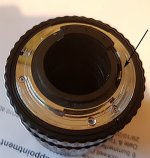
Different makes will probably vary, but the arrow is pointing to a ,ever that is moved by the camera on auto extension tubes. This lever operates the aperture so, if you buy manual tunes then they won't have this lever and the lens will be at either max or min aperture unless the aperture can be set on the lens, which most can't.

Petrochemist
Suspended / Banned
- Messages
- 1,352
- Name
- Mike
- Edit My Images
- Yes
I'd suggest the DCR150 rather than the 250, it's less powerful so is easier to useIt depends on how much extra magnification you want. Assuming your 100mm lens focusses down to 1:1 then 50mm of tubes will give you 1.5:1. More than 50mm and you could run into mechanical and electrical problems. After that you'll need to look at add-on close-up lenses but you'll need quite a high dioptre to get useful magnification with a 100mm lens. The Raynox DCR-250 is very popular but not easy to use. It's one of those areas where you need to experiment to see what suits you best.

The 150 is +4.8 diopter, while the 250 is +8.
Have a look at http://www.extreme-macro.co.uk/ (my favourite resource for macro) using the calculator on the close-up lenses section I see adding a +1 diopter auxillary to your 100mm macro takes the maximum magnification from 1x to 1.2x (a +2 reaches 1.4x, a +4.8 reaches 1.96x & a +8 reaches 2.6x)
You can also use a reverse photography lens as a 'close-up filter' or combine multiple techniques...