Suvv
Suspended / Banned
- Messages
- 2,955
- Name
- Kev
- Edit My Images
- No
This post is meant for beginners and gives an alternative to the Exposure Triangle.
Experienced photographers, especially those who grew up using film, no longer need to think about how to set or change exposure and more recent photographers have probably understood and accepted the Exposure Triangle aide-memoir so neither need what follows.
However I have found that some beginners prefer how I explain it.
I do not want this post to become a discussion about what exposure is and what controls it, there is another thread on that already https://www.talkphotography.co.uk/threads/iso-not-part-of-exposure-triangle-ap.673002/ so if you want to get technical when agreeing or disagreeing about what I say please use that thread. Many beginner threads start off basic and then slowly evolve into complex issues which normally put beginners off.
In my view, coming from film, exposure is determined by the aperture and the shutter settings. Those 2 determine the exposure of the sensor to light. The ISO setting is amplification applied after the actual exposure but, obviously, it is set at the same time as the aperture and shutter so can be considered part of the triangle. However I find some beginners get a bit confused by the triangle and find it hard to visualise what is happening when something changes.
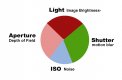
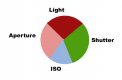
My answer is to say that if you consider ISO, which comes after the exposure, as part of the exposure procedure you can also consider the light, which comes before the exposure, as part of the exposure procedure. This means that you need a 4 sided triangle! or, as I prefer, a circle. Simply seperate the circle into 4 segments, 1 each for light, aperture, shutter and ISO.
This has 2 advantages.
The first is that it makes it easy to visualise what happens as 1 of the segments get larger or smaller, obviously 1,2 or all of the other segments must change.
The second, and to me the more important, is that it introduces light into the procedure as something that can be changed. Not just by using a flash but also by any other light source, reflectors, shades, moving subjects into direct sunlight or shade, waiting for the sun to go behind a cloud etc.
Just my thoughts which may help some people.
Experienced photographers, especially those who grew up using film, no longer need to think about how to set or change exposure and more recent photographers have probably understood and accepted the Exposure Triangle aide-memoir so neither need what follows.
However I have found that some beginners prefer how I explain it.
I do not want this post to become a discussion about what exposure is and what controls it, there is another thread on that already https://www.talkphotography.co.uk/threads/iso-not-part-of-exposure-triangle-ap.673002/ so if you want to get technical when agreeing or disagreeing about what I say please use that thread. Many beginner threads start off basic and then slowly evolve into complex issues which normally put beginners off.
In my view, coming from film, exposure is determined by the aperture and the shutter settings. Those 2 determine the exposure of the sensor to light. The ISO setting is amplification applied after the actual exposure but, obviously, it is set at the same time as the aperture and shutter so can be considered part of the triangle. However I find some beginners get a bit confused by the triangle and find it hard to visualise what is happening when something changes.
My answer is to say that if you consider ISO, which comes after the exposure, as part of the exposure procedure you can also consider the light, which comes before the exposure, as part of the exposure procedure. This means that you need a 4 sided triangle! or, as I prefer, a circle. Simply seperate the circle into 4 segments, 1 each for light, aperture, shutter and ISO.
This has 2 advantages.
The first is that it makes it easy to visualise what happens as 1 of the segments get larger or smaller, obviously 1,2 or all of the other segments must change.
The second, and to me the more important, is that it introduces light into the procedure as something that can be changed. Not just by using a flash but also by any other light source, reflectors, shades, moving subjects into direct sunlight or shade, waiting for the sun to go behind a cloud etc.
Just my thoughts which may help some people.
Last edited: