Exposure calculator

Barney

Suspended / Banned
Messages
3,043
Name
Wayne
Edit My Images
No
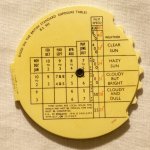
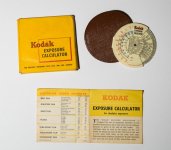
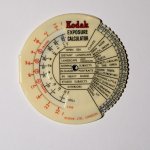
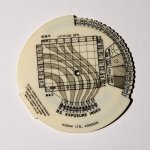
I found this in an old camera bag, has anyone ever seen one of these before and would it still be relevant for manual calculations without lightmeter?

Took me a bit of time to figure out as the stops were hard to find, (very small Print)

I also found interesting the printed note "Based on the British standard exposure tables"

Never heard of that before.

Side 1
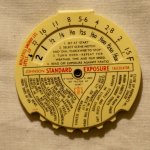
Exposure calculator.jpg

Side 2

Exposure calculator-2.jpg
 
Probably and yes, I that order. My caveat; it may date from before the great film speed updating if the early 60s. Johnson's were a well known photographic chemical and equipment maker who became Brent Cross shopping centre.
 
I never had one of these but have seen them before, and in the absence of a meter I'd be happy to use it, modern film latitude being what it is. Nice find, probably worth a few bomb to a collector too.
 
Probably and yes, I that order. My caveat; it may date from before the great film speed updating if the early 60s. Johnson's were a well known photographic chemical and equipment maker who became Brent Cross shopping centre.

It could well do Stephen, BS 935 was first issued in 1941 and then withdrawn in 1948.
 
It could well do Stephen, BS 935 was first issued in 1941 and then withdrawn in 1948.
The mention of DST (Double Summer Time) also suggests date between 1941 and 1945. (according to Google and Wikipedia)
 
The mention of DST (Double Summer Time) also suggests date between 1941 and 1945. (according to Google and Wikipedia)

Flipping heck Dave, well spotted, I have never even heard of double summer time!
 
The mention of DST (Double Summer Time) also suggests date between 1941 and 1945. (according to Google and Wikipedia)
I thought that couldn't be right, as I remembered Double Summer Time (and I'm not in my 90s yet, quite)... turns out, I was wrong, I was remembering the British Standard Time experiment from 1968-71, when we were on GMT+1 for the whole year. I do remember sitting in the office in Reading Bridge House one winter morning, and watching the reflection of a lovely sunrise in the windows of a building across the river. But I digress, sorry!
 
 
some interesting reading there Stephen, I would not mind one of the 1890's versions
 
How the flipping heck did they work all that out, amazing!

Just note down all the variables and tabulate. When I started I used exposure tables. All I needed to know was the date, the time and my latitude, and then I could go to the correct place to look up the exposure based on my estimate of the lighting conditions. From memory, the tables assumed a specific shutter and film speed, although they may have been combined in a 1/ASA fashion, and probably a specific aperture. It might sound a lot of work, and very laborious, but then again, it was. The real photographers just estimated and got it right based on experience.
 
Pretty much all "serious" photographers used them, back in the day. I vaguely remember ones printed on cardboard, pre-dating plastic.
I also remember "extinction" (I think) exposure meters, look through them and twiddle a knob until the apparent brightness of 2 separate images were about the same, but my memory is vague because, when I tried one, it didn't work for me.

Exposure calculators did work pretty well, and the reason we used them is because that's all we had. I bought my first actual exposure meter, the original Weston Master, second-hand in about 1963. It was a big purchase for me, £4 at a time when I earned £5 a week as a trainee photographer. I was lucky, at the time I worked for a very large photography business in New Bond Street London that also had large retail shops, they had a second-hand shop and staff were allowed to buy at discount rates, and also to look through stuff before it was put on sale.
 
My enlarging exposure meter is a Corfield Lumimeter, which is an extinction meter. I bought a spare from WYC on their final sell out weekend.
 
ICL Dataskill.
I also worked for ICL Dataskill on contract to the Ministry of Technology at The CADCentre in Cambridge. I joined in 1979.

When I was at school and at university I absolutely relied on my Ilford exposure calculators and it wasn't until I got a job that I bought my first proper light meter, a Weston Master IV, second hand from Dixon's. My dad had a Weston Master II but was reluctant to let me loose with it. I still have both meters which work but I couldn't tell you how accurate they are given their age.
 
My enlarging exposure meter is a Corfield Lumimeter, which is an extinction meter. I bought a spare from WYC on their final sell out weekend.
Thanks for that, I didn't know that extinction meters could be used in the darkroom. I always relied on tiny bits of bromide paper for tests, the people I worked with who spent every working day in the darkroom just used their experience, and never got it wrong:) Is my memory correct? How does it work?
I also worked for ICL Dataskill on contract to the Ministry of Technology at The CADCentre in Cambridge. I joined in 1979.

When I was at school and at university I absolutely relied on my Ilford exposure calculators and it wasn't until I got a job that I bought my first proper light meter, a Weston Master IV, second hand from Dixon's. My dad had a Weston Master II but was reluctant to let me loose with it. I still have both meters which work but I couldn't tell you how accurate they are given their age.
Over the years I ended up with all of the Weston models, each new model was more sensitive than the last, the original Weston Master was pretty hopeless and needed a fairly high level of light. I don't know how accurate they were on an objective level, but they were certainly good enough for tranny film.
 
the reason we used them is because that's all we had.


Thank the pantheon times have changed!

The things themselves look interesting and I could probably lose hours figuring one out (with the manual!) but not sure it would be that practical (in comparison to the [now] available alternatives).
 
The things themselves look interesting and I could probably lose hours figuring one out...
Actually, they're easy to use.

I carried a Kodak version in my pocket for years. Batteries fail but there's nothing to go wrong with a couple of pieces of plastic and a pivot rivet! ;)
 
My enlarging exposure meter is a Corfield Lumimeter, which is an extinction meter. I bought a spare from WYC on their final sell out weekend.
I tried one of those many moons ago and then changed to the Melico system, which had a little magic eye, that was the same technology as the sound level indicator on tape recorders of the 1960s.
 
Thanks for that, I didn't know that extinction meters could be used in the darkroom. I always relied on tiny bits of bromide paper for tests, the people I worked with who spent every working day in the darkroom just used their experience, and never got it wrong:) Is my memory correct? How does it work?

There's a bulb in it to provide a light source, and a dial to turn until the spot on the screen disappears. Then you note the reading. That's the short story. In practice, first establish the correct exposure (test strip) to calibrate the meter. It also has scales to let you measure shadow and highlight to determine the paper grade.

Kenneth Corfield was the Corfield of Periflex fame, was the boss at STC when I worked there (only discovered that years after I left), and also ensured the continence of Gandolfi after the last brother retired. As the Variant was post the brothers, I also have a very semi Corfield camera :) .
 
I tried one of those many moons ago and then changed to the Melico system, which had a little magic eye, that was the same technology as the sound level indicator on tape recorders of the 1960s.

And also on the wireless we had when I was growing up. Very useful to get the tuning spot on.
 
Back
Top