So I chose the electronic shutter and in "High Frame rate" it was slower than the mechanical shutter.
So then I chose "Super High Frame Rate" and the camera auto adjusted to Electric shutter and machined gunned off 42 images in a few seconds !!
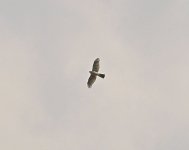
They saved as JPegs, so I assume they won't save in RAW as that's what it's set for. This is a heavy crop from the middle of the 42 shots (50% ish)
View attachment 359608
Couple of things, if you judged the speed by the sound the camera makes, the sound you hear with the electronic shutter just makes a shutter noise, fast of slow, but does not always make a sound for every exposure, where as the sound you hear on mechanical shutter obviously makes the sound on every exposure, the electronic is (or should be) faster than the mechanical.
On the super high burst speed, the picture is low resolution, only 2272 pixels wide (height depends on your chosen aspect ratio, and the width would be less if you choose 1:1)
You would not be likely to see any rolling shutter effect on your photo as the bird only took up a small part in the frame.
A very rough explanation.
Your photo had around 1700 rows of pixels.
The camera reads those rows one at a time (say it starts at the top)
If it took 1/10 second to read all the rows, and the bird billed the whole frame, the bird would have moved forward for 1/10 second between the time the camera recorded the top wingtip to the time it recorded the bottom wingtip. On a bird you probably wouldn't notice, but had that been a flying vertical lamp post, it would appear slanting on the photo.
However, assuming your bird (or the flying lamp post) only filled 1/10 the frame, it would only have moved forward for 1/100 of a second in the time the camera took to record that part of the image, so the effect would be far less.
All the figures are imaginary to try and make the explanation simpler.
The 4k with preburst is useful as well, especially if you want to catch the start/takeoff of something, but again the resolution is lower.