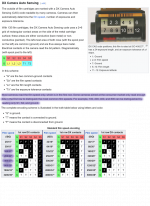
Your answer is right in the above Wikipedia article.

The common film speeds of 100, 200, 400 and 800 can all be determined just by using the first 3 pins in the DX spec, namely ground, S1 and S2. The remaining pins in the first row (S3-S5) are only needed for speeds outside that range. This only becomes a problem if another film speed uses any of S3-S5. For instance, as ISO 50 uses the same S1 and S2 pattern as 800, but is differentiated by the S3 contact, so that means that any camera with only the pins for ground, S1 and S2 will automatically read it as ISO 800 whether the rest of the pattern differentiates it as ISO 50 or 800 (or ISO 64, 80, 1000 and 1250). Somewhat cleverly though, when you have S1, S2 and S3, but lack S4 or S5, the ISO ranges are all within a 1/3-2/3rd of a stop of the actual speed and therefore very little difference is likely to result because of latitude. ISO 100,125 and 160 all use the same S1-S3 pattern and are only differentiated by the S4 and S5.
Very few cameras actually even sense the second row of encoded information for film length and latitude, even very high-end ones would only look at the film length at most. Looking at pictures of various pro level cameras, only the Minolta Dynax 9 seems to have the full set of pins for the second row.
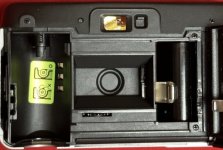
After I wrote the above and did the below picture, I realised that it doesn't actually apply to your camera, which looks unusual as the positioning of the pins suggests to me that it reads S3, S4 and S5 or S2, S3 and S4? (if you could post a picture of a film roll lined up with the camera it would be easier to tell). From either of those combinations you can get a good range of speeds. In the case of having S2, S3 and S4, that means that 100 and 200 would read the same, as would 400 and 800 and various other combinations such as 500 and 1000, 160 and 320 etc. Note that these are all doubles and therefore there will be at the most only a 1 stop under/exposure. I did find a picture of the specs in the manual at
View: https://www.flickr.com/photos/nefotografas/33390714952
and noted that it only lists the ISO range as between 100 and 400 and specifically recommends against slide film. To me that implies that it probably has a simple set of rules programmed where combinations it reads will always be interpreted as one of a set of speeds, like being "high", "medium" or "low" or something. Negative film has excellent latitude anyway, so most people would probably not notice any difference in the overall end picture. I don't quite understand though why they didn't just go with a much simpler scheme using only S1, S2 and S3 or even just S1 and S2!
This is a similar idea to how film speed was encoded on 110 film cartridges, which used the presence or not of a tab on the cartridge to set the camera to meter at either "low" or "high", with the idea being that the exposure latitude would be enough to compensate for other speeds in between or outside. Low and high were unfortunately not exactly defined and each camera manufacturer made their own decision - my Pentax Auto 110 uses 80 and 400 for instance. As 99% of 110 cameras didn't take advantage of reading this tab though, it did mean that ISO 200 film was at a decided disadvantage if you were using a higher end camera like a Pentax Auto 110 SLR. Fuji Susperia 200 was the last 110 film made until Lomography revived it, but unfortunately Fuji chose to encode it as high speed rather than low, which led to underexposure and really didn't help with the grain from such a small negative in the first place. You could however alter the cartridge to read as low by simply filing the tab off!