Dust... How do people see how dusty their sensor is?

  • Thread starter Thread starter A_S
  • Start date Start date

A_S

Suspended / Banned
Messages
864
Name
Andrew
Edit My Images
Yes
Silly question i know. Point the camera at the sky, set a small aperture and a long exposure (but not long enough to blow the highlights) and look at the image.....

Simples....

I have dust on my sensor for sure as one spot appears in every image at smaller apertures and especially when I pan....

Was a bit shocked to get this at F10 over the weekend (i know, i know, its not a perfect photo!)

5G4A3801.jpg


... So after terrible experiences with my 20D, 20 years ago I've always avoided trying to clean my own sensor, especially with a blower.... but....i did what I've always avoided on the basis that it was that or nothing and I'd be taking a trip to WEX to have it cleaned anyway if it didn't work.... And... tonight..... I did this on site at the weekend and didnt do a "before and after" unfortunatly. Didn't think to at the time.....

I can't see any dust. I've done this a few times before in the last few months and each time I can't see any noise... setting in lightroom "rest" to factory so all sliders at zero.. no noise or any other adjustment sliders

8 seconds

5G4A4572.jpg

0.6seconds
5G4A4571.jpg


sorry left the watermark in oops

Anyway here is one I did to check my sanity about finding dust. This is my 20D sensor, ouch


IMG_8770.jpg
 
Last edited:
I use a pinhole lens.

Always cleaned my own, never had any problems.

Talked my then 13 year old daughter through doing her Canon 2000 from 7000 miles away.

Would never use a blower on a mirrorless camera, it defies logic!
 
Would never use a blower on a mirrorless camera, it defies logic!

Seems perfectly logical (and effective) to me.

My blower routine is to hold the camera with the opening facing slightly downward, use blower vigorously for half a minute, take the cap off the lens to be fitted and give the mount area a few hard puffs before quickly fitting the lens. I'm also careful when changing lenses in the field. So far my sensor has needed just 2 wet cleans in 4 years, which is better than the D610 I had before that needed doing every few months.
 
Last edited:
I use a pinhole lens.

Always cleaned my own, never had any problems.

Talked my then 13 year old daughter through doing her Canon 2000 from 7000 miles away.

Would never use a blower on a mirrorless camera, it defies logic!
Why does it defy logic?
 
Where does the dust go?
The same place as it went with a DSLR, except there are probably fewer places in a mirrorless for the dust to get trapped before it falls out of the camera. Assuming you are following the standard "using a blower advice" to hold the camera upside down while using it.

And some might end up in in the trap that it's meant to go into when the sensor is vibrated at shut down or start up to dislodge sensor dust.
 
Last edited:
The same place as it went with a DSLR, except there are probably fewer places in a mirrorless for the dust to get trapped before it falls out of the camera. Assuming you are following the standard "using a blower advice" to hold upside down while using it.

And some might end up in in the trap that it's meant to go into when the sensor is vibrated at shut down or start up to dislodge sensor dust.
Almost.
On the ones I have stripped, the components in the mirrorless are more compact and closer together.

Just above the sensor assembly is the shutter is the shutter and before the dust falls, it is blown sideways, and sideways is the shutter.
I have not seen a dSLR with a stuck or sticking shutter, but have seen a couple of mirrorless, and also found a lot of dust in some when converting to IR.

Even if it does not cause a shutter to stick, there is a chance that it will shake off the shutter back onto the sensor.

Some people think it logical to blow the dust out of the shuttle area of a sewing machine with a compressed air line too :)

Also, many of the dust shakers are behind the filter you see the dust on in front of the sensor
 
Almost.
On the ones I have stripped, the components in the mirrorless are more compact and closer together.

Just above the sensor assembly is the shutter is the shutter and before the dust falls, it is blown sideways, and sideways is the shutter.
I have not seen a dSLR with a stuck or sticking shutter, but have seen a couple of mirrorless, and also found a lot of dust in some when converting to IR.

Even if it does not cause a shutter to stick, there is a chance that it will shake off the shutter back onto the sensor.

Some people think it logical to blow the dust out of the shuttle area of a sewing machine with a compressed air line too :)

Also, many of the dust shakers are behind the filter you see the dust on in front of the sensor
So there are two issues, some of the dust can get blown into the shutter mechanism, rather than out of the camera, which

a) may interfere (damage) the shutter mechanism, and,

b) the dust from the shutter mechanism may be redistributed back onto the sensor as the shutter moves.

I had always worked on the assumption that some dust would be left behind, and make its way back onto the sensor, but never thought of as threatening the shutter mechanism.

As the camera manufacturers recommend using blower bushes, I wonder if they have done a proper risk analysis and compared the risks from higher levels of dust overall i.e not using a blower, with the risks of forcing higher levels into the shutter mechanism, while maintaining a lower baseline of dust within the sensor/shutter box.

How do you deal with dust on the sensor?
 
Right as much as I want to discuss the merits of using a blower or bot

What do people think of the situation? It appears I have dust at slow shutter speed pans at f10 but not by pointing at the sky at f32…..
 
My own technique is to take the lens off the camera seldom if ever,

Unlike film, I don't get a new sensor for every image, so I'd rather keep that digital sensor protected at all times. To me, the point of interchangeable lenses for digital cameras is to choose the lens you want on a particular body and leave it there.

We all have different needs and desires, so other people will have other experiences.

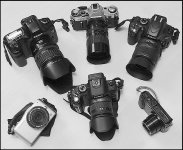
My cameras DSC-R1 07075.jpg
 
Right as much as I want to discuss the merits of using a blower or bot

What do people think of the situation? It appears I have dust at slow shutter speed pans at f10 but not by pointing at the sky at f32…..
I think we got sidetracked by your blower comment, and subsequent post.. The blower brush is the usual recommendation as a starting point to remove dust from the sensor, and it's what most people do before moving on to other methods.

I've never heard of using slow shutter speeds for the sky shot. I just make sure the lens is stopped down and lens is focussed at its closest focusing distance so that any detail in the sky will be totally out of focus.

I also use a solarisation curve (solar curve) to help see dust spots, it is more critical than the dust spot tool in LR.

If you are unfamiliar with this curve, there is a video linked below . It;'s for Photoshop rather than lightroom, but it should work the same (I use it in Capture One). You only need to watch the beginning of the video to get the idea.

View: https://www.youtube.com/watch?v=uAhMSzgI3YM
 
I think we got sidetracked by your blower comment, and subsequent post.. The blower brush is the usual recommendation as a starting point to remove dust from the sensor, and it's what most people do before moving on to other methods.

I've never heard of using slow shutter speeds for the sky shot. I just make sure the lens is stopped down and lens is focussed at its closest focusing distance so that any detail in the sky will be totally out of focus.

I also use a solarisation curve (solar curve) to help see dust spots, it is more critical than the dust spot tool in LR.

If you are unfamiliar with this curve, there is a video linked below . It;'s for Photoshop rather than lightroom, but it should work the same (I use it in Capture One). You only need to watch the beginning of the video to get the idea.

View: https://www.youtube.com/watch?v=uAhMSzgI3YM

Thanks I will have a look

Might be worth me trying again good shout on the closest focusing distance as I focused at infinity on my test shots

I still find it strange that I have dust at f10 but not on my sky shots though…! And those f10 shots were not shot at close focusing distances
 
Thanks I will have a look

Might be worth me trying again good shout on the closest focusing distance as I focused at infinity on my test shots

I still find it strange that I have dust at f10 but not on my sky shots though…! And those f10 shots were not shot at close focusing distances
I use one of these to directly inspect the sensor, but there are lots of makes available. This is just the one that came with a kit I bought from a specialist sensor cleaning company (which included a blower brush)

 
Out of the camera especially if you have the opening pointing down.
I’ve cleaned a film slr camera recently with a blower and little particles of foam found their way into the focusing screen. It made it worse than it was.
I know it sounds irrelevant.
But it kind of proves that dust can go anywhere.
I think a better tool for that job is a sensor brush.
 
I generally notice the occasional spot if I'm using a super telephoto and have an area of consistent colour. Usually I follow the process of using the sensor cleaning function on the camera which basically vibrates the sensor to shake dust, if that fails, I use a blower and the final option is a wet clean.
 
I use a pinhole lens.

Always cleaned my own, never had any problems.

Talked my then 13 year old daughter through doing her Canon 2000 from 7000 miles away.

Would never use a blower on a mirrorless camera, it defies logic!
Same here. They are typically about f/150 so show up dirt really well. Put it on manual with a long exposure. Wave it about pointed out of a window so anything but dust gets motion blur. The dust will be in the opposite position on the sensor to on the picture on the back of the camera.
 
  • Like
Reactions: A_S
I take a picture of a white door at minimum aperture (f16?) with a shutter speed into the seconds and with the lens focussed at infinity and I move the camera about while the shutter is open. This should all avoid any detail on the door being recorded and mistaken for contamination.

I think it's not worth worrying about contamination which doesn't show. For example if the contamination only shows at f16 and you rarely go past f11 then why worry?
 
Where does the dust go?

Some cameras used to have sticky tape inside but I don't know if this still happens. Dust could also conceivably go out of the lens mount. A rocket does give quite a blast so this could be entirely possible.
 
Some cameras used to have sticky tape inside but I don't know if this still happens. Dust could also conceivably go out of the lens mount. A rocket does give quite a blast so this could be entirely possible.


Yes, some will go out the lens mount.

Create a picture of the airflow from the rocket, it travels towards the sensor/filter, then turns 90 deg and travels along the surface of the "sensor".
It gets to the side, then turns 90deg to travel out the lens mount. But on that last turn, some of the the dust being heavier than the air doesn't make the turn, continues straight, into the shutter.

Bit simplistic, but I think you will see the idea.

This is the principle that Donaldson airfilters have worked on since the 60s, and more recently Dyson vacuum cleaners, the dust being thrown out by cyclonic/centrifugal action.

The sticky pad on some makes is between the filter and the actual sensor, and the dust dislodged by the shaker (ultrasonic or not) and worked well to stop it getting back onto the "sensor"

I'm not saying that a blower must not be used, better than a rusty nail, just that I will not use one :)
 
Hi all, I hope I’m not going to sound completely stupid, on the subject of sensor cleaning, with modern mirrorless cameras having the automatic sensor cleaning where the sensor is vibrated to remove dust I’m struggling to understand how this works.
On my Sony the sensor itself is covered with the glass protective screen which we normally clean with the swabs etc and this seems to be sealed around the edges. Surely if dust is on the actual sensor itself we haven’t got any way of accessing this without completely dismantling the camera so if the in camera sensor vibrations don’t dislodge the particles they are unable to be removed.
I’ve not yet (touch wood) experienced this issue but I always thought it was the protective glass that got the dust particles on and not the sensor itself, thus to me meaning the in camera vibrations of the sensor is not really needed or am I missing something.
I hope this makes sense.
 
It's dust on the cover, not the sensor surface itself. The glass is bonded to the sensor, and both vibrate together.
 
Hi all, I hope I’m not going to sound completely stupid, on the subject of sensor cleaning, with modern mirrorless cameras having the automatic sensor cleaning where the sensor is vibrated to remove dust I’m struggling to understand how this works.
On my Sony the sensor itself is covered with the glass protective screen which we normally clean with the swabs etc and this seems to be sealed around the edges. Surely if dust is on the actual sensor itself we haven’t got any way of accessing this without completely dismantling the camera so if the in camera sensor vibrations don’t dislodge the particles they are unable to be removed.
I’ve not yet (touch wood) experienced this issue but I always thought it was the protective glass that got the dust particles on and not the sensor itself, thus to me meaning the in camera vibrations of the sensor is not really needed or am I missing something.
I hope this makes sense.


On Panasonic G series, you have a thick (+- 3mm) quartz glass IR filter, which is what you see, then you have a much thinner (+- 0.5mm) filter/ dust shaker that has an ultrasonic transducer bonded to it, then you have the sensor. The vibrating one is sealed round the edges to the sensor, so theoretically no dust can get to the front of the sensor.
The sensor itself does not vibrate, no need as no dust can get to it.

If there is somehow some dust that can't be removed, there is the dust mapping feature of the camera, which remembers where the dust is and "hides" it.
Don't know if that operates on RAW or only on JPEG
 
On Panasonic G series, you have a thick (+- 3mm) quartz glass IR filter, which is what you see, then you have a much thinner (+- 0.5mm) filter/ dust shaker that has an ultrasonic transducer bonded to it, then you have the sensor. The vibrating one is sealed round the edges to the sensor, so theoretically no dust can get to the front of the sensor.
The sensor itself does not vibrate, no need as no dust can get to it.

If there is somehow some dust that can't be removed, there is the dust mapping feature of the camera, which remembers where the dust is and "hides" it.
Don't know if that operates on RAW or only on JPEG
Wow I never realised there was so much that went into protecting the sensor itself.
The dust mapping feature sounds interesting, like you say dust really shouldn’t be able to get to the sensor itself anyway.
Many thanks for the info.
 
Back
Top