

You are using an out of date browser. It may not display this or other websites correctly.
You should upgrade or use an alternative browser.
You should upgrade or use an alternative browser.
Double Exposure
- Thread starter Barney
- Start date

jakeriding
Suspended / Banned
- Messages
- 8
- Name
- Jake
- Edit My Images
- No
You deliberately underexpose each frame.... Split the exposure between shots, so if you want two images on one frame you expose each at roughly half the normal exposure. That way the total light hitting the emulsion adds up to about right rather than blowing it out.
It’s also why darker subjects work better than bright skies.
It’s also why darker subjects work better than bright skies.
OP

Barney
Suspended / Banned
- Messages
- 3,043
- Name
- Wayne
- Edit My Images
- No
You deliberately underexpose each frame.... Split the exposure between shots, so if you want two images on one frame you expose each at roughly half the normal exposure. That way the total light hitting the emulsion adds up to about right rather than blowing it out.
It’s also why darker subjects work better than bright skies.
So both images of the subject will be underexposed but the background will be fine?
jakeriding
Suspended / Banned
- Messages
- 8
- Name
- Jake
- Edit My Images
- No
No. It’s the entire frame that’s underexposed each time, not only the subject. When you layer the two exposures, darker tones tend to work nicely together, whereas bright areas like sky or strong highlights can add up and blow out.So both images of the subject will be underexposed but the background will be fine?
OP
Barney
Suspended / Banned
- Messages
- 3,043
- Name
- Wayne
- Edit My Images
- No
So,No. It’s the entire frame that’s underexposed each time, not only the subject. When you layer the two exposures, darker tones tend to work nicely together, whereas bright areas like sky or strong highlights can add up and blow out.
A fixed background will get two half exposures, the Subject that moves within the frame, lets say a boot, into a different position, will only get a half exposure each.
What am I missing?
jakeriding
Suspended / Banned
- Messages
- 8
- Name
- Jake
- Edit My Images
- No
So,
A fixed background will get two half exposures, the Subject that moves within the frame, lets say a boot, into a different position, will only get a half exposure each.
What am I missing?
If a subject moves to a different position, that area of film only gets one half exposure, which is why moving subjects can appear ghosted or lighter. That part you’ve got right. A fixed background will only add up cleanly if it’s dark enough. If it’s bright, even two half exposures landing on the same area of film can still build up and blow out. Darker tones have more headroom, which is why they tend to work better for double exposures.
So movement affects how things overlap visually, but it doesn’t make bright areas automatically safe.
The other factor at play here is the latitude of negative film.
I did some tests a little while back of under and over-exposure of both digital and negative film. This was not gone with any thoughts of double exposure, but I do think it applies.
Let's concentrate on over-exposure. For digital, +2 stops was showing image degradation that was recoverable, but beyond that it was toast. With negative film, +4 stops was easily usable, in fact +6 stops could, at a pinch, be used.
Returning to double exposure, what this means is that you could quadruple expose the same frame (at the normal exposure), or even sextuple expose, and the film could cope. The emulsion is not, to paraphrase the OP "blasted to smithereens".
Now, having said that, if I were doing double exposure on film, I would reduce the exposure value for each exposure, just as Jake says.
I did some tests a little while back of under and over-exposure of both digital and negative film. This was not gone with any thoughts of double exposure, but I do think it applies.
Let's concentrate on over-exposure. For digital, +2 stops was showing image degradation that was recoverable, but beyond that it was toast. With negative film, +4 stops was easily usable, in fact +6 stops could, at a pinch, be used.
Returning to double exposure, what this means is that you could quadruple expose the same frame (at the normal exposure), or even sextuple expose, and the film could cope. The emulsion is not, to paraphrase the OP "blasted to smithereens".
Now, having said that, if I were doing double exposure on film, I would reduce the exposure value for each exposure, just as Jake says.

- Messages
- 5,607
- Name
- Stephen
- Edit My Images
- Yes
I'm not sure what you're asking.
Is it "how can a double exposure give an image because all that light would produce a completely black negative" (it doesn't) or
"how can I make a double exposure for trick photography purposes" and if this, then there are 2 further questions:
Do you mean how do you get the camera to make 2 exposures without winding on (depends on the camera) or how do you arrange the subject matter and things in front of the camera for it to work?
Answering that lot is a lot of work, especially since 3/4 would be irrelevant, and I don't know which 1/4 you want.
Is it "how can a double exposure give an image because all that light would produce a completely black negative" (it doesn't) or
"how can I make a double exposure for trick photography purposes" and if this, then there are 2 further questions:
Do you mean how do you get the camera to make 2 exposures without winding on (depends on the camera) or how do you arrange the subject matter and things in front of the camera for it to work?
Answering that lot is a lot of work, especially since 3/4 would be irrelevant, and I don't know which 1/4 you want.

Clive K
Suspended / Banned
- Messages
- 1,496
- Name
- Clive
- Edit My Images
- No
If a subject moves to a different position, that area of film only gets one half exposure, which is why moving subjects can appear ghosted or lighter. That part you’ve got right. A fixed background will only add up cleanly if it’s dark enough. If it’s bright, even two half exposures landing on the same area of film can still build up and blow out. Darker tones have more headroom, which is why they tend to work better for double exposures.
So movement affects how things overlap visually, but it doesn’t make bright areas automatically safe.
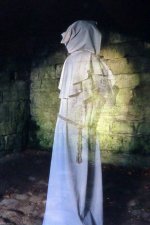
Does this help?
OP
Barney
Suspended / Banned
- Messages
- 3,043
- Name
- Wayne
- Edit My Images
- No
Thats exactly what I do not want.
Nice effect but not looking for that.
I want a solid normal image.
AndrewFlannigan
Suspended / Banned
- Messages
- 11,977
- Edit My Images
- No
Which leads to the other way of making double or even multiply exposed images: start with a black background and then add the various subjects, against the same black background, one at a time.It’s also why darker subjects work better than bright skies.
In the 1960s, my boss acquired a profitable reputation for making performers' composites using this technique and I acquired the ability to make cut out masks for the spotlights very quickly!

OP
Barney
Suspended / Banned
- Messages
- 3,043
- Name
- Wayne
- Edit My Images
- No
does the background get lighter and lighter?Which leads to the other way of making double or even multiply exposed images: start with a black background and then add the various subjects, against the same black background, one at a time.
In the 1960s, my boss acquired a profitable reputation for making performers' composites using this technique and I acquired the ability to make cut out masks for the spotlights very quickly!
AndrewFlannigan
Suspended / Banned
- Messages
- 11,977
- Edit My Images
- No
That's what the masks are there to prevent.does the background get lighter and lighter?
You can even apply this technique to lighter backgrounds but the number and shapes of the masks quickly become unmanageable.
OP
Barney
Suspended / Banned
- Messages
- 3,043
- Name
- Wayne
- Edit My Images
- No
So effectively the film latitude would take care of the overexposed bitsThe other factor at play here is the latitude of negative film.
I did some tests a little while back of under and over-exposure of both digital and negative film. This was not gone with any thoughts of double exposure, but I do think it applies.
Let's concentrate on over-exposure. For digital, +2 stops was showing image degradation that was recoverable, but beyond that it was toast. With negative film, +4 stops was easily usable, in fact +6 stops could, at a pinch, be used.
Returning to double exposure, what this means is that you could quadruple expose the same frame (at the normal exposure), or even sextuple expose, and the film could cope. The emulsion is not, to paraphrase the OP "blasted to smithereens".
Now, having said that, if I were doing double exposure on film, I would reduce the exposure value for each exposure, just as Jake says.
So effectively the film latitude would take care of the overexposed bits
Exactly

sk66
Suspended / Banned
- Messages
- 9,557
- Name
- Steven
- Edit My Images
- Yes
I will simplify with an example,
I want to take a picture of one of my doc martin boots on the ground against a brick wall, I want to move the boot and take another image and everything come out ok on the same neg
Cover 1/2 the field of view with a black card; switch sides for each exposure. The card must be far enough in front to be reasonably in focus and not acting as an aperture mask instead.

OP
Barney
Suspended / Banned
- Messages
- 3,043
- Name
- Wayne
- Edit My Images
- No
It's fiddly (but possible) using film and dead easy with digital.
I had a go with digital and got three which ended up looking ok