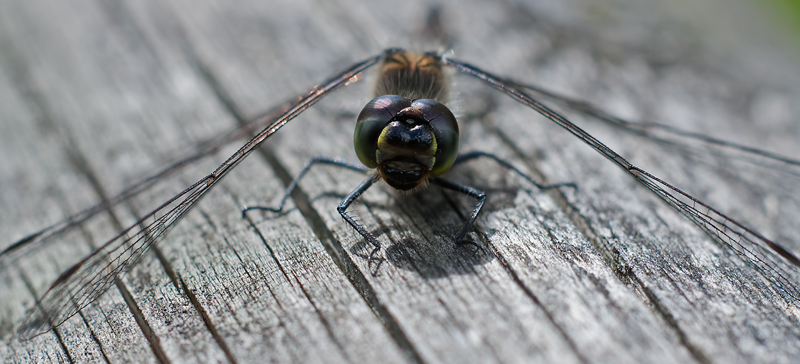
DoF - straight or curved?

If the focal plane is a plane, it would still make a straight line as it passed through the tabletop.

If the DoF is a curve, the DoF doesn't lie on the focal plane in all cases. The Focal Plane is the plane that passes through the focal point, at the focal distance. But a plane is flat, the focal point appears to lie on a curve of "in-focus" points, the Focus Locus, if you like (and I do...being a mathematician. )

Thoughts?
 
It is a product of the lens design, probably to do with the requirements of getting the close focus distances on the macro lens.

I have seen it on other lenses, usually more pronounced at minimum focus distances.

My Zeiss 25/2.8 which has a minimum focus distance of 170mm will do the same if used really close to the subject.
 
It is a product of the lens design, probably to do with the requirements of getting the close focus distances on the macro lens.

I have seen it on other lenses, usually more pronounced at minimum focus distances.

My Zeiss 25/2.8 which has a minimum focus distance of 170mm will do the same if used really close to the subject.

So better lenses, or lenses that don't close-focus in the same way may not distort the DoF?

Makes sense. :)
 
Using a "thick lens" at such short focal lengths will result in no real focal plane. The thin lens rules don't apply here. I like the idea of a focus locus and that's indeed what you will get but it will move as the lens angle changes and the focal point changes. It ought to be parabolic and looks such in the image. Would have to dig out some old optics texts to tell you more.
Cheers
J
 
So better lenses, or lenses that don't close-focus in the same way may not distort the DoF?

Makes sense. :)

The Zeiss 25/2.8 is a "better lens" :D

The engineering design required to achieve such close minimum focus distances is going to have compromises.

If you want a flatter field you would probably have to sacrifice the close focus distance.
 
My Tamron 90 macro has a flat plane of focus at MFD, and it is my understanding that macro lenses are specifically designed this way.

Looking at the OP's pic I would say that the wood that the dragonfly is perched on is curved.

Some lenses have a curved plane of focus and this causes the softness in the corners when the centre of the image is sharp.


Fly by jomike, on Flickr
 
...
Looking at the OP's pic I would say that the wood that the dragonfly is perched on is curved.

Mostly this. :thumbs:

Because the wood is curved down either side, The focal plane appears as a curve, but only because the distance of the curing wood is increasing away from the focused distance, like equally either side making that curved look.
 
Pfft! It's not a locus, it's a dragonfly! :coat:

Ha ha...yes, get your coat! :D


Mostly this. :thumbs:

Because the wood is curved down either side, The focal plane appears as a curve, but only because the distance of the curing wood is increasing away from the focused distance, like equally either side making that curved look.

No, it isn't though. It's a rectangular section handrail on a boardwalk over marshland in a nature reserve in wales. All the rails are the same, and I have clear photos of it showing it is flat.

On a small scale, it may have a curve, but not this much.

I think it is field curvature, as you can also see the focus locus following the forward wings. The curvature is not only showing in the wood, but in the fly too.
 
Well ok if your sure, it was just the shape of the curve is off centre to the camera so i figure it cant be a curved plane because that would be centralized on the centre focus point type thing.

I can see your point about the wings especially the right hand side, it does follow the curve ... but then where exactly is the wing, forward or back.

I dunno then... good game though. ;)
 
Well ok if your sure, it was just the shape of the curve is off centre to the camera so i figure it cant be a curved plane because that would be centralized on the centre focus point type thing.

I can see your point about the wings especially the right hand side, it does follow the curve ... but then where exactly is the wing, forward or back.

I dunno then... good game though. ;)

The image is a crop, so the shape of the curve may not be indicative...it may be off-axis.

the wings on a dragonfly lay forward from behind the head. So they follow the curve, or appear to.

I like the debate/conversation...it's fun. :)
 
Hmm ok thanks, so, bare with me, :D ...I can see this means all of both wings cross right through the DoF range, as we can see only the back veins of the wings are still in focus, and the front of the wings are oof in the foreground, so, imaging the insect from above, the wings position now seems correct and nearer to being flatly in-line with the Dof we see at the head? do you think? I think they aid my argument that the focused plane is flat, or at the least no way near as bent as the effect we discussing on the wooden hand rails.

I also think that if it where a curved plane the parabolic type curve would be symmetrical in its arc, which it isnt, more a a hand drawn curve type look to it. Im guessing there's a bit of camera tilt to the right as the fly was on the edge of the rail, that tilt and the rail disappearing off down to the right hand side has combined to give the curved effect to the flat hand rail.

Possibly. :D
 
Last edited:
Don't suppose you have the uncropped version we can see then?
 
Interesting. But it's just field curvature I think, a characteristic of that particular old lens, made before aspherical element surfaces came along.

I can't get my modern lenses to show that effect, but I have a Lensbaby with very basic optics, that I know has strong field curvature, and shooting a sheet of graph paper from a similar angle, it replicates the OP's image almost exactly.

Edit: since the OP's a mathematician... as far as the lens aperture is concerned, in theory DoF changes from centre to edge. On axis, the lens aperture is perfectly circular, but off-axis it's an elipse with a long and a short dimension. Therefore, DoF is different in vertical and horizontal planes. I've never really looked into this, simply for academic interest, and it would only apply to wide-angles where the change in shape is significant so not an issue here. But interesting :)
 
Last edited:
Interesting. But it's just field curvature I think, a characteristic of that particular old lens, made before aspherical element surfaces came along.

I can't get my modern lenses to show that effect, but I have a Lensbaby with very basic optics, that I know has strong field curvature, and shooting a sheet of graph paper from a similar angle, it replicates the OP's image almost exactly.

Edit: since the OP's a mathematician... as far as the lens aperture is concerned, in theory DoF changes from centre to edge. On axis, the lens aperture is perfectly circular, but off-axis it's an elipse with a long and a short dimension. Therefore, DoF is different in vertical and horizontal planes. I've never really looked into this, simply for academic interest, and it would only apply to wide-angles where the change in shape is significant so not an issue here. But interesting :)

Yeah, people pay good money to duplicate these effects! ha ha! :)
 
HoppyUK said:
Interesting. But it's just field curvature I think, a characteristic of that particular old lens, made before aspherical element surfaces came along.

I can't get my modern lenses to show that effect, but I have a Lensbaby with very basic optics, that I know has strong field curvature, and shooting a sheet of graph paper from a similar angle, it replicates the OP's image almost exactly.

Edit: since the OP's a mathematician... as far as the lens aperture is concerned, in theory DoF changes from centre to edge. On axis, the lens aperture is perfectly circular, but off-axis it's an elipse with a long and a short dimension. Therefore, DoF is different in vertical and horizontal planes. I've never really looked into this, simply for academic interest, and it would only apply to wide-angles where the change in shape is significant so not an issue here. But interesting :)

That was kind of my point but this is explained better!

J
 
Back
Top