Do I Need A Filter As A Beginner

Messages
760
Name
Jon
Edit My Images
Yes
Hi all,

New (ish) to photography. Not shot for over 10 years and pretty much forgotten everything. I am now getting back into it and I am committed now that I have the time.

I recently purchased a Sony A6700 & Tamron 17-70mm f2.8. Purchased a couple of weeks ago.

Today I bought myself a Sony FE 50mm f1.4 GM. As per the title, because I’m a beginner would it be advisable for me to get an ND filter at the moment? I’m thinking yes but ONLY because I want to protect the GM lens to be honest. I’m not far enough along to know how to actually use one. I am very carful with my gadgets so do I even need to bother?

Any help or advice appreciated. Many thanks.
 
Hi Jon,

I think a neutral density filter would be completely unsuitable for lens protection, the idea of that filter is to reduce the light being transmitted. If you want to get a filter to protect the lens you would use an UV (ultraviolet) filter. In the good old days a Skylight filter would do the same job.

Keeping the filter clean is very important as the extra glass does degrade the image to a small extent.
 
I've never seen a clear filter degrade IQ to any extent that I could see it but it is possible that they could cause a reduction in IQ or more flare or reflections. Personally I think being careful is the answer in a lot of cases but if worried about physical damage to the front of the lens maybe consider using a hood?

I suppose one place a clear filter might be an idea regardless of any flare, reflections or reduction in IQ they could cause is when something could splash onto the lens. Maybe at the beach or at a gig when beer or something even nastier might fly your way.

Good luck with the new kit.

PS.
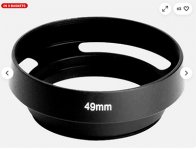
I'm mostly a prime user and I sometimes use hoods like these cheap metal ones...

1-Untitled-1.jpg
 
Last edited:
Thanks for the replies. I agree with the hood and just being careful (I am very picky with my gear. I look after everything). The lens comes with a hood and a bag so this is probably the way forward as to not reduce the IQ. Especially for a beginner.
 
Thanks for the replies. I agree with the hood and just being careful (I am very picky with my gear. I look after everything). The lens comes with a hood and a bag so this is probably the way forward as to not reduce the IQ. Especially for a beginner.

A lot of people do like hoods but one thing to remember is if you want any flare in your pictures, and you might want it in some, remember to remove the hood.
 
Standard UV filters are often made with fairly thin and fragile glass (compared to the front element of a lens).
Some manufacturers do make specific 'protection' filters, with stronger glass and multi coatings to minimise risk of flare and protect against scratches/abrasion.
In practice, a lens hood will often provide better physical protection against impacts, where a protection filter can be beneficial is if you are shooting in conditions with salt spray, flying mud, dust, etc - where you will be wanting to frequently wipe the lens clean - where it becomes the coatings on the filter that get abraded rather than those of the front element (and where the potential loss of IQ due to the filter is negligible when compared to the loss due to conditions)
 
Standard UV filters are often made with fairly thin and fragile glass (compared to the front element of a lens).
Some manufacturers do make specific 'protection' filters, with stronger glass and multi coatings to minimise risk of flare and protect against scratches/abrasion.
In practice, a lens hood will often provide better physical protection against impacts, where a protection filter can be beneficial is if you are shooting in conditions with salt spray, flying mud, dust, etc - where you will be wanting to frequently wipe the lens clean - where it becomes the coatings on the filter that get abraded rather than those of the front element (and where the potential loss of IQ due to the filter is negligible when compared to the loss due to conditions)
Now I’m thinking I should get one. Just in case :)
 
Now I’m thinking I should get one. Just in case :)

If you do get one... Have a look at your lenses and get a filter to fit the largest filter thread diameter lens you have (the filter thread diameter should be written on the front of the lens) and buy step up rings for the other lenses. The reason for this is decent filters are more expensive than step up rings.

For example if you have 67 and 49mm lenses buy a 67mm filter and a 49-67mm step up ring.
 
Last edited:
There us considerable debate about the effectiveness of filters for impact protection. Filters will usually break under minor impacts that the lens itself would not notice and the hard shards produced can scratch your lens.

I've had a lens bashed hard enough in a motorway accident (the camera was loose on the floor at my feet) to completely ruin the zoom/focus mechanisms yet with no apparent damage to the lens elements.
 
I would only use a filter if I need the effect it brings or I'm photographing in a hostile environment. Otherwise no filter.
 
ND filter is far from needed, Very useful to slow down the shutter speed to add blur to an image, such as waterfalls etc, the only filter I use 100% of the time is a polarising filter, not only does it protect the front lens element,it removes reflections and deepens colours.
 
ND filter is far from needed, Very useful to slow down the shutter speed to add blur to an image, such as waterfalls etc, the only filter I use 100% of the time is a polarising filter, not only does it protect the front lens element,it removes reflections and deepens colours.
Well, we're all different and have different photographic interests. I use a polariser when it's needed, which is rare for my type of photography. The simple fact of the matter, which some people don't seem to get, is that the polariser is the ONLY filter that's actually needed for digital photography, although 10x stop or similar ND filters can be needed for very long exposures. All other filter effects can be created better, and with far more control, in PP. That, for some reason, is an obvious fact that the people who sell filters forget to mention in their marketing blurb:(
 
Well, we're all different and have different photographic interests. I use a polariser when it's needed, which is rare for my type of photography. The simple fact of the matter, which some people don't seem to get, is that the polariser is the ONLY filter that's actually needed for digital photography, although 10x stop or similar ND filters can be needed for very long exposures. All other filter effects can be created better, and with far more control, in PP. That, for some reason, is an obvious fact that the people who sell filters forget to mention in their marketing blurb:(
Polarisers are NOT the only filters that can't be replicated in software. Though the exceptions are rather niche - I use infra red filters quite a bit (usually with modified cameras, but also with older cameras that are more IR sensitive). Then there are specialist narrow band filters such as Nebula filters, & light pollution filters used in astro photography. Even with more regular filters there is the Neodymium/red enhancer, which blocks Sodium D wavelengths far more than most other wavelengths which can allow information to be captured that would have been drowned by the sodium light. The most common use for these is with autumn foliage, but it's even more critical for subjects like glass blowing.

Polarisers are my favorites of the normal filters when shooting visual light, where I use them to increase reflections in water or glass and allow stresses in plastics as well as the more typical uses.

However I wouldn't thick any of those cases would be applicable to a beginner. Polarisers are great but they need to be adjusted & beginners have enough other variable to get used to.
 
However I wouldn't thick any of those cases would be applicable to a beginner. Polarisers are great but they need to be adjusted & beginners have enough other variable to get used to.

This. As much as I appreciate people taking their valuable time to reply to my query, I have absolutely no idea about much of what’s being said. From what I can gather, knowing the purpose of filters (which I don’t at this point in my journey) warrants using them.

I was only thinking about protecting my lens for now. But, as I am very careful with my gear, I don’t believe a filter will benefit me. When I have some kind of idea about what I’m doing and my knowledge of photography improves then that’s the time to think about filters.

Thank you to everyone who contributed to my query, even if you did cause my brain to explode :)
 
I bought a lens from someone on here that came with a UV filter attached, when I tested the lens the image quality wasn't all that great. Even though it all looked clean I thought I'd give it a clean and it was only when I removed the UV filter and examined it very closely that I noticed a lot of very tiny scratches on the filter. Without the filter the lens was fine and it made me wonder if that was why the lens was sold.
 
I bought a lens from someone on here that came with a UV filter attached, when I tested the lens the image quality wasn't all that great. Even though it all looked clean I thought I'd give it a clean and it was only when I removed the UV filter and examined it very closely that I noticed a lot of very tiny scratches on the filter. Without the filter the lens was fine and it made me wonder if that was why the lens was sold.

You mean you think they sold the lens because they thought the lens was poor or damaged when it fact it was the filter?
 
You mean you think they sold the lens because they thought the lens was poor or damaged when it fact it was the filter?
Yes, the scratches were tiny and not visible when the filter was on the lens
 
Yes, the scratches were tiny and not visible when the filter was on the lens
Which is worth noting - if you do use a filter as protection for the front element, you should regularly remove and inspect it, treating it as a 'consumable' item.
 
Back
Top