

You are using an out of date browser. It may not display this or other websites correctly.
You should upgrade or use an alternative browser.
You should upgrade or use an alternative browser.
Distance V Power
- Thread starter Barney
- Start date

Graham W
Suspended / Banned
- Messages
- 3,252
- Name
- Graham
- Edit My Images
- Yes
Moving the light further away will reduce the amount of light reaching the subject (Inverse square law) but will affect the quality of the light.
Reducing the flash output will maintain the quality...all things being equal.
That's a quick two line answer. If you have a read of the inverse square law (as it relates to photography) it explains it in more detail.
Reducing the flash output will maintain the quality...all things being equal.
That's a quick two line answer. If you have a read of the inverse square law (as it relates to photography) it explains it in more detail.
Last edited:

Garry Edwards
Moderator
- Messages
- 13,475
- Name
- Garry Edwards
- Edit My Images
- No

Gav.
Suspended / Banned
- Messages
- 9,390
- Name
- Gav
- Edit My Images
- No
I was thinking aesthetically as well.
Closer the light / bigger the light source to the subject, the 'better' quality of the light, ie softer shadow egdes.
Farther the light / smaller the light to the subject, the harder/harsher the light, ie crisp well defined shadow edges.
Graham W
Suspended / Banned
- Messages
- 3,252
- Name
- Graham
- Edit My Images
- Yes
Garry Edwards
Moderator
- Messages
- 13,475
- Name
- Garry Edwards
- Edit My Images
- No
Well, it's been there for more than a year, and it replaced an earlier one from years earlier . . .THAT'S what I was looking for!
The reality is that nobody reads my tutorials unless they feature naked women

An excellent summary, if we assume that softer light equates to better light. A bit like Animal Farm, "4 legs good, 2 legs bad" - an easy shorthand but too simplistic by half.Closer the light / bigger the light source to the subject, the 'better' quality of the light, ie softer shadow egdes.
Farther the light / smaller the light to the subject, the harder/harsher the light, ie crisp well defined shadow edges.
Yes, the ISL applies to all forms of radiated energy, not just to light.I understand Light fall off, similar effect to radiant heat from a fire in the woods.
I was thinking aesthetically as well.
And the aesthetics is what it's all about, even my cat can understand the physics, and I haven't got a cat
The ISL is fundamental to photography, but at the risk of upsetting some people (which really worries me
I'd say that many "outdoor" photographers have a very poor understanding of it, indoor photographers need to have a good understanding. The basic reason for this is that if the light source is the sun and it's 93 million miles from the subject, the ISL won't make a practical difference to the exposure or to the amount of fall-off of light over distance if, for example, the subject is standing in one shot and sitting in the next, adding perhaps half a metre to the distance from the light source. Using artificial light, close to the subject, the difference is immense.I think (or hope) that my example subject, a packet of printer paper, illustrates this well enough. Place the light really close and you'll get a massive fall-off of light over distance, place it a long way away, and you won't. Which works for you?
Graham W
Suspended / Banned
- Messages
- 3,252
- Name
- Graham
- Edit My Images
- Yes
So that's where they are!Well, it's been there for more than a year, and it replaced an earlier one from years earlier . . .
The reality is that nobody reads my tutorials unless they feature naked women
When I log on to TP it takes me straight to "Forums"...I don't even look at the header where "Tutorials" live!
Could the three "Lighting" posts be pinned in the "Talk Lighting and Studio" section?

sk66
Suspended / Banned
- Messages
- 9,557
- Name
- Steven
- Edit My Images
- Yes
Distance affects three primary things:
If there is diffusion on the light source, the first effect is wrap. Diffusion doesn't just make the light "bigger"; it breaks the light source into many light sources, converting it from (more of) a single point source. That allows the light to wrap around objects; "see around corners" and fill in shadows; but it must also be relatively larger than the object being illuminated. This results in two common "rules"... closer is "bigger"/"softer" (filled in shadows). And a softbox should be used within 1x it's diameter (to illuminate an area no larger than itself; beyond 2x there is very little benefit from diffusion).
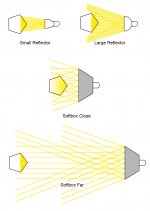
Also, the closer the light source is, the less it is acting like a point source; and the less accurate the inverse square law becomes (but it is still good for understanding/correlation/estimation).
The second effect is falloff. If the light has to travel a long distance to reach the subject, it is also going to continue for a longer distance. And if the light doesn't have to travel very far to reach the subject, it will not travel very far beyond/along it.
And the third effect is specularity; how dense/bright the highlights are. Short distances require less power, so the highlights will be less dense/bright and more color can be seen through them.
These last two effects do not require diffusion and are only due to power/distance... I.e. you could use a hard light source from very close to create hard highlights that are also translucent. And the last two effects trade off; as the highlights become less dense/specular the shadows become more dense more rapidly. So you can't really just move the light source to make it bigger/smaller by changing its' distance.
This series is using a 2x3ft softbox on a bare bulb AD360, starting from 8ft (too far), then 4ft (~ 1x diagonal), 2ft. and 1 ft..
8 ft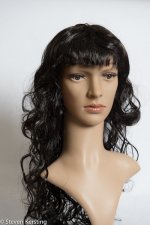
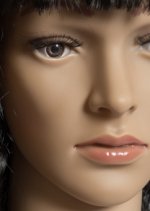
4 ft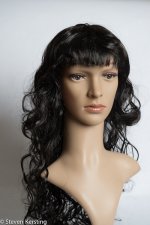
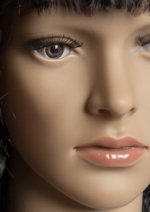
2 ft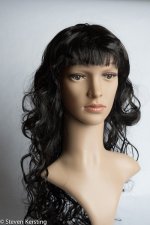
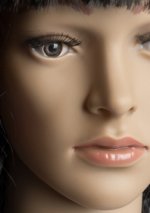
1 ft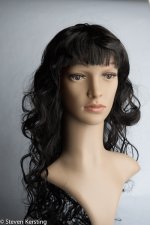
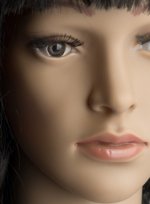
The differences between the images would have been much greater if I had controlled the spill (or if the room wasn't rather small and light).
If there is diffusion on the light source, the first effect is wrap. Diffusion doesn't just make the light "bigger"; it breaks the light source into many light sources, converting it from (more of) a single point source. That allows the light to wrap around objects; "see around corners" and fill in shadows; but it must also be relatively larger than the object being illuminated. This results in two common "rules"... closer is "bigger"/"softer" (filled in shadows). And a softbox should be used within 1x it's diameter (to illuminate an area no larger than itself; beyond 2x there is very little benefit from diffusion).
Also, the closer the light source is, the less it is acting like a point source; and the less accurate the inverse square law becomes (but it is still good for understanding/correlation/estimation).
The second effect is falloff. If the light has to travel a long distance to reach the subject, it is also going to continue for a longer distance. And if the light doesn't have to travel very far to reach the subject, it will not travel very far beyond/along it.
And the third effect is specularity; how dense/bright the highlights are. Short distances require less power, so the highlights will be less dense/bright and more color can be seen through them.
These last two effects do not require diffusion and are only due to power/distance... I.e. you could use a hard light source from very close to create hard highlights that are also translucent. And the last two effects trade off; as the highlights become less dense/specular the shadows become more dense more rapidly. So you can't really just move the light source to make it bigger/smaller by changing its' distance.
This series is using a 2x3ft softbox on a bare bulb AD360, starting from 8ft (too far), then 4ft (~ 1x diagonal), 2ft. and 1 ft..
8 ft
4 ft
2 ft
1 ft
The differences between the images would have been much greater if I had controlled the spill (or if the room wasn't rather small and light).
Last edited:
OP

Barney
Suspended / Banned
- Messages
- 3,043
- Name
- Wayne
- Edit My Images
- No
@sk66
Those differences are very subtle to my untrained eye, it took me a good few looks at the shadows at the side of the nose in the close up, they are definitely smaller and the whole face looks flatter and less "angular", looking at the larger photo then the chin/neck shadows are so much softer in the main shot at image four.
Was the power output adjusted for the different distances or was it auto type situation ?
Those differences are very subtle to my untrained eye, it took me a good few looks at the shadows at the side of the nose in the close up, they are definitely smaller and the whole face looks flatter and less "angular", looking at the larger photo then the chin/neck shadows are so much softer in the main shot at image four.
Was the power output adjusted for the different distances or was it auto type situation ?
sk66
Suspended / Banned
- Messages
- 9,557
- Name
- Steven
- Edit My Images
- Yes
Being in a smaller room can mask a lot because it creates bounced fill light if you don't take steps to prevent it. And if there is a lot of fill/ambient, then the primary light source can become less dominant to the point it doesn't much matter. That's how a lot of beginners create soft light using the wrong lighting; they unknowingly turn the entire room into a light box.Those differences are very subtle to my untrained eye,
And the finer details of lighting are pretty subtle a lot of times.
Power was adjusted. I probably should have done a better job when I created the lesson these were taken for, but that was years ago.Was the power output adjusted for the different distances or was it auto type situation ?
Last edited:
sk66
Suspended / Banned
- Messages
- 9,557
- Name
- Steven
- Edit My Images
- Yes
I created a couple of animations to make it more apparent.
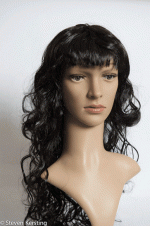
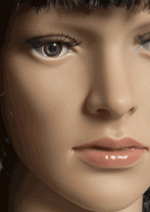
What looks kind of like movement is "shaping." The biggest difference is between too far (4-8ft) and within effective working distance (≤ diagonal). None of the looks are "right" perse, just depends on what you want to achieve.
What looks kind of like movement is "shaping." The biggest difference is between too far (4-8ft) and within effective working distance (≤ diagonal). None of the looks are "right" perse, just depends on what you want to achieve.
Last edited:
OP
Barney
Suspended / Banned
- Messages
- 3,043
- Name
- Wayne
- Edit My Images
- No
Thank you for clarification and for such a fantastic explanation and illustration !Being in a smaller room can mask a lot because it creates bounced fill light if you don't take steps to prevent it. And if there is a lot of fill/ambient, then the primary light source can become less dominant to the point it doesn't much matter. That's how a lot of beginners create soft light; they unknowingly turn the entire room into a light box.
And the finer details of lighting are pretty subtle a lot of times.
Power was adjusted. I probably should have done a better job when I created the lesson these were taken for, but that was years ago.
Garry Edwards
Moderator
- Messages
- 13,475
- Name
- Garry Edwards
- Edit My Images
- No
That's a good, real-world test. It shows misleading results simply because it is real-world. nobody can possibly conduct a test that truly mimics Newton's ISL, simply because those test conditions are entirely theoretical, i.e. point source of light in infinite free space.
In the real world, there's nothing that's actually as small as a point source of energy, and there's no space of truly infinite size, which is also a space with zero light, and a vacuum that cannot contain any polluting materials.
I've gone as close as I can, with my old studio - 4000 sq ft, high ceiling, totally black walls and ceiling, the results are more dramatic than Stevens' but his results give a more truthful rendition.
Very basic tip - understand the principles of the ISL and you'll have 90% of studio lighting nailed!
In the real world, there's nothing that's actually as small as a point source of energy, and there's no space of truly infinite size, which is also a space with zero light, and a vacuum that cannot contain any polluting materials.
I've gone as close as I can, with my old studio - 4000 sq ft, high ceiling, totally black walls and ceiling, the results are more dramatic than Stevens' but his results give a more truthful rendition.
Very basic tip - understand the principles of the ISL and you'll have 90% of studio lighting nailed!
OP
Barney
Suspended / Banned
- Messages
- 3,043
- Name
- Wayne
- Edit My Images
- No
We are so lucky to have experts who can explain complex issues so succinctly, I hope that one day I will be able to do those explanations justice,
Thank you to all contributors, I think I am a step closer to wrapping my head round it all!
Thank you to all contributors, I think I am a step closer to wrapping my head round it all!
OP
Barney
Suspended / Banned
- Messages
- 3,043
- Name
- Wayne
- Edit My Images
- No
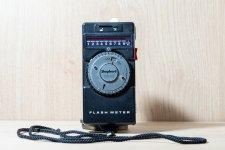
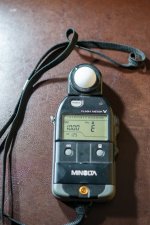
I found this today, an old one but in good condition, I wondered to ask if any good so set up a small table with a small led set up as a hard light,(flash lead it not here yet). I am hoping I will be able to test the flash with it a bit help me learn before a digital test shot.
Tried to set up at angles but difficult to get close, i adjusted angles to feather it a bit though.
I dont know if these flash meters were ever any good or even if the cell will still be usable, but I can have a play.
Tried to set up at angles but difficult to get close, i adjusted angles to feather it a bit though.
I dont know if these flash meters were ever any good or even if the cell will still be usable, but I can have a play.
Garry Edwards
Moderator
- Messages
- 13,475
- Name
- Garry Edwards
- Edit My Images
- No
One of the very cheapest, but the results were perfectly OK. Use it in INCIDENT not reflective mode.
From memory, it's only real fault was that it ate batteries.
From memory, it's only real fault was that it ate batteries.
Garry Edwards
Moderator
- Messages
- 13,475
- Name
- Garry Edwards
- Edit My Images
- No
That's a high-end meter for its time. If it works then it will work in incident mode, and the picture shows it with the standard incident dome in place.
Set the iso, and set the shutter speed to 1/125th or thereabouts, it should then work
Set the iso, and set the shutter speed to 1/125th or thereabouts, it should then work
Garry Edwards
Moderator
- Messages
- 13,475
- Name
- Garry Edwards
- Edit My Images
- No
You're testing it with continuous light?just "E" all the time
Have you set it to measure continuous light?
OP
Barney
Suspended / Banned
- Messages
- 3,043
- Name
- Wayne
- Edit My Images
- No
I have read that manual dozens of times, I have the printed manual and all attachments, the full kit, unless perhaps I am doing something fundamentally wrong?You're testing it with continuous light?
Have you set it to measure continuous light?
I have tried all menu command, auto, ambi, ambi fstop and then all the physical switch adjustments.
Am I missing something for continuous light measurement ? I believe the light meter model was innovative in its day and from reading the booklet it can measure several light and measure ratio's etc.
I am hoping, perhaps unrealistically, that a "flash" will magically bring it to life.
My other Minolta light meter, that I use day to day, just turn it on press the button and you're away.
I dont mind if I use the sheppard though, a cheap working meter beats an expensive inoperative one hands down every time.

Phil V
Suspended / Banned
- Messages
- 26,303
- Name
- Phil
- Edit My Images
- No
When you press the Mode button, right after Ambi fstop is flash (then flash multi)auto, ambi, ambi fstop
It couldn’t be more straightforward
Then you don’t need to connect the flash to the meter to fire the flash, you can hold the meter near the subject and fire the flash with your other hand (camera, trigger, whatever)
Garry Edwards
Moderator
- Messages
- 13,475
- Name
- Garry Edwards
- Edit My Images
- No
I used one of those Minolta 5 meters for years, must still have it somewhere, but can't remember the settings after all these years - but think that @Phil V is right
The meter needs to be told whether you want to measure daylight or another type of continuous light or flash, it's as simple as that.
And the level of light needs to be within the practicable range. If you're trying to take a shot at 1 second, iso 2000 in bright sunlight, then there won't be an aperture small enough and the "reading" will be E. Likewise, 1/1000th second, iso 125, with a low level of light, same result.
I hope this helps, but please don't obsess over the technicalities, the reason that I don't know where my flash meter is that, with digital, I don't need it. The things that really matter are subject, composition, camera position, light placement and, of course, ISL.
- but think that @Phil V is rightThe meter needs to be told whether you want to measure daylight or another type of continuous light or flash, it's as simple as that.
And the level of light needs to be within the practicable range. If you're trying to take a shot at 1 second, iso 2000 in bright sunlight, then there won't be an aperture small enough and the "reading" will be E. Likewise, 1/1000th second, iso 125, with a low level of light, same result.
I hope this helps, but please don't obsess over the technicalities, the reason that I don't know where my flash meter is that, with digital, I don't need it. The things that really matter are subject, composition, camera position, light placement and, of course, ISL.
OP
Barney
Suspended / Banned
- Messages
- 3,043
- Name
- Wayne
- Edit My Images
- No
Thanks, I will try that, did not think of that!When you press the Mode button, right after Ambi fstop is flash (then flash multi)
It couldn’t be more straightforward
Then you don’t need to connect the flash to the meter to fire the flash, you can hold the meter near the subject and fire the flash with your other hand (camera, trigger, whatever)
Phil V
Suspended / Banned
- Messages
- 26,303
- Name
- Phil
- Edit My Images
- No
Does it measure the ambient light OK?tried it, with manual activation of flash, lowest power 100 iso various shutter, still "E"
Think its faulty
Set ambi, a shutter speed and ISO copied from your DSLR that you know will make a reading.
If it works for the ambient, then set the mode to flash, ISO 400, SS of 1/100 flash on MAX power and see what happens.
I don't understand what you mean by 'various shutter' because sync speed or lower are the only the only usable options, and I'd usually set my SS to a little slower* than sync in a studio to account for triggering. ANd I don't know why you would set the lowest power on your flash, when trying to get a measurement, surely you start at MAX?
*If my sync speed is 1/200, I'll shoot at 1/125 in the studio
I could dig my Minolta meter out to help, but currently up to my eyeballs in building work.
Phil V
Suspended / Banned
- Messages
- 26,303
- Name
- Phil
- Edit My Images
- No
Also, my light meter is buried, because I just use a mix of guessing and chimping with digital. \
In fact that'd be my test of the meter.
ISO 400, SS 1/125, f5.6 and light on 1/4 power 3ft from subject
Take a test shot w a digital camera, adjust either aperture or flash power to get a 'correct' exposure. DO NOT CHANGE THE SHUTTER SPEED
then copy the SS and ISO to the light meter, and take a test reading. If it works, it should give the same aperture as you ended up with on your camera.
Simple as that.
In fact that'd be my test of the meter.
ISO 400, SS 1/125, f5.6 and light on 1/4 power 3ft from subject
Take a test shot w a digital camera, adjust either aperture or flash power to get a 'correct' exposure. DO NOT CHANGE THE SHUTTER SPEED
then copy the SS and ISO to the light meter, and take a test reading. If it works, it should give the same aperture as you ended up with on your camera.
Simple as that.
OP
Barney
Suspended / Banned
- Messages
- 3,043
- Name
- Wayne
- Edit My Images
- No
Does it measure the ambient light OK?
Set ambi, a shutter speed and ISO copied from your DSLR that you know will make a reading.
If it works for the ambient, then set the mode to flash, ISO 400, SS of 1/100 flash on MAX power and see what happens.
I don't understand what you mean by 'various shutter' because sync speed or lower are the only the only usable options, and I'd usually set my SS to a little slower* than sync in a studio to account for triggering. ANd I don't know why you would set the lowest power on your flash, when trying to get a measurement, surely you start at MAX?
*If my sync speed is 1/200, I'll shoot at 1/125 in the studio
I could dig my Minolta meter out to help, but currently up to my eyeballs in building work.
Ambient is not working,
Thanks for helping, don't put yourself out because I think it may have a fault.
I know that I can work around not having a light meter with the flash.
I am probably being over optimistic in that I wanted to try and learn flash output for set distances so that I can set up without thinking and knowing it will be somewhere right near.
Just beating myself up with it.
Phil V
Suspended / Banned
- Messages
- 26,303
- Name
- Phil
- Edit My Images
- No
You can learn that, and fairly easily.Ambient is not working,
Thanks for helping, don't put yourself out because I think it may have a fault.
I know that I can work around not having a light meter with the flash.
I am probably being over optimistic in that I wanted to try and learn flash output for set distances so that I can set up without thinking and knowing it will be somewhere right near.
Just beating myself up with it.
As per my post and Garry’s.
And you learn it by measuring first.
Once you do my suggestion and measure exposure with your camera, you’ll know exactly what ISO power setting and aperture match your flash distance.
So next time you shoot, use those settings and they work.
If you move your flash further away, increase the flash power. And it works from 3ft to 4.5 ft an extra stop, and if you go to 6ft that’s 2 stops more than 3ft. (Inverse square law).
But always I’d still do a test exposure. It’s free, takes a second so why wouldn’t I?
OP
Barney
Suspended / Banned
- Messages
- 3,043
- Name
- Wayne
- Edit My Images
- No
Thanks Phil,You can learn that, and fairly easily.
As per my post and Garry’s.
And you learn it by measuring first.
Once you do my suggestion and measure exposure with your camera, you’ll know exactly what ISO power setting and aperture match your flash distance.
So next time you shoot, use those settings and they work.
If you move your flash further away, increase the flash power. And it works from 3ft to 4.5 ft an extra stop, and if you go to 6ft that’s 2 stops more than 3ft. (Inverse square law).
But always I’d still do a test exposure. It’s free, takes a second so why wouldn’t I?
I hope that flipping lead comes tomorrow.