Diesel/Petrol max time in fuel tank

wyx087

Suspended / Banned
Messages
3,209
Edit My Images
Yes
Question for car experts of this forum.

How long is it acceptable to keep diesel in regular car fuel tanks?
Same question for Petrol for other people's benefit. With the lockdown, this might be a consideration for some.

My last fuel up was early October, coming up to 6 months now. Still have around 3/4 left in the tank. I'm wondering whether I need to use up the diesel in the car to prevent problems further down the line. Or it can last for up to a year then it can stay in the car until I actually need it in summer, when we can actually go places.


I try to drive it for at least 20 miles once every month to keep the components working. I also stick it on battery charger in between to ensure the starter battery doesn't excessively drain. Forgot to drive it in Feb, I was surprised to see over still 3/4 full last Sunday.

I've read i3 REx have special fuel tank to allow the fuel last longer due to people may not use ICE for months. So does this mean fuel in regular cars are not designed to be sat unused for months on end? hence this question thread.
 
I'd go a bit further than 20 miles to get everything properly warmed up TBH. You can get Diesel stabiliser fluid.

Petrol is a bit different. Nice, clean, modern Eco fuel is hygroscopic - it absorbs water... Keeping the tank brimmed full helps reduce the surface area for water absorption to happen over but in practice, that often means topping up from a can at home. Higher octane petrol is less of a problem - luckily, I run all our petrol vehicles on super-unleaded rather than "2 star".
 
I'm only seeing gasoline (petrol) stabliser on Amazon. For diesel it's all injector cleaner or other cleaner addictive.

Is Redex Diesel Treatment equivalent? That's the only thing that hasn't got clean in its title for diesel fuel.
 
Question for car experts of this forum.

How long is it acceptable to keep diesel in regular car fuel tanks?
Same question for Petrol for other people's benefit. With the lockdown, this might be a consideration for some.

My last fuel up was early October, coming up to 6 months now. Still have around 3/4 left in the tank. I'm wondering whether I need to use up the diesel in the car to prevent problems further down the line. Or it can last for up to a year then it can stay in the car until I actually need it in summer, when we can actually go places.


I try to drive it for at least 20 miles once every month to keep the components working. I also stick it on battery charger in between to ensure the starter battery doesn't excessively drain. Forgot to drive it in Feb, I was surprised to see over still 3/4 full last Sunday.

I've read i3 REx have special fuel tank to allow the fuel last longer due to people may not use ICE for months. So does this mean fuel in regular cars are not designed to be sat unused for months on end? hence this question thread.
RAC says 6 to 12 months for diesel, after that it starts going "gummy" clogging up fuel pipes and filters. The 6 months would be if the fuel has been subjected to heat at around 30°C.
A diesel additive such as this
https://www.bgprod.com/catalog/diesel-fuel-system/bg-245-diesel-premium-fuel-system-cleaner/
Should prevent it going off further until it is all used up. The usual practice is to add half a can to a near empty tank, then add the rest of the can the next time you fill up, but you may as well use the whole can in this instance.

As far as petrol cars are concerned. 95RON generally lasts around 6 months before it goes off, it won't gum up the fuel system but combustion will deteriorate. Higher octane petrol such as BP Ultimate 97 RON or Shell V-Power 99 RON, should take longer to go off, basically it will start deteriorating towards the calorific value of 95 RON.

Just a reminder incase anyone has not seen the news. 95RON which is 5% ethanol, becomes 10% ethanol from September, some cars, even post 2000 may encounter difficulties on the new fuel as it will rot certain components, especially any rubber fuel lines or brass fittings on older cars. The 97-99RON fuels will remain at 5%.
 
I have this issue ever year as I have 10 full size motorcycles - technically 11 but that's a relatives - lol & 4 x mini bikes....

Petrol storage - if its over 3 months & I'm not going to use it for another few months then I add Stabil.
For normal winter storage, just before storing I fill with Super Unleaded (on the bikes I'm going to use).

I think Diesel will be ok as it uses the compression to start not ignition.
 
Just a reminder incase anyone has not seen the news. 95RON which is 5% ethanol, becomes 10% ethanol from September, some cars, even post 2000 may encounter difficulties on the new fuel as it will rot certain components, especially any rubber fuel lines or brass fittings on older cars. The 97-99RON fuels will remain at 5%.

This part is interesting.....

I can only surmise that my 69 plate Kuga will be fine but SWMBO still has her 54 plate Corolla and wonder how that might cope or for those with even older cars will see them have uneconomic to repair failures due the switch to 10% ethanol fuel???
 
This part is interesting.....

I can only surmise that my 69 plate Kuga will be fine but SWMBO still has her 54 plate Corolla and wonder how that might cope or for those with even older cars will see them have uneconomic to repair failures due the switch to 10% ethanol fuel???
The 69 plate will be just fine. I doubt the Corolla will have any rubber fuel pipes, but I don't know if it may have any brass fittings anywhere in the fuel system. The brass will contaminate the fuel, fittings need to be stainless steel.
Tesco 99 RON is generally as cheap as if not cheaper than some petrol stations 95 RON, if you are unsure of the Corolla, I would suggest using the 99 RON, or at least a mix of the two with the higher proportion being the 99 RON.
 
RAC says 6 to 12 months for diesel, after that it starts going "gummy" clogging up fuel pipes and filters. The 6 months would be if the fuel has been subjected to heat at around 30°C.
A diesel additive such as this
https://www.bgprod.com/catalog/diesel-fuel-system/bg-245-diesel-premium-fuel-system-cleaner/
Should prevent it going off further until it is all used up. The usual practice is to add half a can to a near empty tank, then add the rest of the can the next time you fill up, but you may as well use the whole can in this instance.
Thanks. Yes, I searched and most places said 6-12 months, but many are not talking about car fuel tank so I wondered if cars can last a bit closer to the higher end. I suppose due to cold weather over winter, it should be fine for 8-10 months untreated.

This addictive okay?
 
Thanks. Yes, I searched and most places said 6-12 months, but many are not talking about car fuel tank so I wondered if cars can last a bit closer to the higher end. I suppose due to cold weather over winter, it should be fine for 8-10 months untreated.

This addictive okay?
I've not used that treatment, I have only used the BG product that I suggested earlier when I had a diesel and found it quite effective on cleaning the fuel system and keeping it clean.
 
The 69 plate will be just fine. I doubt the Corolla will have any rubber fuel pipes, but I don't know if it may have any brass fittings anywhere in the fuel system. The brass will contaminate the fuel, fittings need to be stainless steel.
Tesco 99 RON is generally as cheap as if not cheaper than some petrol stations 95 RON, if you are unsure of the Corolla, I would suggest using the 99 RON, or at least a mix of the two with the higher proportion being the 99 RON.

Thanks for the insight. There is one Tesco with a fuel station (nearby'ish) but we rarely go to that location so will have to bear the 99RON 'question' in mind, though I have in recent years avoided supermarket fuels.

In regard to the Corolla I will try and find out if Toyota have any support to offer by way a definitive answer???

Edit:- a pdf on this site was useful

Saying this for Toyota....
Toyota Motors Group
Toyota:
E10 petrol is cleared for use in all Toyota European petrol models made from January 1998,
excluding:
• Avensis 2.0 litre with engine 1AZ-FSE made between July 2000 and October 2008.
• Avensis 2.4 litre with engine 2AZ-FSE made between June 2003 and October 2008.

PS all this talk of diesel reminds me of 'back in the day' my dad telling me that there was Summer & Winter diesel and that the Winter one was special to avoid low temperature waxing that the heater plugs could not cope with (in his Black Cab).
 
Last edited:
That's a good point. I see winter diesel comes in November. So keeping summer diesel in the car at around freezing temperature over winter, below its cloud point temperature. Does it mean it may last longer?

Considering temperature plays a role and quoted 6 months is at 30c. Last few months rarely seen temperature above 10c. I guestimate keeping the fuel under 10 months old should be okay. So I've got 3-4 months to use up the fuel without addictive.


What about adding fresh fuel?
If the tank was half full with old, slightly contaminated fuel, Would refueling to top dilute it enough to last another 4-6 months?
 
That's a good point. I see winter diesel comes in November. So keeping summer diesel in the car at around freezing temperature over winter, below its cloud point temperature. Does it mean it may last longer?

Considering temperature plays a role and quoted 6 months is at 30c. Last few months rarely seen temperature above 10c. I guestimate keeping the fuel under 10 months old should be okay. So I've got 3-4 months to use up the fuel without addictive.


What about adding fresh fuel?
If the tank was half full with old, slightly contaminated fuel, Would refueling to top dilute it enough to last another 4-6 months?
Topping the tank up should help, as you say it will start diluting the older diesel and the additives in the fresh diesel should help break up anything that starts solidifying in the fuel system.
My Mondeo had a large fuel filter in the engine bay, it might be worth changing that, just incase it is starting to clog up. You normally have to fill them with diesel before fitting and they usually have a drainage tap underneath, I would just let the fuel drain from the old filter, through some filter paper into a clean jug. and use that fuel to poor into the new filter.
 
What there is still specific Winter Diesel......I thought over the past 50+ years that they would have formulated a more forgiving fuel ~ I am pleased I gave up diesel as it is a nasty one and did not think the 'drive' to diesel when the UK did was as good an idea as was claimed!
 
What there is still specific Winter Diesel......I thought over the past 50+ years that they would have formulated a more forgiving fuel ~ I am pleased I gave up diesel as it is a nasty one and did not think the 'drive' to diesel when the UK did was as good an idea as was claimed!
Diesel is just oil that is alot less refined than petrol. Winter diesel is pretty much a small amount of petrol added to prevent it waxing (solidifying) in cold temperatures.
The only thing that has really changed with diesel is its bio content made from rapeseed etc, which if anything makes it worse for solidifying or leaving unwanted deposits in the fuel system.
 
I wonder if the Adblue additive would have any effect on the stability of Diesel? Not added any to our car yet.
 
I wonder if the Adblue additive would have any effect on the stability of Diesel? Not added any to our car yet.
Adblue isn't a fuel additive, it's for the catalyst/dpf system and is added to a seperate reservoir, it should never be added to the fuel tank.
 
RAC says 6 to 12 months for diesel, after that it starts going "gummy" clogging up fuel pipes and filters. The 6 months would be if the fuel has been subjected to heat at around 30°C.
A diesel additive such as this
https://www.bgprod.com/catalog/diesel-fuel-system/bg-245-diesel-premium-fuel-system-cleaner/
Should prevent it going off further until it is all used up. The usual practice is to add half a can to a near empty tank, then add the rest of the can the next time you fill up, but you may as well use the whole can in this instance.

As far as petrol cars are concerned. 95RON generally lasts around 6 months before it goes off, it won't gum up the fuel system but combustion will deteriorate. Higher octane petrol such as BP Ultimate 97 RON or Shell V-Power 99 RON, should take longer to go off, basically it will start deteriorating towards the calorific value of 95 RON.

Just a reminder incase anyone has not seen the news. 95RON which is 5% ethanol, becomes 10% ethanol from September, some cars, even post 2000 may encounter difficulties on the new fuel as it will rot certain components, especially any rubber fuel lines or brass fittings on older cars. The 97-99RON fuels will remain at 5%.

Phew. I run the Escort on 99. Well, when it actually gets used!
 
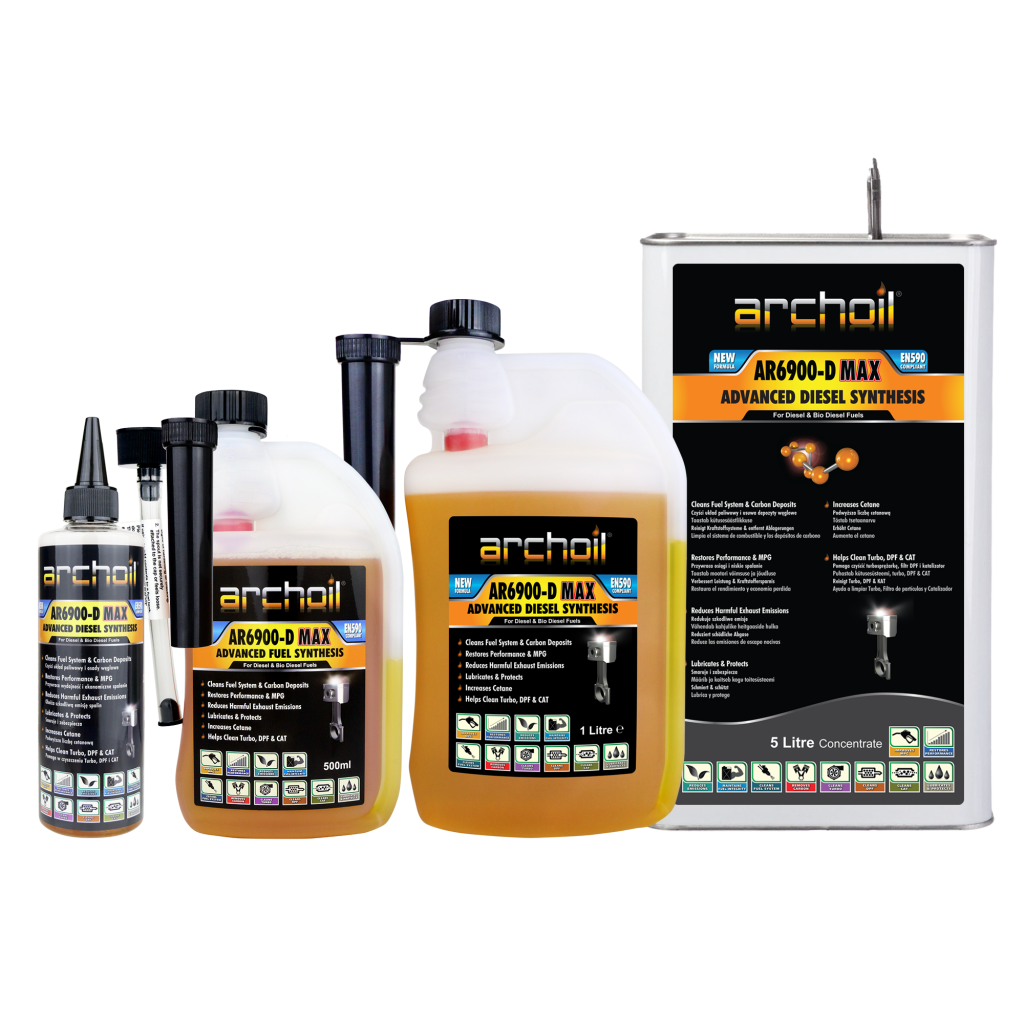
There is this.


I use it from time to time.

I use both Archoil AR6400-D Max and sometimes the 6900 in between 6400 applications. It's excellent stuff, quietened my engine and it also keeps the soot levels in my DPF low despite doing a lot of very local driving. Without it my soot levels start to climb by over 3 times the amount.

A mate has started AR6400-D Max in his older Scania big rig, although it's 5 litres which goes in each time so a little pricey. But after only two applications of 5 litres he has already noticed less smoke from the exhausts.

In my eyes it's a long term ongoing maintenance item rather than a quick fix, the latter of which I think people expect and are then disappointed.
 
Esso supreme petrol is ethanol free in many, but not all areas, see
https://www.esso.co.uk/en-gb/fuels-faqs

Yep that’s what I’ve started using in my motorbikes
I had serious rust problems inside the petrol tank with one of my bikes which I believe was caused by me leaving petrol in the tank over the winter and the ethanol in the petrol absorbing water
I now use the ethanol free petrol at least for the motorcycles
 
Diesel is just oil that is alot less refined than petrol. Winter diesel is pretty much a small amount of petrol added to prevent it waxing (solidifying) in cold temperatures.
The only thing that has really changed with diesel is its bio content made from rapeseed etc, which if anything makes it worse for solidifying or leaving unwanted deposits in the fuel system.
They also added (in the early 80s?) a perfume additive, which makes road vehicle (white) diesel smell a bit like roses. Presumably this was to make diesel more palatable to the noses of the general public, and to stop them thinking that they'd got a dead rat in their fuel tank!
 
They also added (in the early 80s?) a perfume additive, which makes road vehicle (white) diesel smell a bit like roses. Presumably this was to make diesel more palatable to the noses of the general public, and to stop them thinking that they'd got a dead rat in their fuel tank!
It probably makes it easier to check for red diesel too.
 
Well, in addition to the red colour and the chemical tag. :LOL:
With vehicles now having the anti misfùeling flaps and anti siphoning it makes it harder to dip the tank. Much easier to just smell it first, then check further if they need to.
 
When I was in the motor sales trade I picked up a car that had stood for 2 years ish, car did start and run, but very poorly, much better when I got fresh fuel in the tank.
 
How long ago was that?

Apparently, modern fuel injection systems cope much better with bad fuel than older fuel injection systems or carburettors.
 
How long ago was that?

Apparently, modern fuel injection systems cope much better with bad fuel than older fuel injection systems or carburettors.
I wouldn't have thought the fuel injection system would make much difference other than it's start of injection timing might alter. The main problem is going to be the ignition of the fuel. As the fuel gets older it will lose its RON rating this will mean the engine will knock and the ecu will be continuously having to retard the spark. The knock can also damage the piston. Even if it doesn't blow a hole in a piston crown or cause part of the piston skirt to fall off, it can leave tiny craters in the piston crown surface where carbon and fuel get trapped leading to more knock or pre ignition when running on fresh fuel again.
 
I don't know how I'll go on with the new petrol with this engine, brass and copper fuel lines, brass carb fittings and a brass fuel pump!

51052036047_dec8ec2d53.jpg


Oh, wait a minute, it was made in England in 1940, so it'll probably be fine... after all, it did survive once looking like this. :)

51051950911_ff190a36ac.jpg
 
Last edited:
Joking aside, you'll probably want to find some non "E" petrol - for the cost involved in a few weekends per year, it would probably be cheaper than Ethanol proofing the Lister! (I had a Fowler 1 1/2 H.P. many years ago - never showed it but built it up from worse than your starting point. Mechanically, so simple but parts availability was zero - everything that needed replacing had to be fabricated from scratch, although I did manage to scrounge a mag. from my Grandfather. Not the "correct" one but it fitted and made the right bangs at the right time!)
 
Joking aside, you'll probably want to find some non "E" petrol - for the cost involved in a few weekends per year, it would probably be cheaper than Ethanol proofing the Lister! (I had a Fowler 1 1/2 H.P. many years ago - never showed it but built it up from worse than your starting point. Mechanically, so simple but parts availability was zero - everything that needed replacing had to be fabricated from scratch, although I did manage to scrounge a mag. from my Grandfather. Not the "correct" one but it fitted and made the right bangs at the right time!)

I'll probably run in on 99 RON and see how it goes, it's not like it gets used every day and I drain the fuel off if it's going to be standing idle for more than a couple of weeks anyway. As for restoration, this needed new valve springs, valves regrinding, new piston rings and light honing of the cylinder bore to remove the glaze and let the rings bed in, a new fuel tank, new big end bearings (carefully scraped in to fit, using engineer's blue), a magneto coil re-wind, and a complete dismantle and a really good clean inside and out. There was about an inch of oil sludge in the sump that had the consistency of chocolate mousse and I found a 2 inch nail lurking at the bottom of it! I then gave it a traditional repaint (all coats carefully applied using a brush, not sprayed).

It's amazing how these engines would still go on running when so poorly maintained during life on a farm! This one has quite an interesting history too; it was supplied to the Air Ministry just in time for the Battle of Britain and was used to power a Zwicky aircraft fuel bowser to refuel fighter planes on wartime airfields: ROYAL AIR FORCE FIGHTER COMMAND, 1939-1945. | Imperial War Museums (iwm.org.uk) When the war ended it was sent back to Lister's factory for reconditioning and resale, then spent its time on a farm driving a saw bench to cut logs up. So, one way or another, it helped keep the home fires burning all its working life. :)
 
Last edited:
Back
Top