Developed film left in water overnight?

Cluster

Suspended / Banned
Messages
770
Name
Dave
Edit My Images
Yes
Hi, I suffer from dust/fibres on my negatives. I mentioned in another post that I might try leaving my film in the developing tank overnight so that I can hang them in the shower in the morning.
As our use of the shower is usually in the morning, I hope that I can leave the film hanging in the (dust-free?) bathroom for a couple of hours without disturbing them.

Would there be a problem in leaving the developed and washed film in water overnight?
 
Not a good idea... The emulsion will soften and probably peel or frill. Any loose bits will permanently adhere to other parts. At worst,and I have seen it, the entire emulsion comes off. The same can be true of prints left too long in the wash.
I have don that more than once when I missed a print in the Syphon washer.
 
Not a good idea... The emulsion will soften and probably peel or frill. Any loose bits will permanently adhere to other parts. At worst,and I have seen it, the entire emulsion comes off. The same can be true of prints left too long in the wash.
I have don that more than once when I missed a print in the Syphon washer.
:agree:
 
Thanks for the info guys....... now to look for a different way to lessen the accumulation of dust.
 
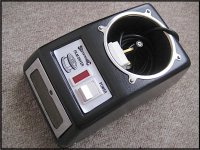
What will reduce, if not solve, your dust problems is an on-reel dryer, like this Silvertronic...

Silvertronic film dryer Ixus 70 IMG_4342.JPG

The film, on its reel, drops over the spindle and air is sucked in via dust filters and forced out past the film, drying it. Because the air is under pressure, the film will dry in ten to fifteen minutes, depending on the ambient humidity and temperature.

By the way, a secondhand film dryer may not have been stored properly and have collected dust in the film chamber. Before using it with a film, run it two or thee times for twenty minutes each, with an empty reel. That should be enough to expel any dust build up in storage. Mine is kept, alongside the rest of my developing kit in a dust sealed equipment case.

They're a bit rare these days but I found this one for around £30 a few years ago and it does what it claims to.
 
Last edited:
That's interesting. I'd be concerned that the film would come out glued to the reel. (Does it finish without damage? ..particularly where the film edge is in contact with the reel)
 
That's interesting. I'd be concerned that the film would come out glued to the reel.
I can't speak for metal reels but when on Patterson reels the film never sticks, in my experience.
 
Thanks for the info, my 3D printer may have a few big prints to make...
 
A quick search on t'internet showed a homemade drier made from a 4 inch waste pipe. Reportedly works well.
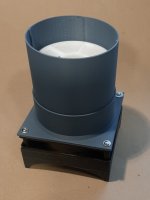
I applied my 3d printer to an own design that has a filter/base, a 120mm 12v fan, a mount and a reel holder (this one holds 2x35mm or 1x120 reels).

The airflow is pretty good for a simple filter. If the "J-cloth" filter stops the small stuff, it should work!
Looking forward to trying it on a test film (looking at the forecast, that might take a while to expose).

Drier.jpg
 
Last edited:
Brilliant gadget!
Would muslin cloth, doubled perhaps, make a good filter?
The J-cloth is pretty fine and lets air pass fairly easily. If the airflow is too low, I had planned to make a holder in which the cloth is in concertina format.
Each stage takes around 2-3 hrs to print in draft mode (just a little poorer finish), so I'll try this as it is.
Plenty of 9-12v power adapters lying about the house.
My concern was that the drying emulsion would glue the film to the reel, but apparently, that doesn't happen.
 
You could always attach a 4inch plumbing pipe and hang the unwound film vertically like in a drying cabinet.

You could probably cut car vent interior filter material to fit.
You could also use a low watt bulb as a heater element.
You need very low airflow and heat. Or you can get drips and drying marks...


My last drying cabinet would dry 12 or more films in around 1/2 an hour but usually left them for an hour. To make sure there was no drips caught in the clips.
 
Last edited:
You could always attach a 4inch plumbing pipe and hang the unwound film vertically like in a drying cabinet.

You could probably cut car vent interior filter material to fit.
You could also use a low watt bulb as a heater element.
You need very low airflow and heat. Or you can get drips and drying marks...


My last drying cabinet would dry 12 or more films in around 1/2 an hour but usually left them for an hour. To make sure there was no drips caught in the clips.
I have a vague idea that John @thedarkshed had one like that. My feeling is, it'd be quite hard to get a 135 film into the pipe without it touching (and subsequently perhaps sticking to) the sides. Might work if the pipe was on the stairs and the film was lowered in over the bannister, I suppose? I spent a while trying to work out how one could make a door in the side of the pipe, but it was all way too much for my limited (non-existent?) DIY skills!

The reel approach seems a bit more practical. I remember the idea was that the fan could come from an old PC, and that old vacuum cleaner filters were abiut the right size for the pipe...
 
I developed an old 120 film that I found in my wardrobe. This was a good candidate for my test, as it didn't matter how the images came out, provided it had light enough areas to show up the dust and fibres that I usually suffer from.
I popped it in the drier and ran it for 20mins then inverted the reel and ran for another 20mins. After this it looked quite dry so split the reel, but found that the film edges, where they were in contact with the reel guides, were still wet. As they were wet and sticky, I couldn't reload the film onto the spool, so had to dry it by hanging in the shower.

So... having scanned a few frames, I can see that the images seem to be totally dust/crud free. Looks to be very promising. I just have to work on how long to leave film in the drier to ensure the film edges get dry.
 
One thought about wet edges occurs to me with regard to dust etc - dust tends to only stick to the wet/damp areas so not the (dry) image area. Possibly not ideal but once the main part of the film is as dry as the drier can get it, it could be hung up in the area of your choice for the edges to dry with a much reduced risk of the pictures getting dusty (and, if they do, a puff of air should get rid of it.)
 
One thought about wet edges occurs to me with regard to dust etc - dust tends to only stick to the wet/damp areas so not the (dry) image area. Possibly not ideal but once the main part of the film is as dry as the drier can get it, it could be hung up in the area of your choice for the edges to dry with a much reduced risk of the pictures getting dusty (and, if they do, a puff of air should get rid of it.)
That's a good point. That could be a workable solution if the film margins can't be dried in the drier easily.
 
I have a vague idea that John @thedarkshed had one like that. My feeling is, it'd be quite hard to get a 135 film into the pipe without it touching (and subsequently perhaps sticking to) the sides. Might work if the pipe was on the stairs and the film was lowered in over the bannister, I suppose? I spent a while trying to work out how one could make a door in the side of the pipe, but it was all way too much for my limited (non-existent?) DIY skills!

The reel approach seems a bit more practical. I remember the idea was that the fan could come from an old PC, and that old vacuum cleaner filters were abiut the right size for the pipe...

Fit a triangle of wire to the bottom clip. This will keep the film from the sides of the pipe as you lower it. But making up a narrow box shape with a hinged side out of MDF or the like would be easy.
 
Last edited:
Fit a triangle of wire to the bottom clip. This will keep the film from the sides of the pipe as you lower it.
The device I have cobbled together dries (apparently only partly) the film on the Paterson reel, so that the film margins are within the guides of the spiral.
 
The device I have cobbled together dries (apparently only partly) the film on the Paterson reel, so that the film margins are within the guides of the spiral.
when you think how difficult it is to dry an empty plastic spiral of all the trapped water in the grooves, how more difficult would it be when you add the capillary attraction between the film and the sides of the grooves. Eventually it will dry but there will be minimal airflow around the contact areas.
Stainless steel centre loading spirals might be better as they have far less contact area and no flat spots. It is Far better to have the film dry hanging straight as it will also dry with less curl.

There are vanishing small amounts of dust in the air of a still room. just hang your film in a room that you are not going to use, for a couple of hours. but do so well away from radiators as they tend to circulate air and dust. It is better to turn them off, and shut the door. do not keep going in to check. this will stir up dust to stick on semi dry film emulsion..
 
Tried another 120 roll today. Left it for 80 mins in the drier. It came out perfectly dry and (as far as i can see) free of dust and my usual tiny fibres.
The film that I developed was a test film from my new-to-me folder. The film is Fomapan 200 which is of a batch that is noted for poor quality and shows marks that show on the scans as dark spots and short lines. I can be confident that it is not dust from my drier.
 
  • Like
Reactions: Nod
Back
Top