Hi Mike,
I've got all of those :-/
The light blaster, despite it's seemingly basic form, is the best performing - when used with a speedlight, zoomed right in. Here's some tests a did a few years back:-
https://owenlloydphotography.com/lightblaster-tests/
I also have one of these:-
The PixaPro EF-Mount Optical Snoot Spot Projector II enable you to use Canon EF or EF-S lenses, to project patterns to add cinematic effects.

www.essentialphoto.co.uk
..and one of these:-
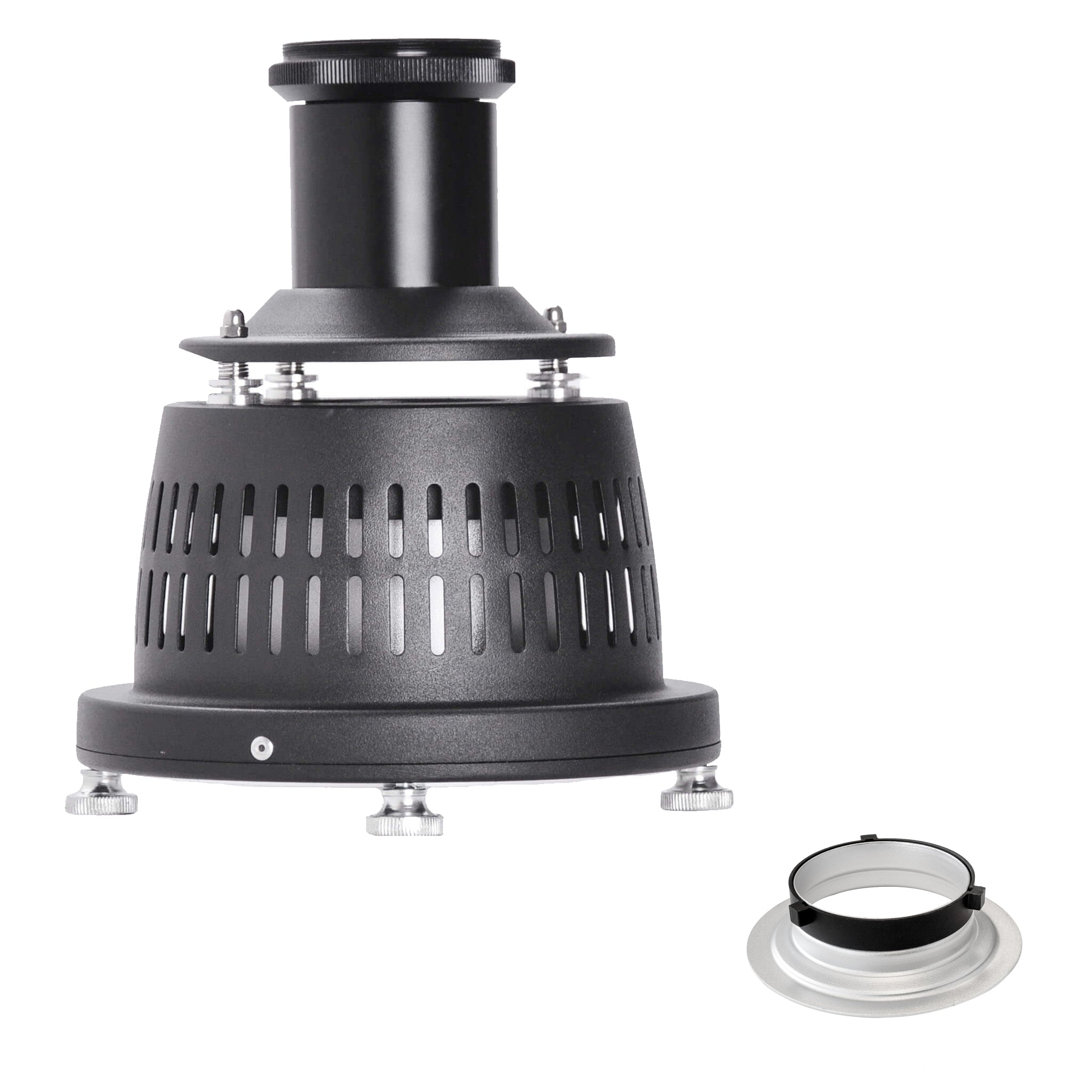
The PixaPro Optical Snoot Spot Projector with 85mm Focusable Lens enables you to project patterns onto your subject or background.
www.essentialphoto.co.uk
They both suffer the same problem as the Lightblaster does when used on a full size studio head - almost none of the light enters the tiny aperture at the back of the lens directly - as that aperture is in the centre of the circular tube. I bought the second one with it's own fixed lens , as I thought it may perform better with optics designed for the job rather than a tiny 50mm camera lens with a tiny rear element to gather the light. It's not really any better though, but a bit more convenient as it requires no assembly to use. The Lightblaster + AD200 produces about 1.5 stops more light than either of the others on 600J flash head.
To get a projection attachment to work efficiently on a studio head, it must be scaled up to suit the bigger lights. Neither of the two projectors sourced from Pixapro (they are available with other names on the side) are remotely the right scale to work well with a full size flash tube. They also have their reflectors mounted the wrong way round - more like a silver coated snoot cone..
I do have one that works:-
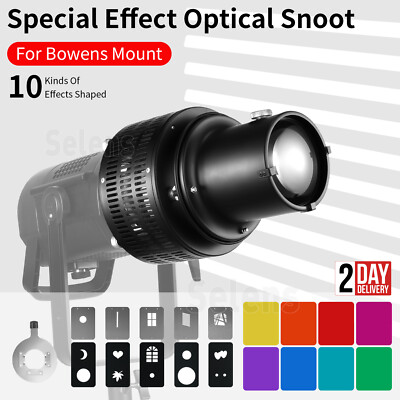
1x Zooming Snoot. To adjust the focusing length with one knob. Great to create the dramatic effect. 10x Hollowed Effect Card. 8x Gel Filter. Easy to set up and use just in a few seconds.
www.ebay.co.uk
I think these are the ones you've seen before. It is pretty heavy - mainly due to having a large lump of hemispherical glass on the front. These "optics" are crude, and whilst you can get the centre of the gobo in focus, the edges tend to smear out. It is 2 stops brighter then either of the smaller projectors though, as the lens, gobos and apertures are all much bigger. It also has its reflector bowl the right way round. It can be a hard to focus due to the locking bolt moving the lens slightly when you tighten it, and the weight of the lens. It's not a big deal though tbh and I often want the pattern slightly soft anyway. If I need more light, (or need to spread the light over a wider area) I'll use this.
Both the Lightblaster and the EF mount Pixapro offering, have the advantage of easily swapping focal lengths to make the projected pattern bigger or smaller from a fixed distance. I often use a Nikon 18-35mm zoom on mine with an adapter which means I can fine-tune the pattern.
The Lightblaster is also able to take 35mm slides, out of the box. You could tape them to the gobo holder in the other projectors of course. There are services that will write a digital image (up to 4k) onto a 35mm colour slide so you can create your own patterns and have them projected with flash power, and at higher resolution than most (reasonably priced) digital cinema projectors
Here's another short article I wrote on adapting the vast Rosco gobo library to use with a Lightblaster. I've also successfully used bigger sizes with the other projectors - trimming a bit off the sides of the thin metal gobos with a large pair of scissors to fit in the gobo holders.
You could make your own however if you are still using a camera lens to focus the light, it will still have the fundamental problem of the small Bowens mount lights above. One possible way of solving this is to use large, flat Fresnel lenses (which you can by from Rymans for about £5 for an A4 sized one), to focus the image of the gobo. I've had a go hand holding the Fresnel and it works in principle, however the resulting contraption would be quite large. Or, maybe just use a Source 4 projection light as used by theatres and movie productions the world over for decades
 https://stagedepot.co.uk/lighting/profiles/tungsten-fixed/etc-source-four-fixed-beam
A 5th option which I've recently started working with is to use a digital projector:-
 View: https://www.instagram.com/p/CGZ7iVPATdi/
Initially, I thought I'd use it as a sort of prototyping projector - and then get the images written to colour transparencies to use in the Lightblaster, but tbh, this Optoma HD400 is pretty bright, and the pixelation is nowhere near as noticeable as I thought it would be, and I've now used it on two shoots with good results. It's a bit cumbersome to mount, hence the light stand with a table on it, a mitre box and some rubber door wedges to adjust the tilt.
In conclusion, I'd get one of the cheap large heavy ones, and a Lightblaster, and then raid the vast library of Rosco Gobos
https://stagedepot.co.uk/lighting/gobos