Confused by Auto-FP and High Speed Flash

TriggerHappy

Suspended / Banned
Messages
4,729
Name
Jamie
Edit My Images
Yes
Let me start by saying that I understand (or at least I think my understanding is right) that the x-sync is the shortest (read fastest shutter speed) possible that exposes the entire sensor to light at any one time. I also know that Auto-FP gets around this by firing pulses of light at a reduced output so that all of the sensor gets exposed to the same light levels despite the fact the the 1st and 2nd curtain conceal part of the sensor at any given time. It stands to reason then that a fast moving object would demonstrate some sort of shift in the image as each of the flash pulses records it in a slightly different position. Now the part that confuses me - on Flickr there are many images where auto-fp has been used at speeds of up to 1/8000th of a second on fast moving subjects such as water splashing (both studio set-ups and natural waterfalls) and demonstrates no such shift but surely this shouldn't be possible. I know somewhere along the lines I've misunderstood something so can someone explain to me where my understanding has gone wrong?
 
Are you talking about subject deformation due to the focal plane shutter?
 
Are you talking about subject deformation due to the focal plane shutter?

Yes. I read this guide (it's quite long) and it used the example of a racing car and how the wheel would appear to lean forward because it would be exposed momentarily later than the lower half.
 
A good explanation here using a very famous shot showing focal plane shutter deformation. CLICKY

Pretty well all modern focal plane shutters now travel vertically, largely because it's a shorter travel across the picture gate, and therefore gives a slighter faster max flash sync speed, but prior to the 70s (ish) they were pretty well all horizontal travel.

Apart from the effect in the thread above, you can get some very curious effects when you photograph an object moving across your FOV and it's speed happens to coincide with that of the moving slit between the shutter curtains. In other words, the subject remains within the slit throughout the exposure, or for a significant part of it. There's a shot of a horse running across a beach at right angles to the camera where the head has become very elongated due to this effect, but I'm damned if I can find it now.

There are actually photographers who set out to deliberately exploit the effect in their images.
 
I've been thinking some more about this and assume it is a phenomenon not limited to situations where a flash is being used. Obviously the 2 curtains have to behave in that way to achieve higher shutter speeds and the presence of a flash is somewhat irrelevant. Am I right?

That's a great explanation you linked to, especially the middle diagram. It was exactly that type of animation I was trying to recreate in my mind to get my head around the concept.
 
It's certainly not limited to flash - the phenomenon has always been there with FP shutters. You've got the hang of it I reckon - modern FP shutters achieve speeds of 1/8000th of a second by the two curtains travelling together with a very narrow slit between them, the overall effect being that the frame recieves an exposure of 1/8000th, but incrementally as that slit moves across the sensor. The overall shutter travel time is much longer.
 
LOL. It's a bit cerebral for this time in the morning. :D
 
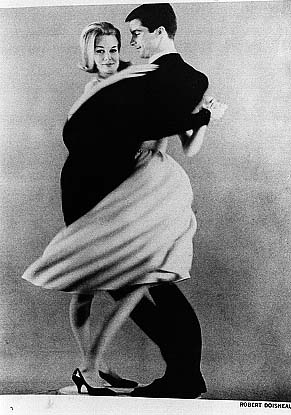
Some more weird FP shutter effects.....

doisneau-1.jpg


Focalplane_shutter_distortions.jpg


helicopter.jpg
 
I think we don't see much of it nowadays as focal plane shutters move vertically and, most of the time, the world travels horizontally. Plus the fact that modern shutters move very fast - much faster than the scanning shutters on mobile phones which do strange things to helipcopters.

The only time I really notice it is with something like a racing car where the spokes of the wheel form differently blurred patterns from top to bottom and side to side.
 
Back
Top