Chemicals use by dates

lindsay

Admin
Messages
8,060
Name
Lindsay
Edit My Images
Yes
I know a lot on here use expired film and perhaps chemicals, so I just wanted to check: having found a box with unopened containers of Ilfosol, Ilfostop and Ilford Rapid Fix, that I appear to have bought in mid 2017 (so 4 years old), does the panel think they will be good to use (they've not been opened, I forgot I had them. They've been in a box in the garage the whole time). I'm assuming so, but not sure if I should increase dev/fix times? It's probably not that sensitive, I'm surmising...
 
As you've probably found on searches, Ilfosol has a relatively short shelf life of 18 months so is probably dead (or at least not very well!) by now. The stop and fixer are probably OK but I would test the fixer on a bit of leader just to be sure.
 
You can test the fixer with a piece of undeveloped film, such as the leader off a 35mm roll, just make up some fixer, put a piece of film in a small amount of fixer and time how long it takes for the film to become clear, fixing time is then twice the clearing time (IIRC). The stop is usually just an acid so a bit of litmus paper, etc. will tell you if that is OK and I would try the dev on a film that is not too important to you, or a great chance to test develop a frame from your new Snapshot ;)

>Cross posted with Nod<
 
Just to add that we never bothered with stop when I did most of my B&W D&P at school. Water was unlimited so we just ran it through the tanks or trays for a few minutes before fixing.
 
IIRC stop is just a dilute acetic acid solution, so should last a long time.
 
Thanks guys and @StephenM for the responses. I was pretty sure the Ilfosol was going to be dead, I'll try that trick with the fixer thanks - and good point Sirch. I agree I never used stop bath back in my past home darkroom days, but as I have it will probably use it (plus a good wash in water). I'll pop over to Skears in Northampton to pick up some fresh chemicals sometime this week.
 
Ilfostop has a built in indicator. When diluted is light yellow you can re-use until it starts changing to purple.
 
As I'm playing catch up, and report the main contents of my PM to Lindsay here:

Fixer - test as stated.

Developer - IFF you can find the Watkins factor for the developer anywhere, you can test it on a piece of film in a saucer. The Watkins factor is the amount that you have to multiply the time it takes to first see evidence of development (i.e. something starts to darken) to reach complete development. e.g. First darkens after 30 sec, Watkins factor 6, development complete in three minutes. You could always ascertain the Watkins factor when you have a fresh bottle of developer.

Stop bath. Odourless is citric acid, otherwise acetic. You can also in a pinch use white vinegar.

There are a few posts (I think in the LF zero to hero" thread) where Woodsy was wondering about stains. I posted some info on washing and fixing. You might want to find and review - from memory it gives the reason why a stop bath might be a good thing not only to halt development, but also improve the fixing process.

Grant Haist was a (the?) top chemist at Kodak. He died a few years ago. His magnum opus (O.K. apart from "Monobath Manual") was a two volume set on photographic processing and chemistry. I know of nothing so up to date, thorough and comprehensive. It was published 50 years ago, and as far as I know never reprinted, except for "print on demand" orders submitted to the author. Obviously, that's not a route you can now use.

They come up for sale second hand from time to time - I think at around £90 per volume when I got mine, but the price could be higher now. As the government says, prices can go up as well as increase.

On the other hand...

 
Last edited:
The two volumes came with me to Onich and were on the shelf there. I still wonder if anyone looked...
 
The two volumes came with me to Onich and were on the shelf there. I still wonder if anyone looked...
Not me, I'm afraid. The weather here this weekend is worse than Onich, so I've downloaded a couple of the linked books to keep me occupied indoors. (y)
 
I'll search out a few more links in case the Onich effect continues. Given that modern books more or less bypass film, and older (out of copyright, out of print) books are still fantastically useful, I'll attempt to dig out links from the Internet Archive. If it proves too difficult, I'll just stick them on my OneDrive and give a link to that. I particularly like the Gevaert Manual (which I have two editions of in print form).

This will be in a new thread, coming to a forum near you soon :D

HM. Just had the computer count up the size - the "Technical" section of my downloads is just under 8GB, and the total 153gb. More than I can simply upload as the software doesn't seem to allow hierarchies to be sent in one go. I'll have to be very selective, and put up a list of links.

And another edit. I forgot my backup software can handle hierarchies and upload to OneDrive.
 
Last edited:
Having looked down the link I posted here, I think that gives a good starting place. There are some more books that are well worth looking at, and as the problem with the Internet Archive can be that multiple difference scans of the same book are available. I've tried to sort through and pick the most readable, so possibly loading up and providing a link to my preferred books and variants is still worthwhile.
 
Guaranteed to err on the side of caution, this is one of the FAQs from the Ilford website.

What recommendations can you give for Paper/Film /Chemistry Storage - including freezing & defrosting?


Avoid keeping our products stored in warm, humid conditions. We expect paper to last for up to three years after purchasing depending on storage conditions and liquid chemistry for around two years.

It is possible to extend product life by keeping them cool and dry. Never freeze liquid chemicals, there are ingredients that will come out of solution and some may never re-dissolve.

Paper and film may either be refrigerated or frozen but should first be sealed in plastic bags for protection. Products should be allowed to return to room temperature before opening otherwise condensation will cause damage. Avoid repeated thawing and freezing of films.
 
Ilfostop has a built in indicator. When diluted is light yellow you can re-use until it starts changing to purple.
Capture.JPG

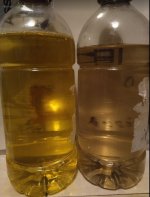
Example of how the indicator changes, not bad for 6 months use. The Mrs will now ask why I've got fresh bottle of p*** in the bathroom.
 
And the answer is:

 
Depends on the "pouring" distance and the care taken with the transfer from vessaile (?sp?) to tank/tray!
 
37c but allow for a temperature drop with mixing and the tank temperature. I assume...:D
 
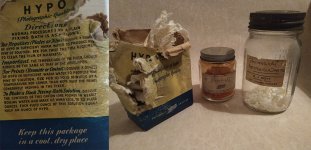
Just rootling through an old box of photographic bits looking for a film loader and found these old bits. Oh for those days of my youth when I could nip to the nearest chemist and buy photochemicals with no questions asked. I think these would still be OK but the metabisulphite might need testing.


old_days.jpg
 
I don't have a photo, but I did make a find.

We had the plumbers in yesterday to replace 6 taps and some lead pipe; two of the taps replaced were in the kitchen, and this required clearing the cupboard under the sink to give them access. Tucked away was a small box containing a bottle of M & B photographic dish stain remover that I'd forgotten I had.
 
Back
Top